In November 2025, Airbus grounded approximately 6,000 of its A320 family of aircraft after an international flight suddenly lost altitude, leading to an emergency landing and the hospitalization of 15 passengers.
In 2003, during a local Belgian election, a candidate received over 4,000 extra votes on a computerized voting machine — more than was physically possible, triggering an investigation.
And in a now-famous 2013 incident, two players were speedrunning “Tick Tock Clock,” a difficult level on the Nintendo 64 game Super Mario 64, when one player’s character shot through the air, skipping a large section of the level and gaining a mysterious advantage over their opponent.
What do these strange, seemingly random events have in common? A bit. Specifically, a computer bit.
The leading explanation for each of these events is what’s known as a bit flip: an electronic glitch caused by radiation from space. Although uncommon, they can have significant consequences. And as our reliance on electronics continues to increase, so does our vulnerability to bit flips.
Flipping a bit
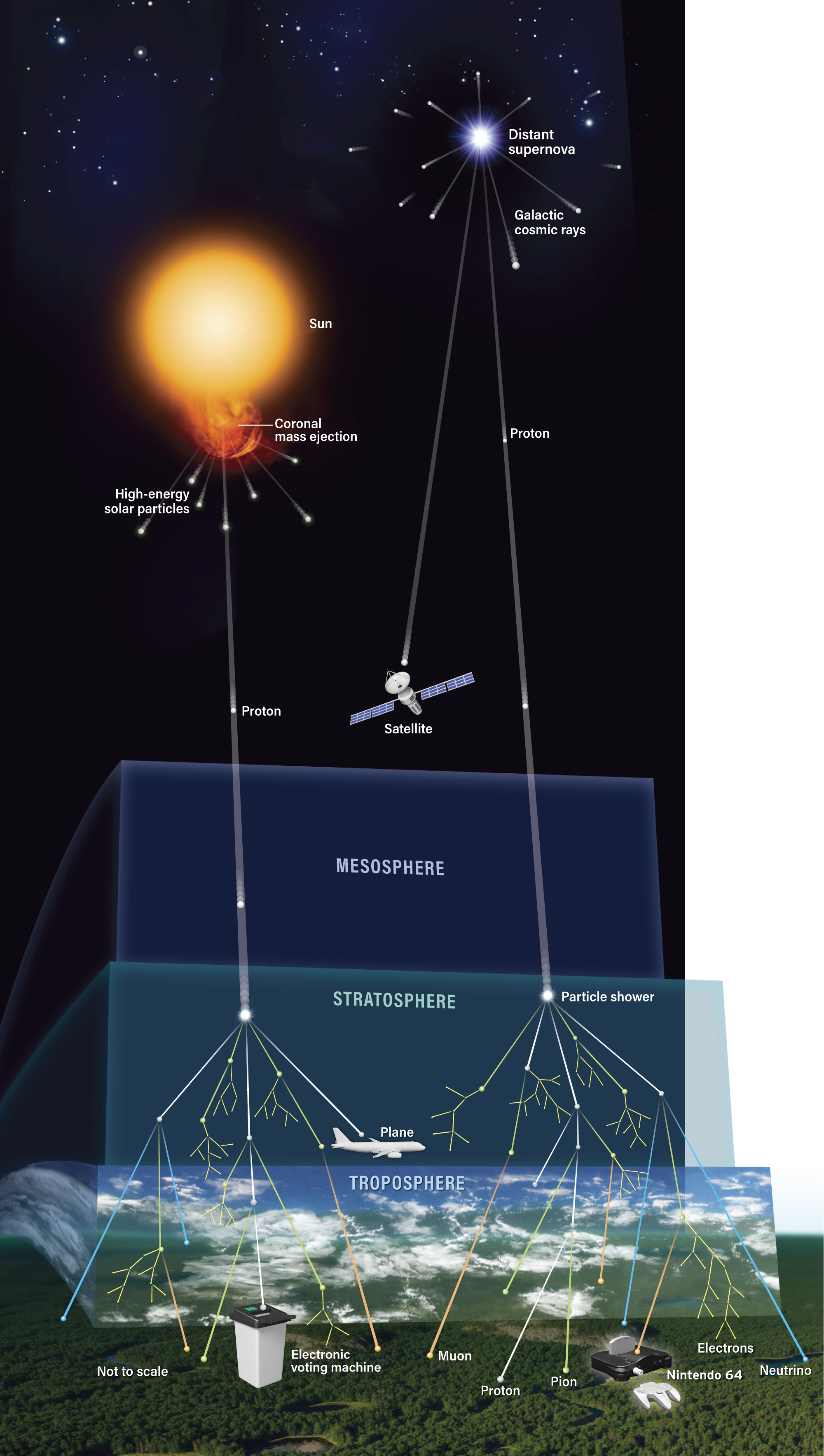
Outer space is filled with high-energy radiation: fast-moving particles, such as protons, that constantly bombard Earth. These particles can come from the Sun, but also from deeper space in the form of galactic cosmic rays caused by powerful, distant events like supernovae.
While radiation is more likely to affect electronics operating in the harsh environment of space and at high altitudes where Earth’s atmosphere is thin, it can also affect ground-based electronics.
Computers store information at its most basic level as bits, electronic units that can have one of two states, corresponding to a value of 0 or 1. A bit flip occurs when a high-energy particle strikes a microchip and quite literally flips one of the chip’s bits from 0 to 1, or vice versa. This unintended switch can cause the device to behave in unexpected ways. Typically, bit flips (also known as single-event upsets or SEUs) cause mundane glitches like a frozen screen. Sometimes, though, the glitches can be remarkable or even dangerous, like an airplane suddenly losing altitude, or a voting machine hallucinating thousands of votes.
Process of elimination
What makes bit flips especially insidious is that we often can’t confirm one has occurred at all. They are as elusive as they are disruptive. As Bharat Bhuva, professor of electrical and computer engineering at Vanderbilt University, explained in a 2017 Vanderbilt Research News post, “The only way you can determine that [an issue] is a single-event upset is by eliminating all the other possible causes.”
In the case of the Super Mario 64 speedrunning incident, informal investigations conducted by the video game community led to the suggestion that a high-energy particle struck the memory location responsible for Mario’s vertical position. Flipping a single 1 to a 0 spontaneously increased Mario’s height value, teleporting him upward through the floor. A member of the community tested this by intentionally swapping this bit and recording the results. In side-by-side videos, the bit-flipped simulation appears similar to the original glitch.
Yet even with this evidence, there’s no way to say for certain a bit flip is to blame. That elusiveness also makes it more difficult for engineers to determine whether their strategies for mitigation are effective, increasing the challenge when it comes to preventing them.
Mitigating the effects
While a video game glitch or a frozen computer screen is relatively inconsequential, radiation can be a serious problem for spacecraft, which operate in high-radiation environments. When reliability is crucial, engineers work to protect electronics from radiation’s damaging effects through a process called radiation hardening.
Electronics can be hardened through process, design, and shielding. The specific strategy depends on the environment; for instance, a satellite orbiting Earth faces lower radiation levels than a spacecraft at Jupiter, which must withstand intense radiation produced by that planet’s tremendously strong magnetic field. For example, NASA’s Europa Clipper, a probe bound for Jupiter’s moon Europa, required a purpose-built aluminum vault to shield its electronics and an elongated orbital path designed to minimize radiation exposure — strategies unnecessary for a GPS satellite orbiting Earth.
The oldest mitigation method is radiation hardening by process (RHBP), in which fabricators construct chips from materials that make them more resistant to radiation. For example, rather than building chips on standard silicon, fabricators use insulating substrates like sapphire to prevent radiation-generated charge from spreading through the chip. Fabricators also carefully introduce small amounts of impurities into the silicon — a process called doping — to reduce how much charge a particle strike can generate.
The idea behind RHBP is to embed radiation resistance into the physical properties of the chip itself. However, “[RHBP] technologies tend to serve niche, low-volume markets, and the manufacturing expense and specialized supply-chain requirements make RHBP integrated circuits very expensive,” says Brian Sierawski, professor and interim director of the Institute for Space and Defense Electronics (ISDE) at Vanderbilt University.
A lower-cost alternative is radiation hardening by design (RHBD), which foregoes specialized materials and instead modifies how the circuits are structured and arranged. Designers might, for example, “make transistors different sizes or shapes … add in circuit redundancy … or come up with a clever circuit design,” Sierawski says.
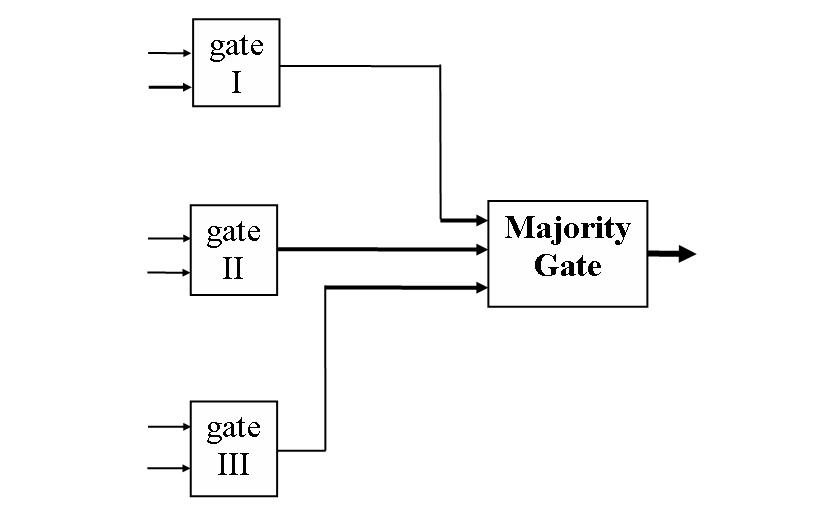
One common RHBD approach in spacecraft is triple modular redundancy, where three separate circuits perform the same calculation and vote on the result. For example, on NASA’s Perseverance Mars rover, three copies of each instrument circuit are installed so that if one is struck by a particle, the other two override it.
Perhaps the most intuitive approach is radiation hardening by packaging, also called shielding. This involves putting heavy material between the electronics and the radiation in an attempt to keep the radiation out. This is the function of Europa Clipper’s aluminum vault — designed to absorb enough of Jupiter’s intense radiation to keep the spacecraft’s electronics operating.
“People less familiar with radiation will typically say, ‘Let’s just shield it,’ ” ISDE associate director Michael Alles says. The problem, he explains, “comes down to mass.” Shielding requires placing components in radiation-resistant materials like lead or tungsten, which are heavy and not always practical for launching into space.
It’s not all bad news for shielding. According to Sierawski, there is a lot of low-energy radiation in space that can be blocked by shielding. “By using some shielding, you . . . knock down that lower energy so it doesn’t actually reach your electronics,” he says.
However, the technique does come with diminishing returns: “Once you get to a point where you’re just adding mass and you’re not able to actually stop the rest of the environment, that’s just a cost to the system,” he says.
Transient versus cumulative effects
Bit flips fall into the broader category of transient radiation effects. Transient effects are random occurrences: “the result of a single particle that happens to be in the right place at the right time,” says Brian Sierawski. The damage from single-event upsets is generally temporary and reversible. Other transient radiation effects are not. Single-event burnouts, for example, occur when a striking particle doesn’t just flip a bit. Instead, “a power transistor [a switch that controls current and voltage] gets hit by an ion [a charged particle] of some sort, and it burns out. It ceases to function,” explains Michael Alles.
Electronics are also susceptible to cumulative radiation effects — particularly electronics in high-radiation environments like space. The total ionizing dose (TID) is the total amount of radiation that a component will be exposed to over time. Unlike the sudden hit-and-run nature of transient effects, TID is a slow buildup of radiation damage over time. This can lead to parametric degradation, where components gradually function less and less efficiently. Eventually, this degradation results in the total failure of the component.
Closer to home
While radiation hardening is often associated with spacecraft, the effects of bit flips are also felt on Earth. At cruising altitude, aircraft flight computers are exposed to elevated radiation levels. To combat this exposure, airplane computers employ an RHBD technique called dissimilar redundancy, which uses flight computer hardware and software architectures from different manufacturers to ensure a single-event upset doesn’t affect all systems simultaneously.
In the 2025 Airbus incident, engineers determined the accident was most likely the result of a bit flip in the plane’s Elevator Aileron Computers (ELACs) — the systems responsible for pitch and roll. “Analysis of a recent event involving an A320 Family aircraft has revealed that intense solar radiation may corrupt data critical to the functioning of flight controls,” the company wrote in a Nov. 28 press release.

The affected computers have dissimilar redundancies in place to mitigate this sort of error. The A320 employs multiple independent flight control computers: two ELACs and three Spoiler Elevator Computers. Similar to triple modular redundancy, these units constantly cross-check each other’s calculations. If one computer generates a command that disagrees with the others, the system is designed to vote it out and ignore the erroneous data.
The solution deployed by Airbus was to roll back all A320 ELACs to a previous version. For most of the fleet, this meant a simple software swap; for some planes, entire computers were replaced. As Alles notes, “the [bit flip] is still likely happening in the hardware, but it’s how the software is communicating” that determines the outcome. It’s possible that a software update introduced a flaw that overrode the flight computer’s dissimilar redundancy, requiring a fallback to proven code.
The incident speaks to the elusive nature of bit flips — and to how vast the threat really is. It’s difficult to say for certain whether a bit flip was to blame, why the redundancies failed, or even where the offending particle came from.
Researchers at the University of Surrey’s Space Centre questioned Airbus’ claim of solar radiation, noting the aircraft would have experienced normal radiation levels that day. Matthew Owens, a professor of space physics at the University of Reading, adds that “there was no space weather of note on Oct. 30.” This raises the possibility that the culprit was a galactic cosmic ray, rather than a solar particle — a reminder that the threat does not end at the edge of our solar system.
‘Hardening by serendipity’
The Airbus incident underscores the importance of hardening in applications where a bit flip can put lives at risk. But in many other applications, that level of rigor is being set aside.
Traditionally, space agencies developed specialized electronic components for space applications, meaning that commercial off-the-shelf components — like the inexpensive chips found in modern smartphones — were off-limits. The rapid expansion of commercial spaceflight is forcing a rethink of this approach. As costs mount, Alles says a new philosophy is emerging, one he calls “hardening by serendipity.”
Rather than engineering out the risk, companies accept it. A company might launch a constellation of satellites knowing that 10 to 20 percent will fail, Alles says, simply rerouting data through functioning neighbors when one goes down. “They don’t care about that one big thing they got to get right like NASA always did,” he says.
The consequences of this shift are felt on Earth: As radiation-vulnerable commercial components become the backbone of global infrastructure, bit flips and other radiation effects may become a routine cost of doing business. And when satellites do fail, deorbiting hardware burns up in the atmosphere, contributing to a growing problem of atmospheric pollution. It is a philosophy born of cost, whose consequences may be felt beyond the satellite industry.
As modern consumer electronics scale down, the possibility of radiation effects becomes a game of trade-offs. While smaller transistors present a smaller target for a passing particle, they also allow for higher component density — meaning that even if an individual bit is less likely to be hit, there are more bits available to be struck. The problem can’t be solved by simply making chips increasingly smaller; instead, it requires new ways of managing risk.
Whether the consequences range from trivial gaming glitches to critical aviation failures, the underlying physics of bit flips remains the same. As we grow more dependent on electronics on Earth, fill the skies with satellite constellations, and set our sights on a permanent human presence beyond our planet, managing these events is no longer a specialized task for space agencies, but a basic requirement for the reliability of the global digital infrastructure.
Editor’s note: An earlier version of this story appeared on Astronomy.com in December 2025. Read it here.
Brooks Mendenhall is a staff writer for Astronomy and is based in Chattanooga, Tennessee.