Since the universe was very small right after the Big Bang and yet it contained the same amount of matter as now, would the intense gravity have slowed the passage of time?
Roger Reed
Pierre, South Dakota
Shortly after the Big Bang, the density of the universe was greater than the inside of a neutron star … greater than the density of nuclear matter … greater than everywhere in space.
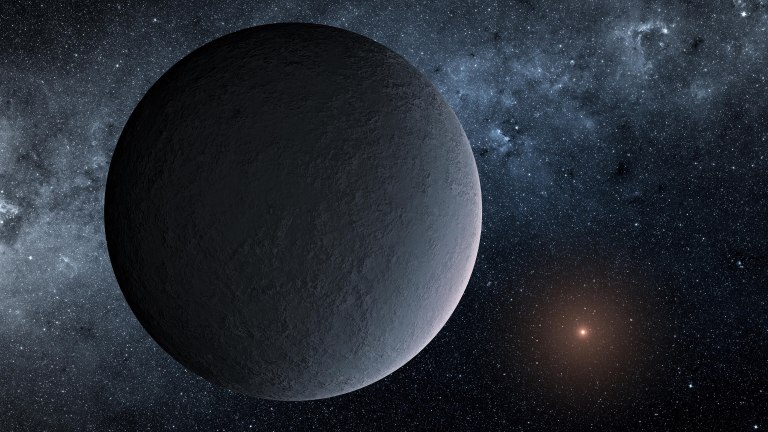
We know that neutron stars are so dense — they squeeze roughly twice the mass of the Sun into an object only the size of a small city — that their mass starts to warp local space-time around them severely. This causes a time-dilation effect, so time passes 1.9 times slower near the neutron star than it does for us.
The only clock that you can actually use to gauge what is happening is the clock that you carry. It ticks off what is called proper time as you move along your worldline — the path you trace in the universe as you move through it, living your life. If you traveled near the speed of light to Alpha (α) Centauri, you could literally get there in seconds by your proper time clock while observers back on Earth saw 4.3 years go by. Likewise, the neutron star time-dilation factor of 1.9 is only measurable with respect to distant clocks located where space-time is not distorted and gravity is weak, like Earth.
But there is no such distant place for the Big Bang. Soon after the Big Bang, the entire universe was filled with a dense plasma and every particle within it was traveling at nearly the speed of light. Every particle measured its own proper time as it moved along its torturous worldline through the mishmash of the Big Bang event. Within the small, hot, dense universe, there was no external, faraway clock outside these conditions against which to measure the time dilation experienced by all these particles at a given proper time.
Let’s think back to our neutron star: If you have two nearby clocks both in the gravitational field of the neutron star, an observer with one clock would see an observer with the other clock experience a severe but different time dilation effect because they are located in different parts of the neutron star’s gravitational field and traveling at different velocities. Near the Big Bang, the intensity of the gravitational field causes a similar “differential effect,” but its magnitude is vastly greater and changing so rapidly in time that it is impossible to measure the differential time dilation experienced between particles carrying their own proper time clocks.
So, the answer to the question is that we cannot measure the slowing of time near the Big Bang because there is no “cosmic clock” outside of this dense plasma against which we could gauge such differences. Proper time is only what we measure on our own clock, whether that is a clock we hold here on Earth, for which the Big Bang occurred 13.8 billion years ago, or the clock of a particle shortly after the Big Bang, for which only 10-15 seconds has elapsed.
Sten Odenwald
Senior Outreach Coordinator, NASA HEAT Program, Kensington, Maryland
Related: What is time? An astronomer explains the search to find its origins