Scientists believe they may finally have an explanation for a bizarre cloud that appears and promptly disappears each day above a martian volcano during the dusty season.
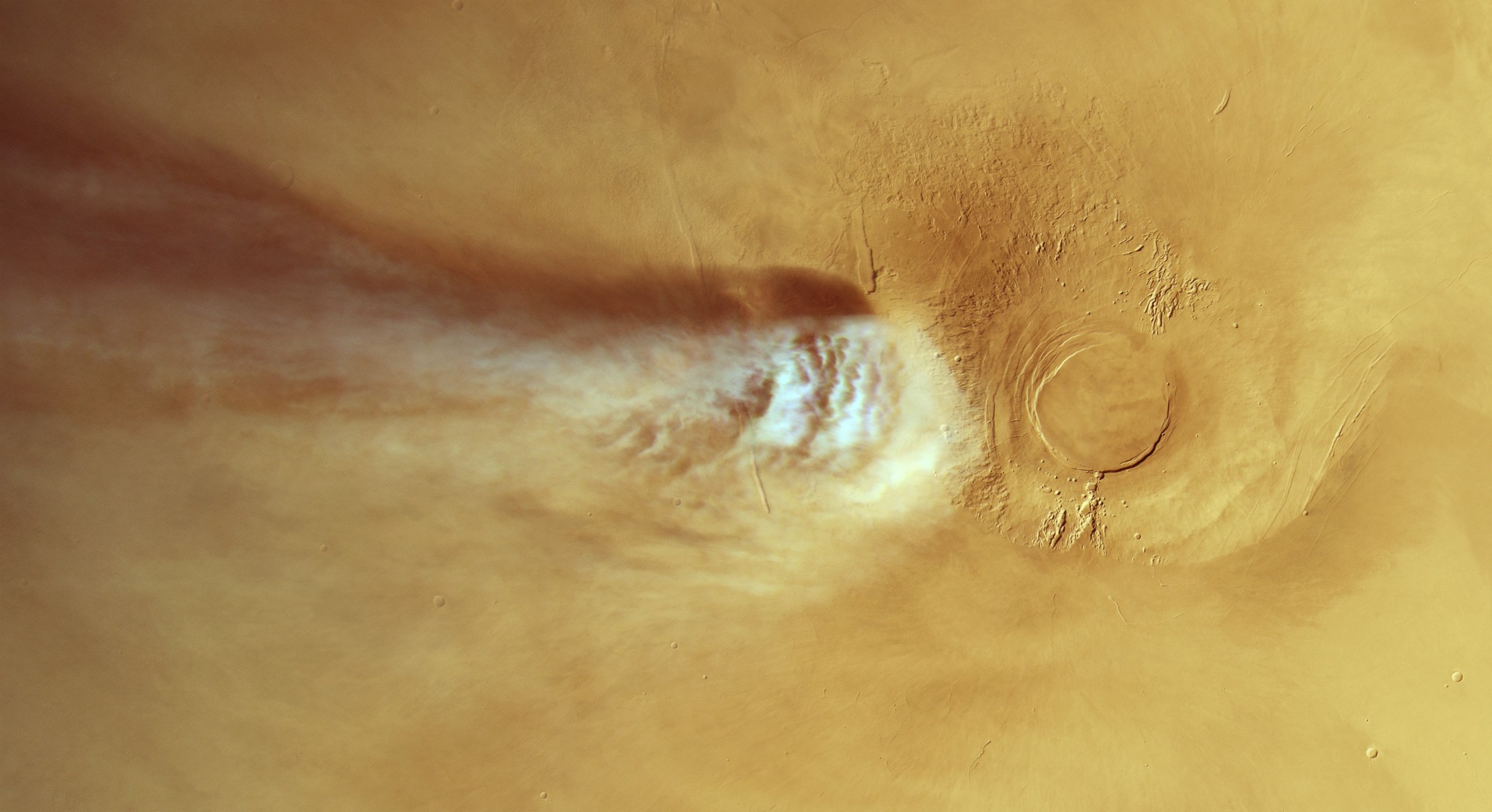
Just after sunrise during spring and summer on Mars, an elongated cloud forms near the 12-mile-high (20 kilometers) volcano Arsia Mons. Stretching roughly 1,100 miles (1,800 km) in length, the aptly named Arsia Mons Elongated Cloud (AMEC) is unlike any cloud previously observed on the Red Planet. Since it was first identified by the European Space Agency’s Mars Express orbiter in 2018, scientists have struggled to replicate the cloud’s formation with computer modeling. In a new study published Oct. 7 in Nature Geoscience, researchers were finally able to simulate the cloud using physics that, while long considered possible, had never before been observed in a planetary atmosphere.
“To create the AMEC in our modeling, we found that we needed to include some exotic physics … that, while included in textbooks, is treated as theoretical and usually thought not to happen in nature. It certainly hasn’t been seen in action before,” Jorge Hernández-Bernal, lead author of the study and researcher with the Laboratoire de Météorologie Dynamique at the Institut Pierre-Simon Laplace in France, said in a statement.
The finding shines a new light on martian atmospheric processes and could change how scientists think about clouds on other worlds, including our own.
An early riser
While Viking Orbiter 2 caught a glimpse of the AMEC in 1977, the cloud wasn’t officially recognized as a phenomenon until Mars Express spotted it with its Visual Monitoring Camera (VMC) in 2018. Mars Express has been orbiting Mars since 2003. The VMC is a modest 640-by-480 resolution webcam originally meant to watch the Beagle 2 lander (also carried aboard Mars Express) separate from the craft prior to descent. The orbiter also carries the High Resolution Stereo Camera (HRSC), which can capture the cloud in far sharper detail, and a French-developed imaging spectrometer called Observatoire pour la Minéralogie, l’Eau, les Glaces et l’Activité) (OMEGA). All three instruments contributed to the new study.
Most martian orbiters, like NASA’s Mars Reconnaissance Orbiter (MRO) and Mars Odyssey missions, are in orbits that allow them to only observe the planet during the afternoon. Because Mars Express is in a different type of orbit, its path changes with every pass, allowing it to see Mars early in the morning; it observes at altitudes ranging from 205 to 6,540 miles (330 to 10,530 km). This shifting vantage point offers the perfect opportunity to catch the AMEC in action.
The cloud’s daily cycle is short. A bright head forms over the volcano’s western slope about 28 miles (45 km) up. A tail then races westward at roughly 380 mph (610 km/h), extending as far as 1,100 miles (1,800 km) in length but typically less than 120 miles (200 km) in width. After about three hours, the whole cloud breaks free of the volcano and drifts away, evaporating before afternoon — and before MRO or Mars Odyssey have a chance to see it.
The missing tail
When researchers tried to replicate the AMEC’s unusual morphology in computer models based on the conventional understanding of cloud formation, the models could never replicate the AMEC’s signature tail.
Clouds on Earth form through a process called heterogeneous nucleation. Water vapor in the atmosphere condenses around tiny solid particles — pollen, smoke, dust — floating in the air. Scientists have long theorized that clouds could also form through homogeneous nucleation, in which water vapor condenses or freezes entirely on its own, with nothing in the middle to initiate the process. Although it’s possible homogeneous nucleation could occur in the upper atmosphere of Earth and even Venus, it has never been observed in action. The conditions required are extreme: For the process to occur, the air would need to hold roughly 100,000 times more water vapor than normal, a condition called supersaturation. That rarely happens because Earth’s atmosphere is so full of particles that normal heterogeneous nucleation triggers clouds long before humidity climbs that high. Only an exceptionally clean atmosphere free of particulates could allow the alternative to happen. But evidently that’s exactly what Arsia Mons provides.
From thin air
When the team included homogeneous nucleation in their models, they were able to replicate the cloud’s unique tail. The researchers think this process can happen over Arsia Mons because the volcano creates a rare combination of conditions. Relative to any peak on Earth, Arsia Mons is massive, standing 12 miles (20 km) high and stretching 270 miles (435 km) across. Mars’ atmosphere is also exceedingly thin. And even in the dusty season, the higher the altitude, the less material there is in the air. About 28 miles (45 km) above Arsia Mons, the air holds hardly any dust at all, roughly a tenth of a dust grain per cubic centimeter.
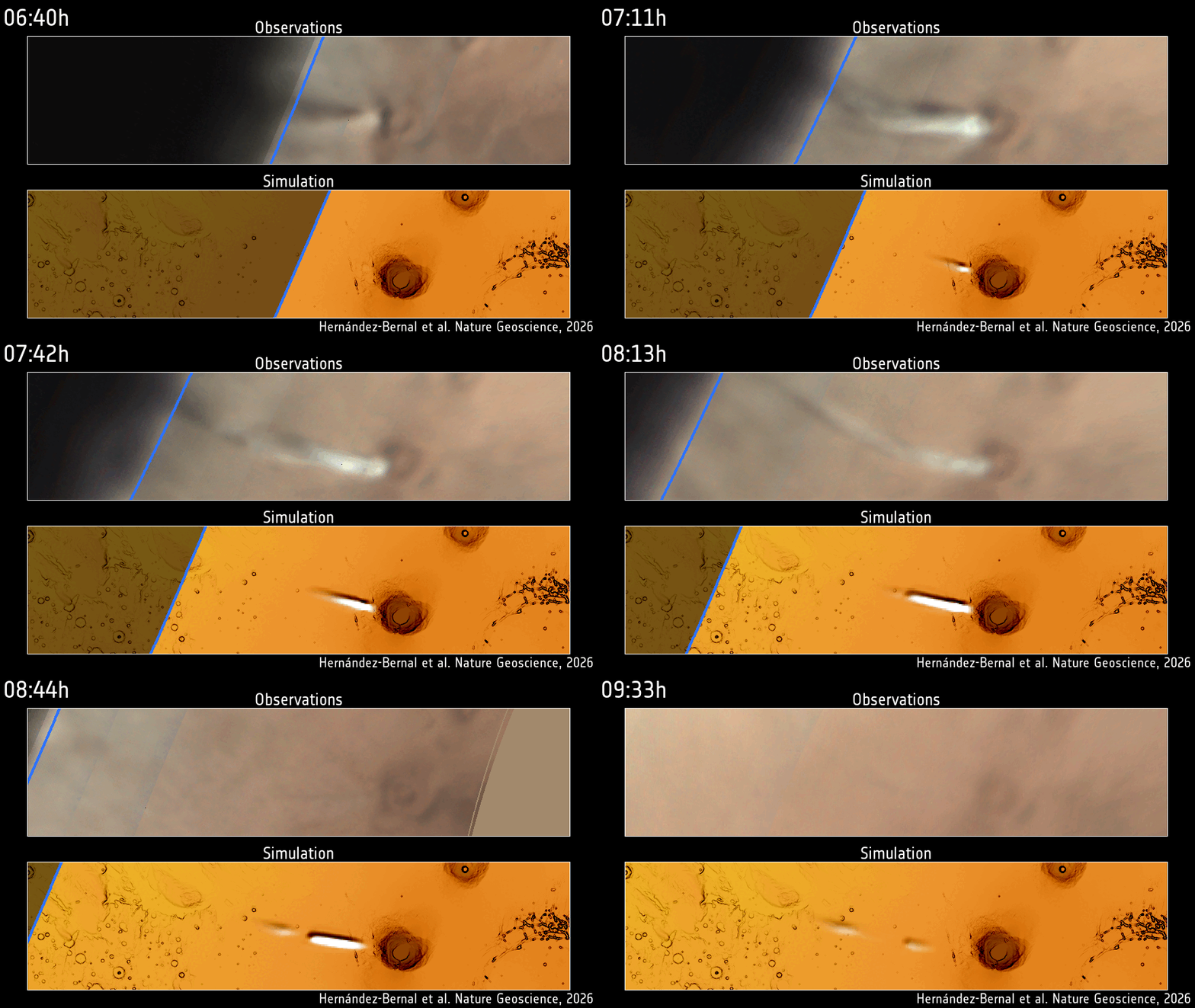
In the simulations, as wind flows over the volcano, moist air shoots several miles high. That sudden climb chills the air dramatically, with temperatures dropping about 54 degrees Fahrenheit (30 degrees Celsius) in 10 minutes. The chill is concentrated in a compact pocket of cold air on the volcano’s western slope, right where the cloud’s head appears, with temperatures dipping below –226°F (–143°C). The cooling happens too fast, and the dust is too sparse, for heterogeneous nucleation to keep up. So, the vapor in the pocket freezes on its own, forming hundreds of tiny ice crystals per cubic centimeter.
From there, winds sweep the crystals west. Because they’re in a state of equilibrium with the surrounding air, they don’t grow or evaporate much, letting the tail stretch for hundreds of miles. Later in the morning, the cold pocket weakens, ice production shuts off, and the cloud breaks free of the volcano, just as Mars Express has observed.
The simulated cloud isn’t a perfect match, but Hernández-Bernal called the result “remarkable,” given how little is known about Mars’ atmosphere. “It’s akin to droplets of condensation appearing in the middle of a room, rather than on a window. … We’ve never seen it before in a planetary atmosphere. It’s wholly unexpected,” he said.
Now the team wants to know whether the AMEC is unique, or whether this exotic process shapes other clouds or the water cycle across Mars.
Brooks Mendenhall is a staff writer at Astronomy, based in Chattanooga, Tennessee, fueled by an unending curiosity about the universe. A former classroom teacher, he has a knack for breaking down complex concepts for a wide audience.