When the Sun reaches higher levels of activity, junk drifting in low Earth orbit loses altitude at an increased rate — and for the first time, scientists have measured that increase and identified when it kicks in.
A study published May 6 in Frontiers in Astronomy and Space Sciences tracked 17 pieces of space debris over 36 years of publicly available orbital data spanning three complete solar cycles, finding that decay rates surge once the Sun’s activity hits roughly two-thirds of its peak. The work is the first to identify the specific point in the solar cycle at which decay rates accelerate — and to track how much faster debris falls once that threshold is crossed.
“For the first time, we find that once solar activity passes a certain level, this loss of altitude happens noticeably more quickly. This observation is expected to be key for planning sustainable space operations in the future,” said Ayisha M. Ashruf, a scientist and engineer at the Space Physics Laboratory at Vikram Sarabhai Space Centre in Thiruvananthapuram, India, and lead author of the study, in a press release.
How sunspots push space debris out of orbit
The Sun runs on an approximately 11-year cycle of activity, swinging between quiet periods and peaks marked by an increase in sunspots — dark, magnetically intense patches on the Sun’s surface that serve as a proxy for overall solar output. Near the solar maximum, which the Sun reached in late 2024, it emits intensified ultraviolet and extreme ultraviolet radiation along with streams of charged particles.
That energy heats the thermosphere — the atmospheric layer between around 62 and 6,200 miles (100 and 1,000 kilometers) altitude — and pushes denser air higher, increasing the drag experienced by anything orbiting in low Earth orbit, where most satellites and debris reside. More drag means orbits decay faster.
36 years of space debris data
To track decay over nearly four decades, the researchers drew on a continuous public record of orbital positions from the Space-Track database — a catalog of every tracked object in orbit that stretches back to the early days of the Space Age — pulling data going back to 1986 for 17 debris objects all launched in the 1960s and still in orbit today.
The pattern that emerged was consistent across all 17 objects: Orbital decay doesn’t proceed at a steady rate. Near the solar minimum, debris drifts downward gradually. Once sunspot numbers climb past roughly 67 to 75 percent of their cycle maximum, the descent steepens noticeably — shifting from a slow drift into a faster linear decline that persists through solar maximum before easing again as the cycle winds down. The authors identified this behavior — gradual slope, steep slope, gradual slope — repeating across all three cycles in the data.
The figure below, from the study, plots this pattern for a single representative object, a piece of Delta 1 rocket debris that has been orbiting since the 1960s. Its altitude drops from roughly 428.7 miles (690 km) at the start of solar cycle 22 to about 341.7 miles (550 km) by the end of solar cycle 24. The steeper segments, marked by the solar maximum windows, are immediately visible against the shallower slopes on either side.
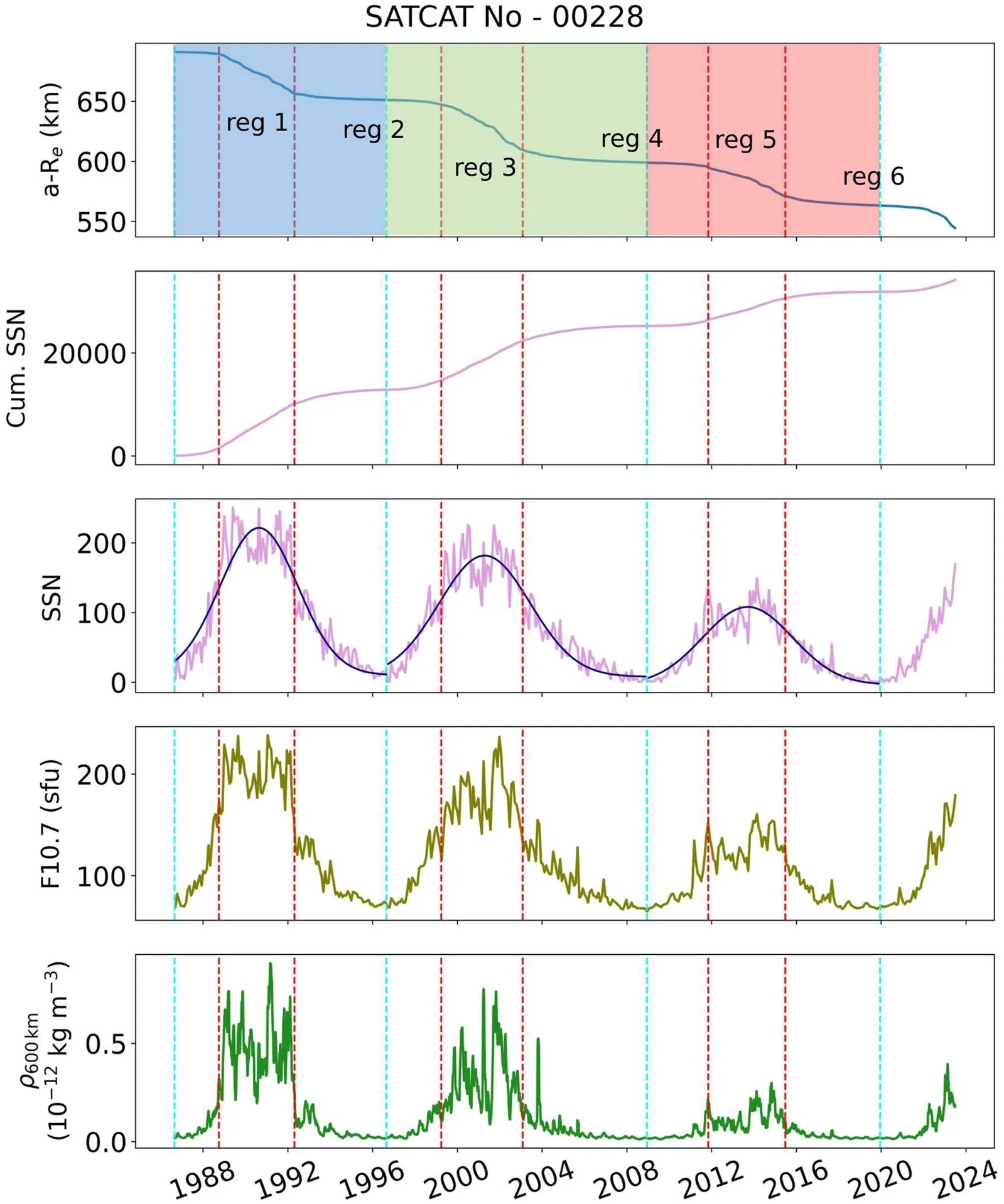
The top panel of this figure tracks the altitude of a single piece of Delta 1 rocket debris over 36 years, from roughly 428.7 miles (690 km) in 1986 to about 341.7 miles (550 km) by 2024. Red dashed lines mark where the descent steepens as solar activity increases. The four panels below show different measures of that solar activity each rising and falling in lockstep with the debris’ rate of decline. Frontiers in Astronomy and Space Sciences: A. M. Ashruf et al., 2026, DOI: 10.3389/FSPAS.2026.1797886, CC BY 4.0
Solar strength also shapes how fast debris falls during those peak windows. During solar cycle 22, the most active of the three cycles studied, the 17 objects fell at a mean peak rate of about 1.94 feet per hour (0.59 meters per hour). During the comparatively quiet maximum of solar cycle 24, that mean dropped to just 0.82 feet per hour (0.25 meters per hour) — less than half as fast.
All 17 tracked debris pieces have been aloft since the 1960s — and because none of them have ever maneuvered, every change in their trajectories reflects nothing but the environment around them.
“What is most interesting is that all of this information comes from objects launched back in the 1960s. They are still contributing to science, serving as valuable tools for studying long-term effects of solar activity on the thermosphere,” Ashruf said.
What this means for satellites and space junk removal
Low Earth orbit is increasingly crowded with defunct satellites, old rocket stages, and collision fragments. A single crash can trigger a chain of further collisions — the scenario known as Kessler Syndrome — making it critical to track and predict which objects pose the greatest near-term danger. Missions to actively capture and remove debris remain in early development, so for now, the focus is on tracking objects more precisely to identify which pose the highest risk.
Because the debris objects in this study don’t perform any maneuvering, their orbital paths reflect responses to atmospheric conditions. That makes them natural candidates for tracking long-term solar effects. The threshold the team identified gives satellite operators concrete data to work with: When solar activity is approaching its peak, both debris and active satellites lose altitude faster, requiring more frequent orbit corrections and more fuel — factors that directly affect how long a satellite can stay operational and how much a mission costs to run.
For debris-removal planners, the findings add another variable to an already complex problem. An object that poses a manageable risk near solar minimum may become a higher priority target as solar maximum approaches and its orbit decays faster than expected. Knowing when that acceleration kicks in — and by how much — gives both satellite operators and debris trackers a clearer picture of what the next few years in low Earth orbit will look like.