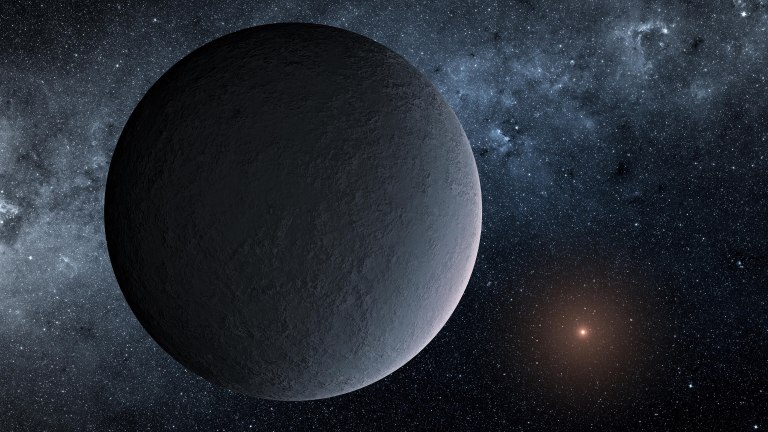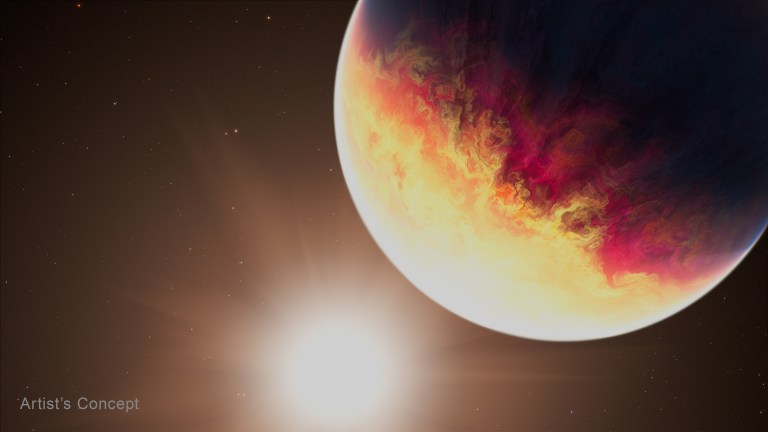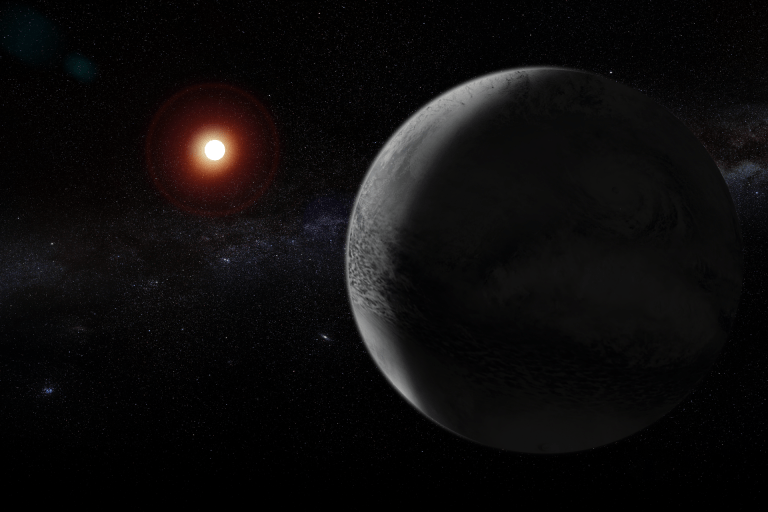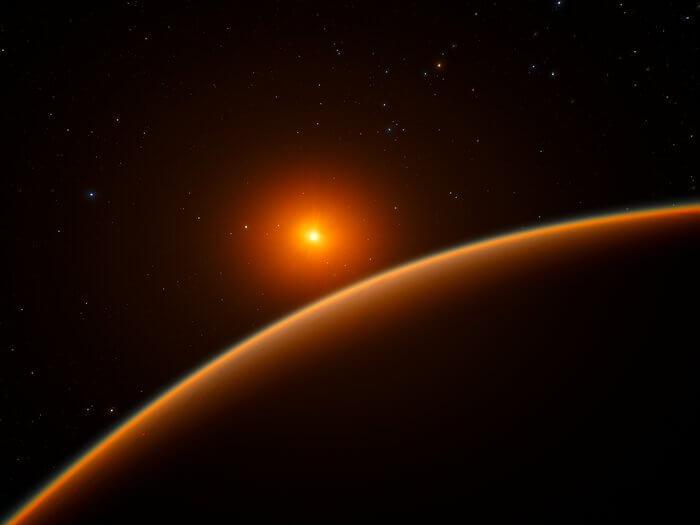
Astronomers have detected helium leaking from a rocky exoplanet, a sign that the planet may have an atmosphere. If confirmed, the finding represents the first such detection around an Earth-like world in its host star’s habitable zone, a groundbreaking discovery in the ongoing search for life on other planets.
The rocky super-Earth LHS 1140 b is one of two known exoplanets orbiting the star LHS 1140, located roughly 50 light-years from Earth in the constellation Cetus. LHS 1140 is classified as an M dwarf, roughly one-fifth the size of our Sun and less than 1% of its brightness. Using a highly sensitive spectrograph on the Magellan Clay Telescope in the dark skies of Chile’s Atacama Desert, lead author and Harvard Ph.D. candidate Collin Cherubim and his team spotted evidence of LHS 1140 b’s atmosphere in 2024 when the planet crossed in front of its host star from our point of view. That detection confirmed predictions made by Cherubim’s own computer model, developed as part of his Ph.D. research. The study, published July 16 in Science, marks LHS 1140 b as a great candidate for further research on exoplanet habitability.
“We tend to think for a planet to be habitable, it has to be mostly rocky, has to have an atmosphere to shield the surface from harmful radiation, but also to keep water present,” Cherubim said in a podcast interview with Science. “And now we know LHS 1140 b meets those criteria.”
The M-dwarf trap
Since the first confirmed exoplanet detection in 1992, scientists have found more than 6,300 exoplanets. But in the search for life, they care most about the ones that might be habitable.
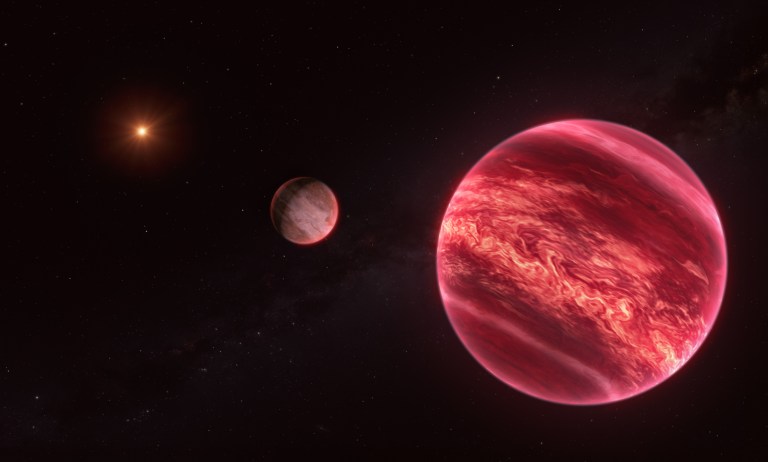
Most exoplanets, including LHS 1140 b, are found through transit photometry, watching a star dim slightly as a planet crosses in front of it. Gas giants are big, so they’re easy to spot as they create lots of variability even in front of bright Sun-like stars. But gas giants are not candidates for habitability. Rocky planets are small, so they’re harder to catch, unless they orbit a small, dim star. That’s what makes M dwarfs, the most common stars in the galaxy, so useful. A rocky planet blocks a much larger share of an M dwarf’s faint light than it would a star like the Sun, making the transit easy to measure.
But M dwarfs come with a catch. They flare often and blast out disproportionate amounts of X-ray and ultraviolet radiation, which can heat a nearby planet’s atmosphere until it expands and escapes into space — a process known as irradiation. As a result, astronomers have found numerous rocky planets around M dwarfs in the habitable zone — the region around a star where planetary surface temperatures would support liquid water. But until now, none of them had a confirmed atmosphere.
RELATED: Animal life unlikely around a third of stars in the galaxy, study says
The TRAPPIST-1 system illustrates the M-dwarf catch-22 well. Perhaps the most promising rocky planets astronomers know of, the seven Earth-sized worlds orbiting this M dwarf about 40 light-years away have been the focus of intense scrutiny in the last few years. The James Webb Space Telescope (JWST) has observed several of the system’s planets, hoping to find a stable atmosphere, but so far to no avail.
Finding a leak
Cherubim’s team caught LHS 1140 b’s atmosphere by observing the star as the planet crossed in front of it. During this transit, a small fraction of the star’s light filtered through the planet’s atmosphere. By breaking this light into its component colors (akin to a prism), astronomers can determine what wavelengths the atmosphere was absorbing and what elements are responsible. This technique, called transit spectroscopy, can reveal and characterize the exoplanet’s atmosphere — or lack thereof.
In the case of LHS 1140 b, they found helium leaking from the planet’s upper atmosphere during a September 2024 transit. The team also observed LHS 1140 c, a second rocky planet in the system on a tighter orbit that exposes it to roughly five times the radiation LHS 1140 b receives, and found no helium there at all. “It’s not surprising that the inner planet does not have an atmosphere, because it’s more highly irradiated by the star,” Cherubim said in the interview. “Whereas the outer planet is consistent with the prediction that it should have maintained some primordial atmosphere.”
That prediction came from a computer model Cherubim built during his Ph.D. research, which found that light gases like hydrogen should escape a small, irradiated planet’s atmosphere faster than heavier helium, leaving helium-rich atmospheres behind as the natural end state for planets like LHS 1140 b.
The discovery came not from a space-based telescope like JWST but from the ground-based Magellan Clay Telescope (MCT). The Clay telescope’s primary mirror spans 6.5 meters — identical to Webb’s segmented 6.5-meter primary. But its advantage over JWST lies in the instruments attached to it — in this case, a spectrograph called WINERED.
WINERED was designed with the ability to split light very finely into its individual wavelengths. Webb’s Near Infrared Spectrograph has a resolving power — a metric of this ability — that tops out at 2,700. WINERED, by comparison, offers resolving powers of roughly 28,000 and 70,000 depending on the mode. “The James Webb Space Telescope, the resolving power is just at most like a tenth of what this ground-based telescope is,” Cherubim explained in the podcast.
A world imagined
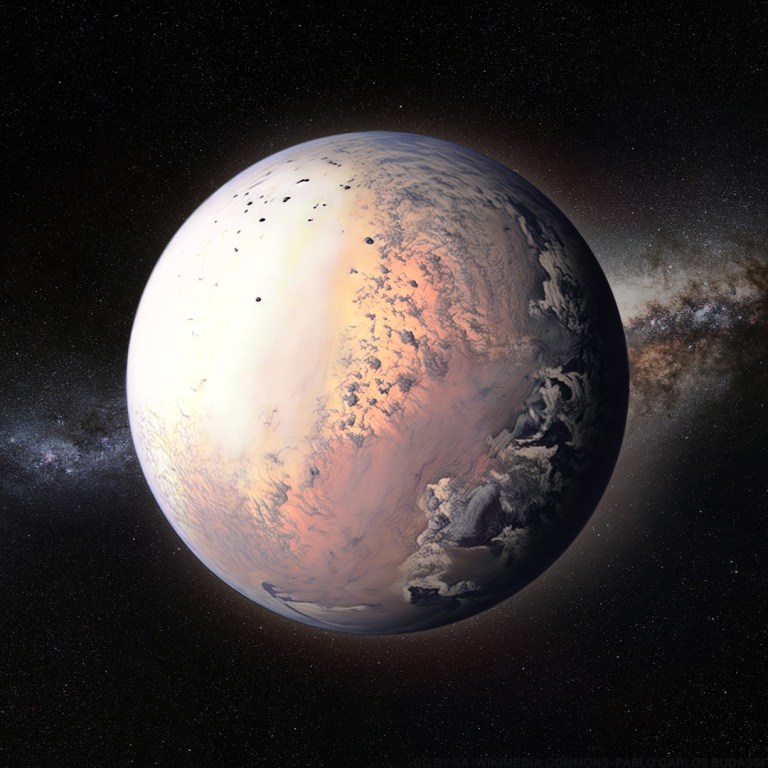
While spectroscopy can tell scientists a lot about an exoplanet, it doesn’t give a clear picture of what it would be like to stand on the planet’s surface, assuming it even has one. For that, some imagination is required. “I think it’s really fun in this field to try to be imaginative and sort of picture being on these places,” Cherubim told Science. “If you were standing on the surface of the planet, the star would appear to be twice the size of the Sun in the sky … probably a lot more red because it’s a red dwarf.” Because LHS 1140 b is tidally locked, it would also have a permanent day side, a permanent night side, and a permanent twilight band in between.
LHS 1140 b’s observed mass and radius suggest a rocky world that is not as dense as Earth, Cherubim said. That that means the world likely contains a low-density component like a substantial atmosphere or a lot of water — or both. Now that the atmosphere is confirmed, Cherubim thinks water is a good bet too.
To keep its ocean though, LHS 1140 b would need a cold trap — the same barrier of cold air between Earth’s troposphere and stratosphere that stops our oceans from boiling off. Water vapor rising from a planet’s surface hits this cold layer and freezes, before it can climb high enough to escape.
“Our modeling suggests there’s a very strong cold trap on this planet that’s even colder than Earth’s cold trap,” he said. If LHS 1140 b ever had water, his models suggest it likely still does, making it a plausible ocean world.
Future planned observations with JWST will search for molecules like carbon dioxide. It could also search for imbalances in the abundances of different chemicals that could signal that some process — such as life — is producing gases faster than they break down. None of that would confirm biology on its own. But with a temperate, rocky, atmosphere-bearing planet just 50 light-years away, LHS 1140 b is now one of the most exciting targets in the search for life.
Brooks Mendenhall is a staff writer for Astronomy magazine and is based in Chattanooga, Tennessee.