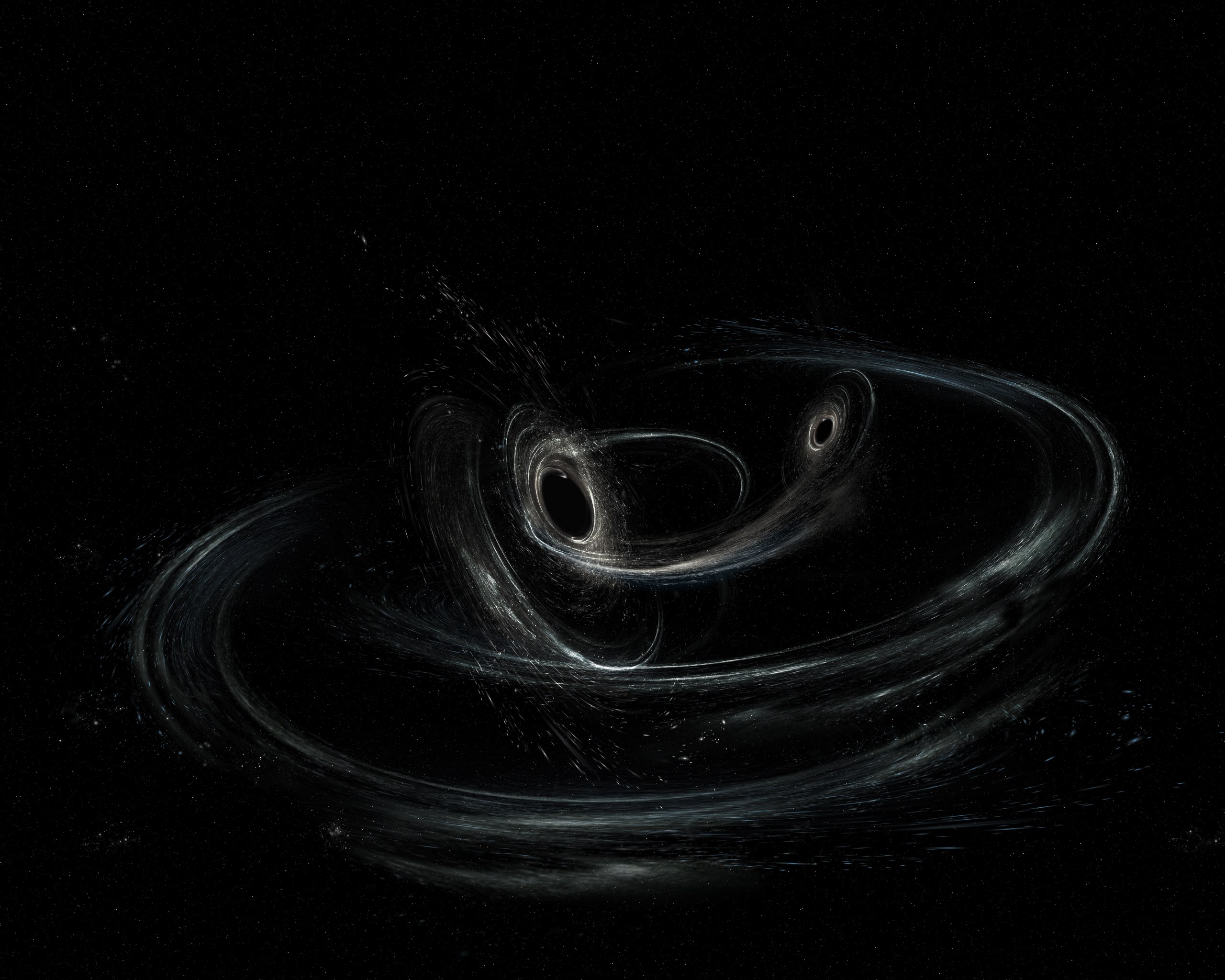
Some 1.3 billion years ago, when multicellular organisms were just emerging on Earth and life was still confined to the ocean, two behemoth black holes smashed together in a far-flung galaxy. The collision was so powerful that it jolted the universe, creating a ripple in the fabric of space-time that traveled across the cosmos at the speed of light.
At 5:51 a.m. EDT on Sept. 14, 2015, that ripple reached Earth.
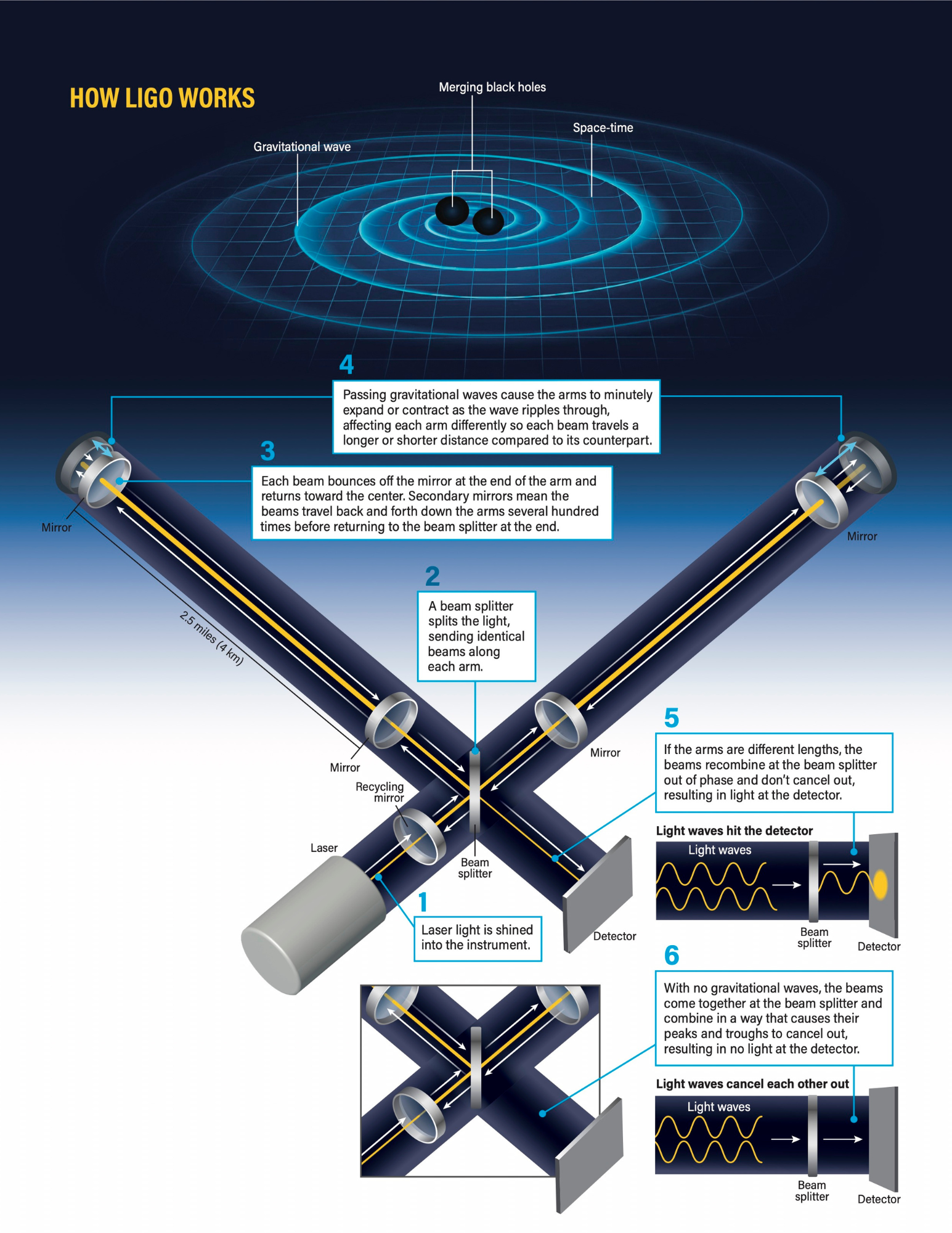
By then, the wave had been diluted so much that it was barely detectable. The Laser Interferometer Gravitational-wave Observatory (LIGO) detector in Livingston, Louisiana, registered it first: a small chirp as the distortion passed. Seven milliseconds later, the ripple reached the other LIGO detector in Hanford, Washington, which picked it up as well.
The tiny signal, now dubbed GW150914 for its detection on the 14th day of the ninth month of the year 2015, lasted just a fraction of a second. But it had a gargantuan impact on science. The discovery opened up an entirely new branch of astronomy. Now, while other telescopes look at space, gravitational-wave observatories listen to it, too.
In the decade since the original detection, gravitational-wave astronomy has blossomed into a precision tool for studying black holes, neutron stars, stellar evolution, and the universe’s expansion. As detections surge, astronomers are shifting from trying to make sense of scattered signals to using them for full-fledged cosmic demographics. And the next generation of detectors may be so sensitive that they’ll hear echoes from the dawn of the cosmos itself.
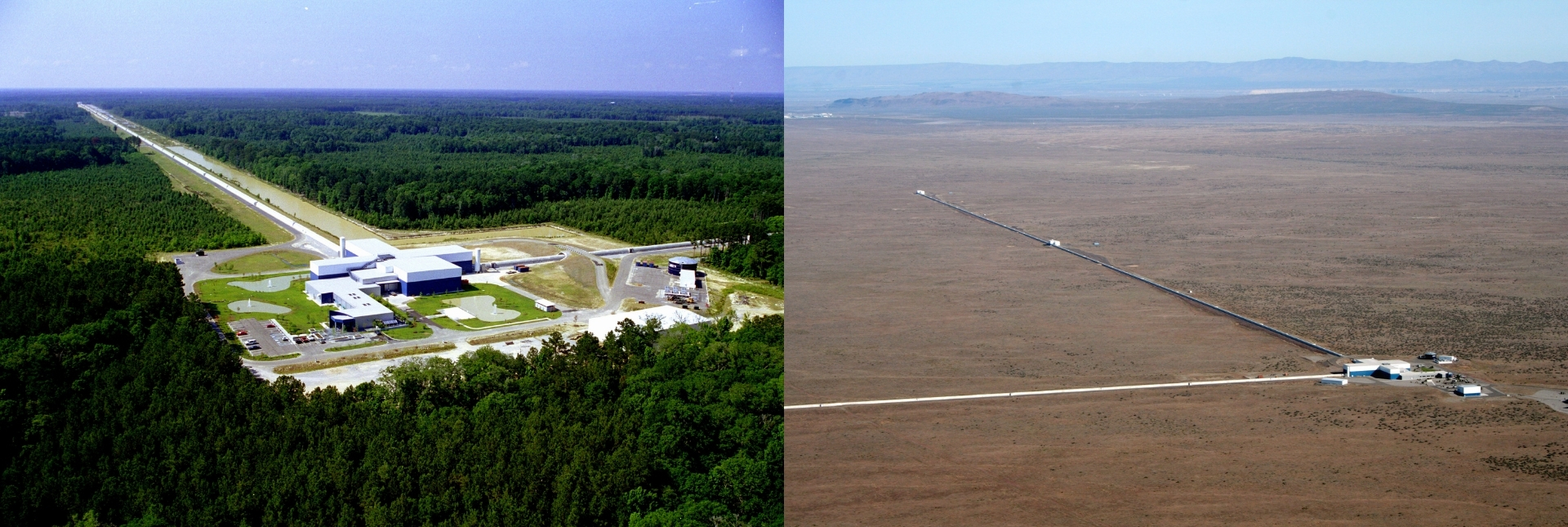
(4 km) long, positioned perpendicular to each other. Two detectors are vital to both ensure detections are real (they must be seen by both interferometers and the signal must be confirmed to travel at the speed of light), as well as to determine its origin on the sky. Credit: Caltech/MIT/LIGO Lab (2)
A new era
Scientists had been anticipating the first gravitational-wave signal ever since Albert Einstein predicted their existence a century earlier.
In 1905, Einstein introduced the concept of the fabric of space-time, showing mathematically that space and time aren’t separate parameters of the universe but instead are interwoven. In 1915, he added gravity to the mix, explaining that it’s a result of the way space-time curves in the presence of mass.
The latter theory, called general relativity, predicted that massive accelerating objects, such as two heavy objects in a tight binary orbit, would create ripples in space-time — gravitational waves — that travel outward across the cosmos. When LIGO registered its first gravitational-wave detection 100 years later, evidence supporting the theory of general relativity was already well established. But the detection meant it passed the test in the most extreme regime ever observed, further cementing our belief that the theory accurately describes gravity.
After decades of planning and anticipation, scientists were stunned by how quickly the facility made its debut detection: LIGO had begun its first observing run just two days prior to the discovery.
“Nobody was really expecting a detection right away,” says Laura Cadonati, a physics professor at the Georgia Institute of Technology who’s been involved in the LIGO Scientific Collaboration since 2002. “It was such a perfect signal and so unexpected, we were all in disbelief.”
Many of the team members initially assumed it was a blind injection — a fake signal one of them had put into the data to test whether they’d be able to find it. “For a couple of weeks we were all calling each other: ‘Do you think it’s real? Do you think it’s real?’ ” Cadonati says. “There was almost like a forensic investigation into the detector. When we finally convinced each other it was real, we all cried. Here was this beautiful signal that was so perfect — direct proof that gravitational waves exist!”
Emanuele Berti, a theoretical physicist at Johns Hopkins University who specializes in gravitational physics and gravitational-wave astronomy, recalls in comments submitted to the Portuguese Physical Society’s Gazeta de Física: “My son was two years old at the time and my daughter was born in December 2015, so I had many sleepless nights in those days. On Jan. 20, 2016, I did not sleep for a different reason.” That day, he learned about the gravitational-wave detection. “My jaw dropped when I saw the now-famous plot of the measured signal in the Hanford and Livingston detectors, and I almost missed my daycare pickup,” he says. “The way in which we observe the universe changed forever.”
LIGO detected three confirmed signals during its first observing run, which lasted just over four months and ended Jan. 19, 2016. All three were created by mergers of black holes.
Then, near the end of the second observing run, which ran from Nov. 30, 2016, to Aug. 25, 2017, LIGO flagged a signal from a very different type of event: a neutron star merger. A newer gravitational-wave observatory in Italy called Virgo detected it as well.
Like black holes, neutron stars are formed in the supernovae that occur when massive stars die. These city-sized spheres pack in more mass than the Sun, squeezing matter far more tightly than we can in labs on Earth. When two black holes collide, they simply meld together; their unyielding gravity keeps the process very tidy. But when neutron stars collide, they can eject hot debris that produces a cosmic light show detectable from Earth if the fireworks are aimed in our direction.
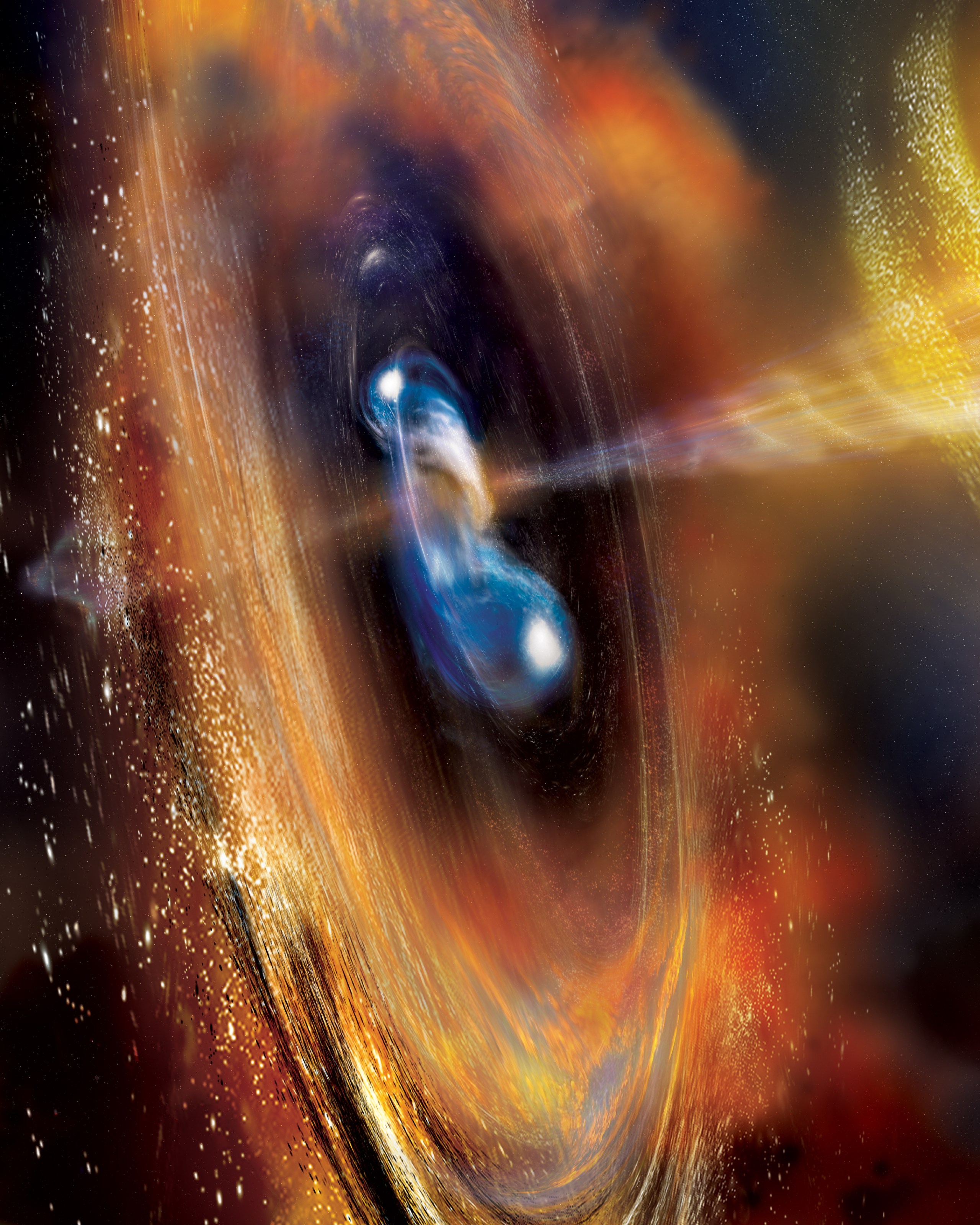
Just 1.7 seconds after LIGO and Virgo detected the neutron star merger, NASA’s Fermi space telescope detected a short burst of gamma rays. Within hours, LIGO and Virgo had narrowed down the possible location of the event and issued a sky map. Optical telescopes then identified a new point of light in the galaxy NGC 4993: a kilonova, the burst of light and radiation following the smash-up of two neutron stars. The first such event ever detected, its spectrum showed signatures of a batch of freshly formed heavy elements from a category including gold and platinum, whose cosmic origins were previously uncertain.
RELATED: Astronomers may have detected a first-of-its-kind superkilonova
In the following days and weeks, X-ray, ultraviolet, infrared, and radio telescopes watched the fading afterglow. For years, radio observatories continued monitoring a jet of material streaking away from the collision at more than 97% the speed of light as it plowed into surrounding material.
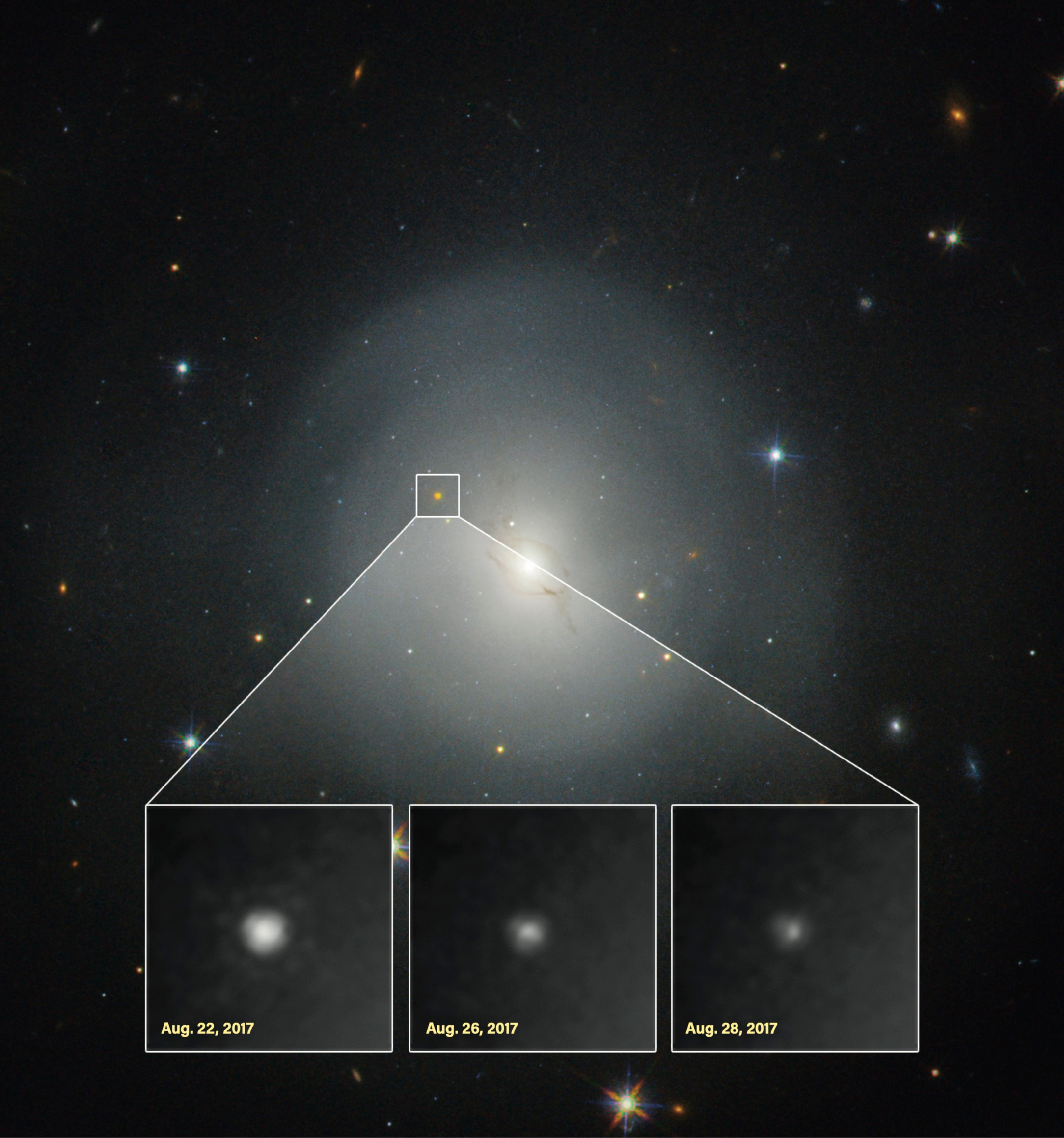
Called GW170817, this was the first full-fledged multimessenger gravitational-wave event, detected in both light and gravitational waves. Thanks to the discovery, scientists confirmed that neutron star mergers produce gamma-ray bursts and heavy elements, and tested existing kilonova models (which passed, since the observation matched what they expected to see). It even offered hints about the ultradense cores of neutron stars, where matter is packed more tightly than in the nucleus of an atom. Without LIGO’s gravitational-wave detection, none of that would have been possible — we probably wouldn’t have been able to identify the event as a neutron star merger in the first place.
Black hole bombshells
There’s been no single equally rich multi-messenger gravitational-wave event since then, but there has been an explosion in detections. LIGO and Virgo have been upgraded, and Japan’s Kamioka gravitational-wave detector (KAGRA for short) came online in 2020. Together, the three have registered hundreds of detections: more neutron star mergers, black hole binaries, and even mixed black hole-neutron star collisions.
Now, instead of being limited to analyzing single gravitational-wave events, astronomers can zoom out and see them in context. Studying entire populations of mergers has revealed a few surprises.
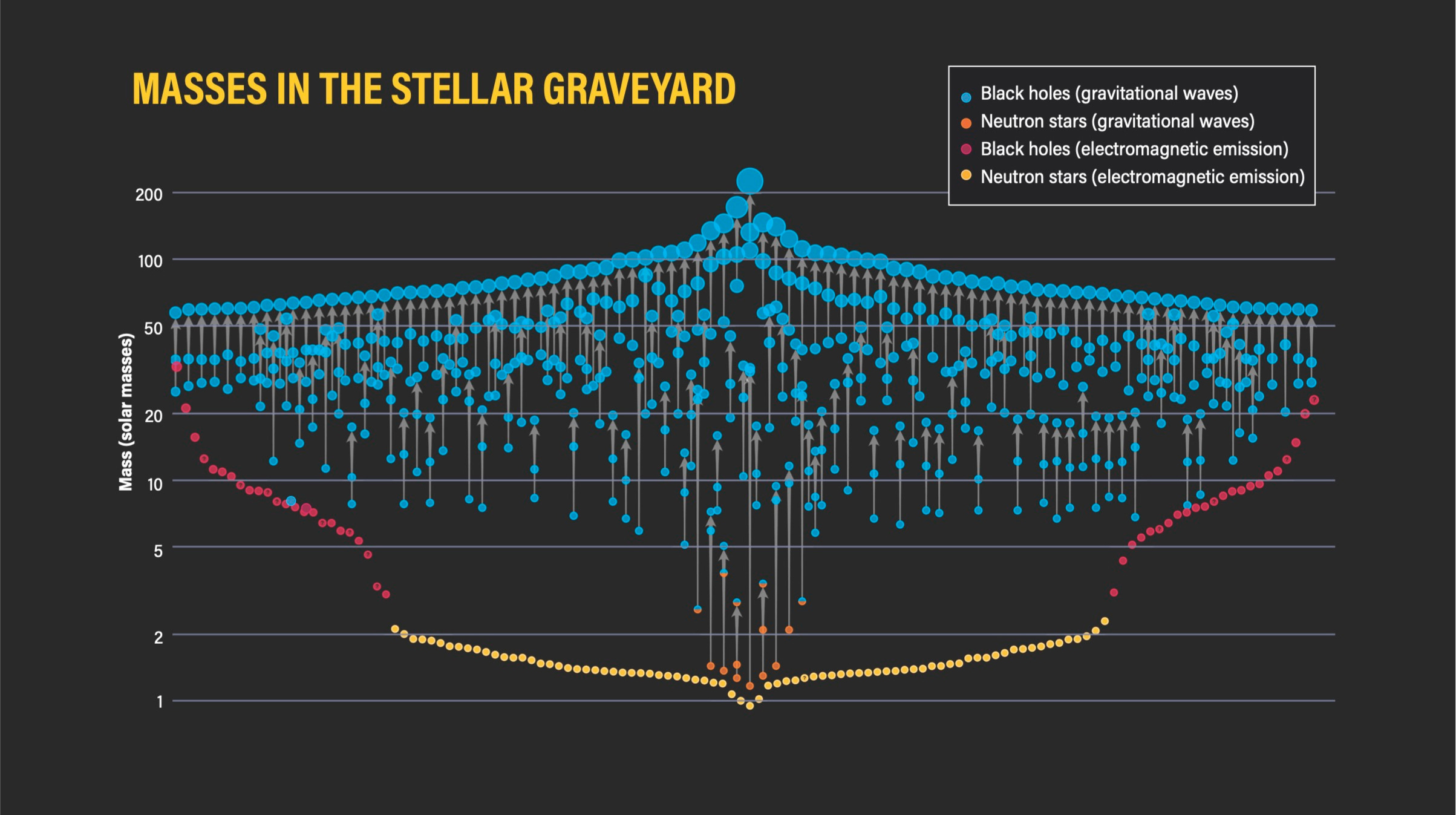
First, black holes come in a much wider variety than anticipated. Astronomers expected merging black holes to look like the ones we’d already found in our galaxy: mostly around five to 15 times the Sun’s mass per black hole. Instead, mergers often involve black holes that were much heavier, coming in at 20, 30, or even 50 solar masses.
What’s more, there seems to be a certain pattern among these heavyweights. “We’re seeing hints of overdensities at particular mass ranges, especially near 35 solar masses,” Cadonati says. “But we need more data to be sure.” That overabundance may hint that something about how massive stars live and die, or how they pair up and merge, favors producing remnants of this size.
Astronomers are even finding black holes in mass ranges that once appeared to be bereft of them. Based on electromagnetic (light-based) observations alone, neutron stars seemed to top out around 2 solar masses, while black holes appeared to start popping up around 5 solar masses. Astronomers interpreted this observational gap as a natural consequence of the physics that occur as a star’s core collapses and subsequently explodes to form one or the other of these remnants. But in 2023, gravitational waves revealed an object within that range, forcing astronomers to consider whether this gap truly exists or other methods just aren’t good at finding objects within it.
Stellar evolution models predict another gap, with no black holes between about 50 and 120 solar masses. Astronomers thought that any star with enough mass to yield such a hefty black hole would undergo a type of supernova that would instead obliterate the star, leaving no black hole behind. Beyond 120 solar masses, scientists think a star may skip the supernova altogether and collapse directly into a black hole.
But gravitational waves have shown that this gap is populated too, if sparsely. Some scientists think the so-called forbidden black holes in this upper mass gap may have formed through multiple rounds of mergers, rather than direct collapse of a single star, which would leave current models intact.
To learn the answers, gravitational-wave astronomers are keen to probe these gaps further and push to earlier cosmic eras — before repeated mergers would have had a chance to build black holes between 50 and 120 solar masses — where detections have been much thinner.
Cosmic oddballs
Space-time ripples are also cluing astronomers in about some of the weirdest objects in the universe: neutron stars. Gravitational waves have delivered exciting new data about the extreme nuclear physics going on inside these stellar remnants.
One thing scientists have long been eager to learn is how matter behaves when it’s crushed to enormous densities — how pressure, density, and size all interplay. When two neutron stars spiral together, their intense gravity stretches and squeezes each other. That leaves tiny fingerprints in the gravitational-wave signal, allowing scientists to infer how squishy or rigid the stars are inside.
And when two neutron stars collide, the resulting object may wobble a bit before collapsing to form a black hole. Those vibrations create characteristic frequencies that are tied directly to the stars’ internal properties.
In systems where a neutron star merges with a black hole, the black hole may rip the neutron star apart before swallowing it. Whether (and how violently) that happens also depends on the neutron star’s internal structure, giving further clues about what’s going on deep within them.
So far, gravitational waves have shown that neutron stars aren’t all identical — they have a range of sizes and squishiness, meaning their internal pressures vary. That squishiness matters because it encodes how ultradense matter responds to pressure, letting astronomers test competing ideas about the exotic physics inside neutron stars. Since their interiors deform a little under each other’s gravity during a merger, astronomers have been able to place limits on how rigid they can be. Neutron stars also apparently have a size limit based on their stiffness: For a typical neutron star about 1.4 times the Sun’s mass, this translates to a radius of roughly 14 to 17 miles (22.5 to 27 kilometers).
What’s in a wave?
Gravitational-wave observatories measure almost imperceptible distortions in space-time, yet reveal detailed data about cataclysmic events from far across the cosmos. How is that possible? All the clues are encoded in each little wiggle.
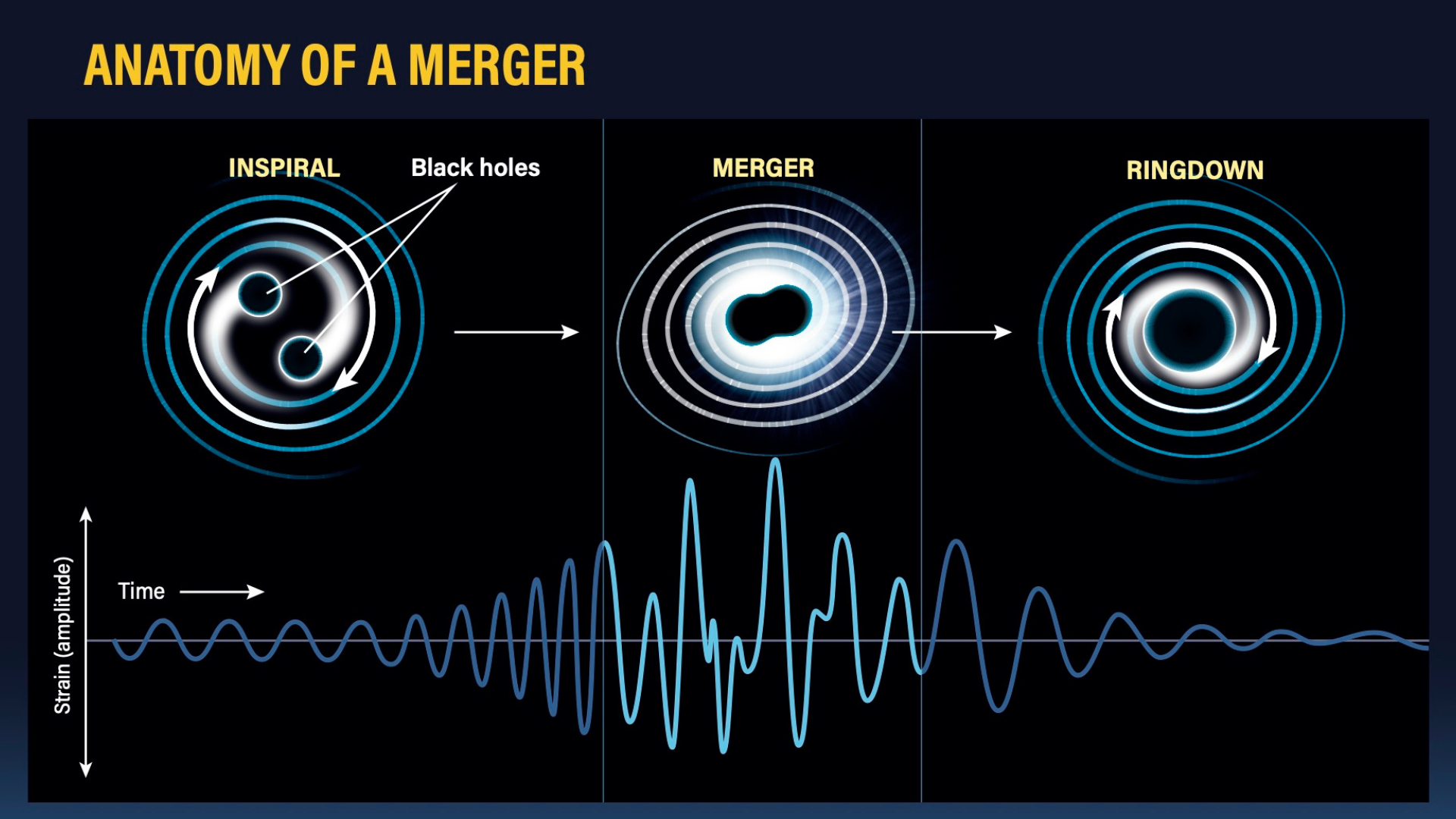
Pitch → Mass: Astronomers learn the masses of the objects involved from how quickly the wave oscillates (its frequency) and how suddenly the oscillation begins. The frequency and duration also reveal the types of objects involved: whether they’re black holes, neutron stars, or a mixed pair. The more massive the objects, the lower-pitched and shorter the signal — it’s a quicker process because the bodies draw together with far greater force. Since lighter objects aren’t pulled together as strongly, it takes longer for them to merge and the waves they produce last longer and reach higher frequencies. And if one object is heavier than the other, that makes the wave more complex.
Volume → Distance: Given the objects’ masses, astronomers can calculate how strong the waves would be at the source. Comparing that to the wave’s amplitude when it arrives at the detectors shows how much they’ve diminished from their original strength, so it’s easy to tell how far away the event was — it’s inversely proportional to the amplitude of the wave.
Wobbles → Spin: If the objects are spinning or their spins are tilted, that creates subtle wobbles and distortions that modify the wave’s shape in a predictable way.
Timing → Location: With at least three detectors, astronomers can also triangulate the source’s location based on the timing of the wave’s arrival at different locations around the world.
The more sensitive the detectors, the more information astronomers can glean from each signal. So far, these rich datasets have largely supported fundamental physics and general relativity, but they’ve revealed a few surprises too (like heavier black holes and a much wider variety of black hole systems than expected). Next-gen detectors may pick up signals from much farther across the cosmos with enough detail to uncover new phenomena or bring hidden physics to light. — A.B.V.
Stress-testing Einstein
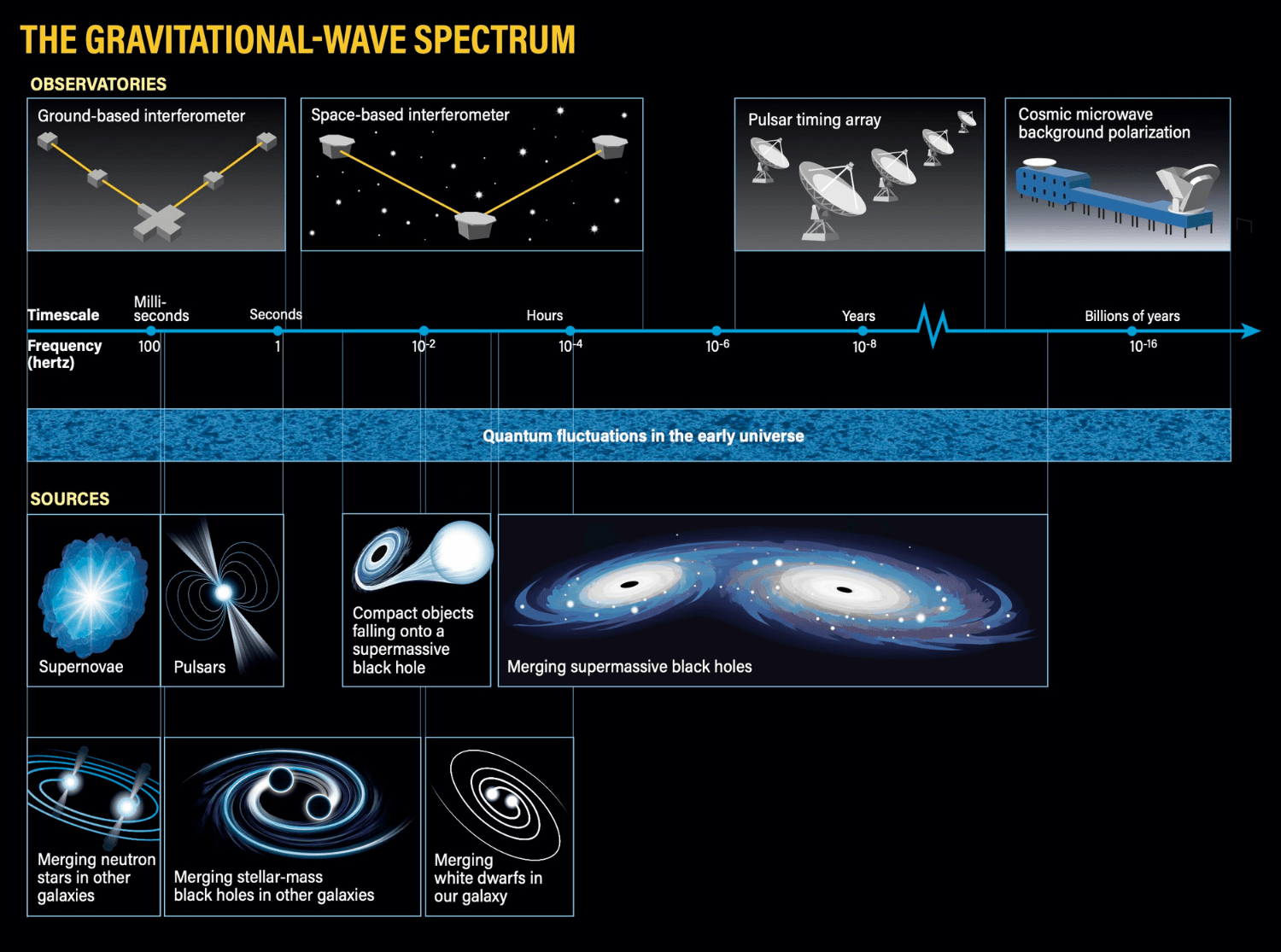
In the mid-2000s, as researchers and engineers were building the instruments that led to LIGO’s 2015 detection, another international collaboration was beginning its own hunt for gravitational waves — but with an entirely different approach. If observatories like LIGO were looking for tsunamis caused by individual events, the North American Nanohertz Observatory for Gravitational Waves (NANOGrav) project was looking for the sea of background waves from countless mergers across cosmic time, blended swells of energy gently and continuously washing over our planet.
To do so, they spent 15 years observing millisecond pulsars — a type of neutron star that spins ultrafast and sends a beam of light sweeping over Earth with each turn. These pulsars throb so regularly that scientists can detect a shift in the arrival time of their pulses as passing gravitational waves stretch or squeeze space between Earth and the pulsar, causing blips to arrive ater or earlier, respectively. Together, they’re like a galaxy-sized detector.
After comparing the timing data from dozens of pulsars, a clear statistical pattern emerged, meaning the researchers probably weren’t just seeing random timing glitches. Pulsars in certain directions speed up or slow down together, while others shift in opposite ways. This pattern of correlations across the whole sky is exactly what Einstein’s relativity predicts for gravitational waves.
In 2023, the NANOGrav collaboration announced that they’d detected this “background hum” of gravitational waves. The result showed that space-time is stretching and squeezing with a faint rhythmic thrum that may have been originally generated billions of years ago by smashing supermassive black holes — the monstrous black holes found at the centers of galaxies. Because such pairs take millions of years to merge, numerous mergers in progress across the cosmos continually generate gravitational waves, which make up the detected background hum.
While the discovery wasn’t entirely unexpected, it’s still very exciting. “I think the real significance is the promise that this discovery holds for learning about the merger history of the universe, and possibly other exotic physics sources, in completely new ways,” says Maura McLaughlin, a professor of physics and astronomy at West Virginia University and co-director of the NANOGrav Physics Frontiers Center. “I hope NANOGrav is remembered for its robust scientific work and leading role in opening a new window in the gravitational-wave spectrum.”
Gravitational waves are also delivering hints about the universe’s underlying physics, including the possible existence of a particle called the graviton. General relativity says that gravity is a result of the curvature of space-time. But physicists trying to merge gravity with quantum mechanics — a notoriously tricky problem, since the two appear to violate one another — have proposed that gravity could be carried by particles called gravitons, tiny messengers that would act a bit like photons do for light.
“We’re placing increasingly tight constraints on the mass of the graviton, if it has one at all,” Cadonati says. “Gravitational waves have shown that if the graviton exists, it must be extremely light or essentially massless, since the waves travel across billions of light-years without noticeable slowing or distortion.” With any significant heft, their arrival wouldn’t coincide with light from the same events, and it would create detectable distortions in the waveform. That puts some guardrails up for competing gravity theories.
So far, gravitational-wave detections support general relativity. Pressing to greater distances and earlier eras with next-gen observatories could reveal whether gravity has behaved the same way across cosmic history.
New cosmic earbuds
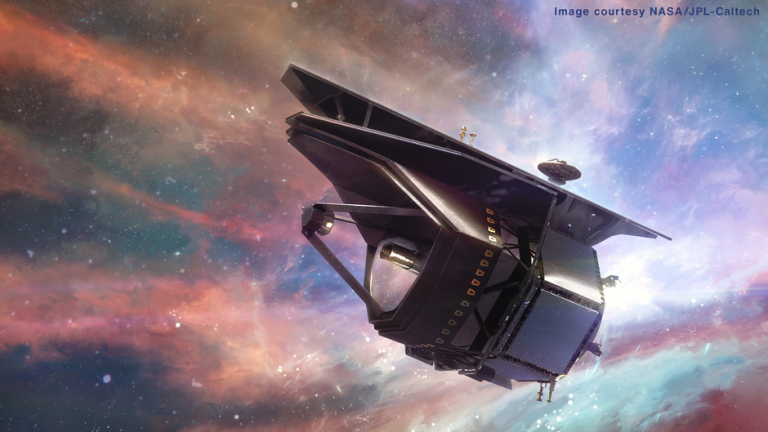
Upcoming detectors could revolutionize the field. The European Space Agency (ESA) will put a gravitational-wave detector in space for the first time. Called the Laser Interferometer Space Antenna (LISA) and planned for launch in 2035, this mission is expected to detect more than 10,000 gravitational-wave events.
That includes many with lower frequencies than are detectable from Earth, which means LISA will pick up signals from smaller events as well as those that take place much farther away — perhaps including gravitational waves from shortly after the Big Bang. LISA will be sensitive enough to hear echoes from white dwarfs (the remnants of lower-mass, Sun-like stars) smashing together and may even pick out individual supermassive black hole pairs inspiraling to create the overall gravitational-wave background.
It could also act as an early warning system, particularly for supermassive black hole mergers. “LISA could detect the low-frequency inspiral years before the merger happens and alert ground-based detectors to tune in,” Cadonati says.
Among those following up will be the U.S.-based Cosmic Explorer gravitational-wave observatory, which is currently in the design and planning phase. It will operate at much higher frequencies than LISA, targeting fast mergers of stellar-mass objects like neutron stars and black holes, rather than the slow, massive systems and background early-universe signals LISA will detect.
Once Cosmic Explorer begins operations in the 2030s or 2040s, it will be able to detect neutron star mergers happening anywhere in the cosmos they can exist, back to when the first stars were forming. And it could find black hole mergers even earlier in the universe, if they occur.
In particular, detecting mergers of primordial black holes, thought to have formed shortly after the Big Bang, would reveal a completely new population of objects that could explain some or even all of the universe’s dark matter. LISA and Cosmic Explorer could find such signals in different frequency ranges from different stages of the merger process. Astronomers could use these next-gen observatories to test theories of cosmic inflation, too, by looking for gravitational waves produced during this time, as tiny fluctuations in the universe’s properties quickly grew.
Altogether, the next generation of detectors will take us from hundreds to millions of gravitational-wave detections. Studying them could help astronomers trace black hole evolution, resolve inconsistencies in current measurements of the universe’s expansion rate, and reveal echoes from the early universe. As gravitational-wave astronomy is coming of age, the brightest discoveries still lie ahead.
Ashley Balzer Vigil is a NASA science writer and freelancer with master’s degrees in space studies and science writing.