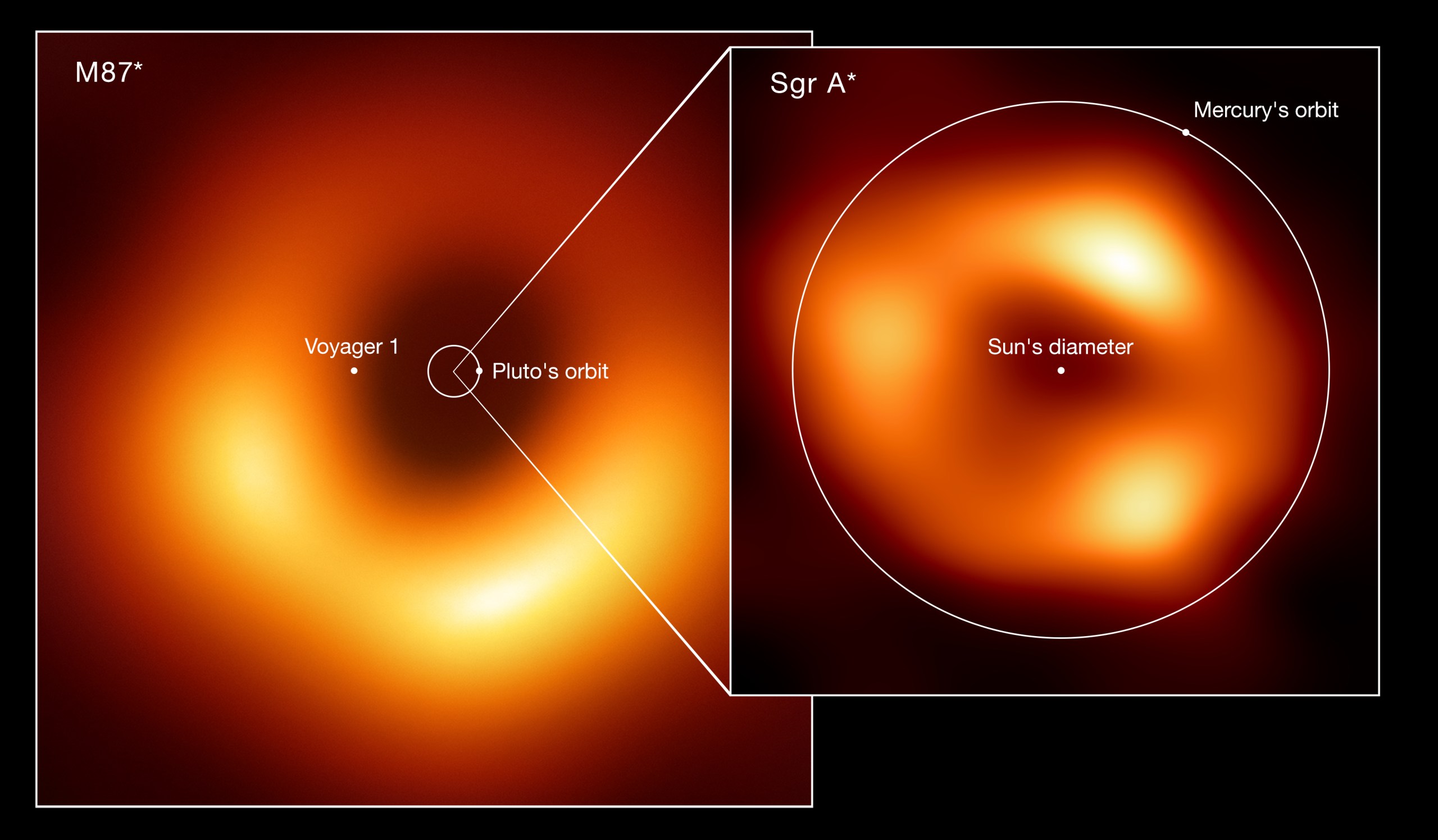
When a supermassive black hole is measured as 1 billion solar masses, what would be its actual physical size relative to the size of our Sun?
Joseph De Benedetto
Oxford, New Jersey
The size of a black hole is generally taken to be the size of its event horizon. The event horizon is a mathematical boundary around the black hole that marks the “point of no return” — anything that crosses this boundary is trapped inside and becomes part of the black hole forever.
The size of the event horizon can be calculated from Einstein’s field equations, and it depends on (1) the mass of the black hole, and (2) how fast the black hole is spinning. For a nonspinning black hole that has the same mass as our Sun, the radius of the event horizon (also called the Schwarzschild radius) would be about 1.8 miles (3 kilometers). A nonspinning supermassive black hole that is a billion times more massive than our Sun would have an event horizon radius that is a billion times larger, or 1.8 billion miles (3 billion km). This is 4,300 times larger than the radius of the Sun, or about the typical distance between the Sun and Uranus. However, if a billion-solar-mass black hole is spinning very rapidly, then the radius of the event horizon would shrink by about 30% (to around 1.3 billion miles or 2 billion km) because of the way the black hole distorts and drags space around it.
It is important to note, however, that while the event horizon is considered the outer boundary of the black hole, the mass inside the black hole has likely collapsed into a much smaller size under its own self-gravity, often referred to as a singularity. But we don’t actually know if the mass has collapsed into an infinitely small point in space, and, unfortunately, we can’t really say more than that because our understanding of physics breaks down under the extreme conditions that are present inside a black hole. So we use the event horizon as a convenient reference for the black hole’s size, because everything inside the event horizon is part of the black hole.
Misty Bentz
Professor of Physics and Astronomy, Georgia State University, Atlanta