Credit: ESO/T. Schirmer/T. Khouri/ALMA (ESO/NAOJ/NRAO)
Starlight and stardust are not enough to drive the powerful winds of giant stars, transporting the building blocks of life through our galaxy. That’s the conclusion of a new study published in Astronomy & Astrophysics. The team, from Chalmers University of Technology, Sweden, focused on the star R Doradus. Its result overturns a long-held idea about how the atoms needed for life spread.
“We thought we had a good idea of how the process worked. It turns out we were wrong. For us as scientists, that’s the most exciting result”, says Theo Khouri, astronomer at Chalmers and joint leader of the study.
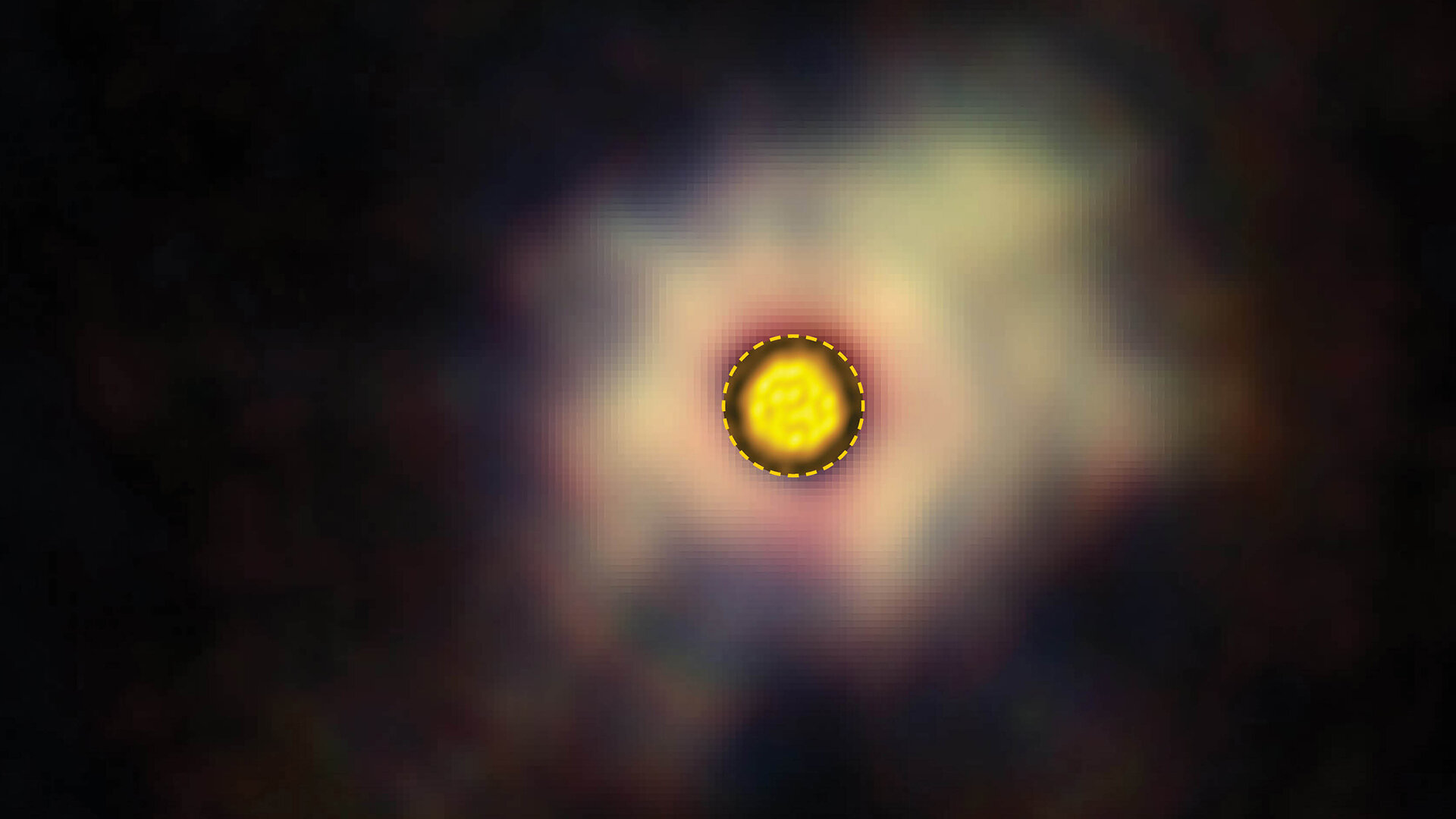
R Doradus is a red giant star located 180 light-years away in the far-southern constellation Dorado the Swordfish. Once similar to the Sun, it’s now nearing the end of its life. R Doradus is an example of a star that loses its outer layers to space via dense stellar winds that transport gas and dust. This star loses the equivalent of a third of Earth’s mass every decade. Similar stars can lose mass hundreds or thousands of times faster. Several billion years from now, astronomers expect the Sun to become a star like R Doradus.
Dust in the wind
To understand the origins of life on Earth, astronomers must understand what powers the winds of giant stars. For decades, scientists believed that winds from red giant stars — which seed the galaxy with metals (elements other than hydrogen or helium) — are powered when starlight pushes against grains of newly formed dust. The new observations of R Doradus challenge this picture. Astronomers found that the tiny grains of stardust surrounding the star are too small to be pushed outward by starlight strongly enough to escape the star’s gravity.
“Using the world’s best telescopes, we can now make detailed observations of the closest giant stars. R Doradus is a favourite target of ours — it’s bright, nearby, and typical of the most common type of red giant,” says Theo Khouri.
The team observed R Doradus using the Sphere instrument on ESO’s Very Large Telescope, measuring light reflected by dust grains in a region roughly the size of our solar system. By analyzing polarized light at different wavelengths, the researchers determined the size and composition of the grains, finding them consistent with common forms of stardust such as silicates and alumina.
The observations were then combined with advanced computer simulations that model how starlight interacts with dust.
“For the first time, we were able to carry out stringent tests of whether these dust grains can feel a strong enough push from the star’s light,” says Thiébaut Schirmer.
The team found that the push of starlight is not enough. The grains surrounding R Doradus are typically only about one ten-thousandth of a millimeter across — far too small for starlight alone to drive the star’s wind into space.
“Dust is definitely present, and it is illuminated by the star,” says Schirmer. “But it simply doesn’t provide enough force to explain what we see.”
“Even though the simplest explanation doesn’t work, there are exciting alternatives to explore,” says Wouter Vlemmings, professor at Chalmers and co-author of the study. “Giant convective bubbles, stellar pulsations, or dramatic episodes of dust formation could all help explain how these winds are launched.”