How does a black hole generate a magnetic field and how can it be measured and visualized?
Alan Croft
Seattle, Washington
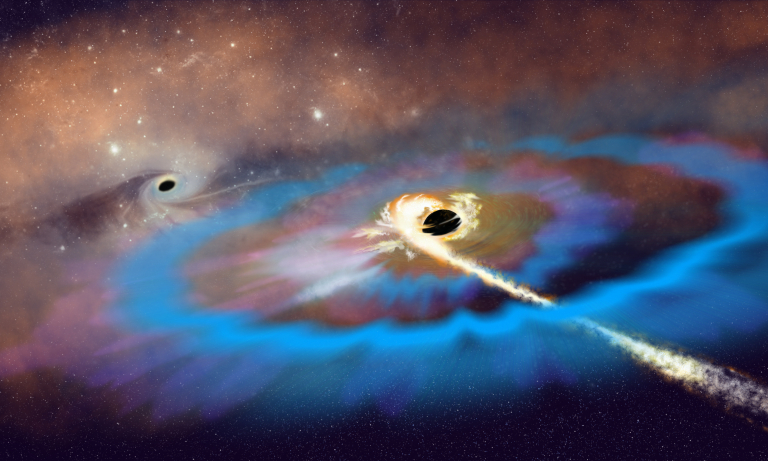
As black holes feed, they pull material into a disk around them. The material orbiting in this disk gets heated to extreme temperatures, and so it becomes a plasma — a state of matter in which some of the electrons are separated from their atoms. This creates ions, or atoms that become charged because the number of electrons and protons are no longer the same. So, there are both positively charged ions and negatively charged electrons in this plasma. As these charged particles move, they generate electric currents, which naturally lead to magnetic fields forming.
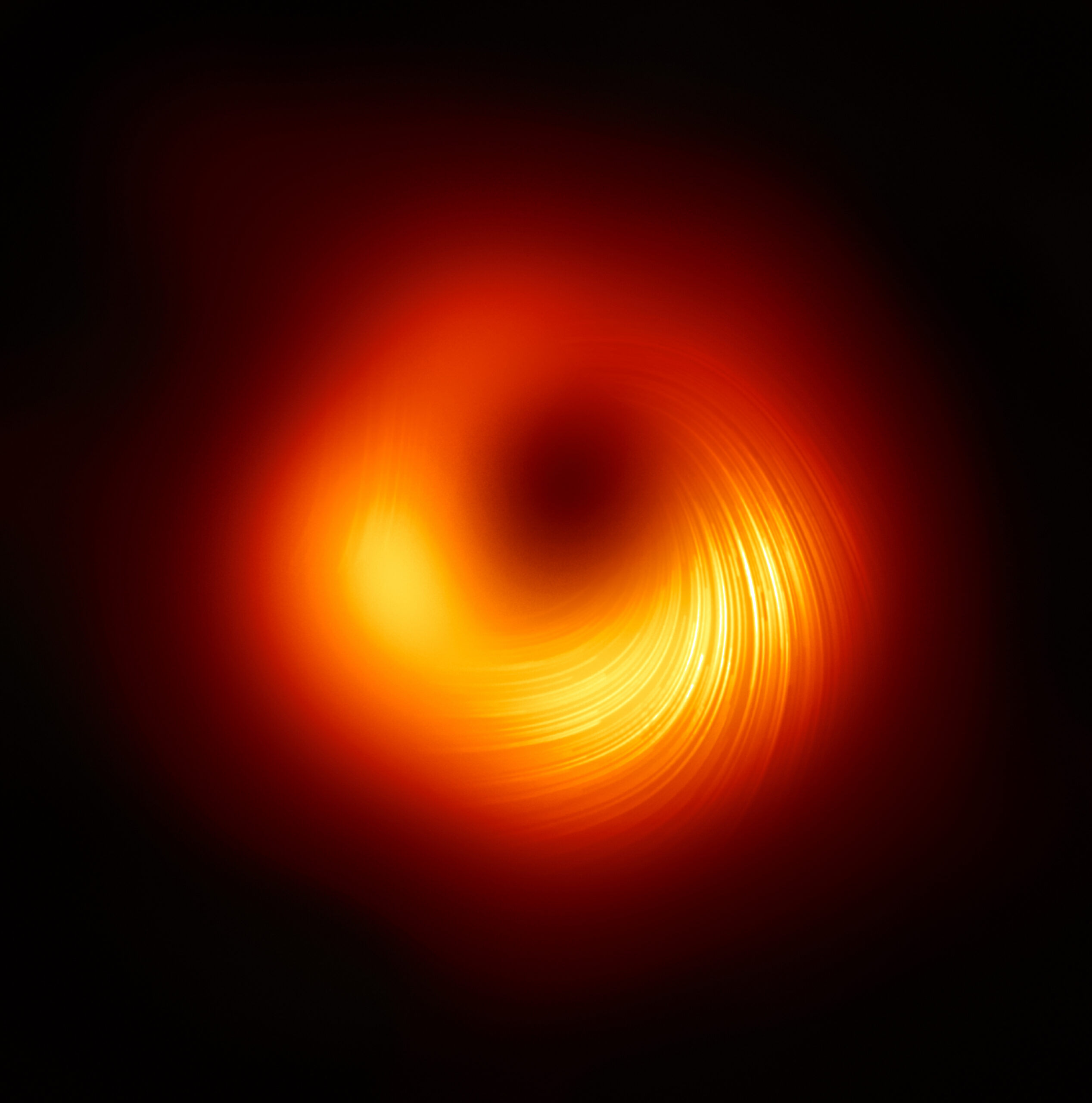
Electrons gyrating around magnetic field lines produce a type of emission at radio frequencies called synchrotron radiation, which we observe with the Event Horizon Telescope (EHT). Synchrotron radiation is inherently polarized: the radio waves oscillate in a specific direction prescribed by the geometry of the magnetic field line around which the electron was moving when it emitted this radiation. By imaging polarized light from hot glowing gas near black holes, we are directly inferring the structure and strength of the magnetic fields that thread the flow of gas and matter that the black hole feeds on and ejects.
So, polarized light teaches us about the astrophysics, the properties of the gas, and the mechanisms that take place as a black hole feeds! There is a lot of evidence that magnetic fields play a fundamental role in how a black hole feeds and ejects powerful jets of plasma. The process that launches these jets is the most energetic mechanism in the universe, and dramatically affects how galaxies grow, merge, and evolve. It is so striking that such large-scale damage can be caused by such a small object in the center of a galaxy, and it all starts in the plasma at the edge of the black hole, where these magnetic fields rule.
With the EHT, we have imaged the polarization structure around both the M87* and Sagittarius A* (Sgr A*) black holes. M87* and Sgr A* are very different black holes. M87* is quite a special black hole: It weighs in at 6 billion solar masses, it lives in a giant elliptical galaxy, and it ejects a powerful jet of plasma visible at all wavelengths. Sgr A*, on the other hand, is a more run-of-the-mill black hole: It is 4 million solar masses, it lives in our ordinary spiral Milky Way Galaxy, and it doesn’t seem to have a jet at all. Yet, when we first imaged all the light coming from these black holes, the images looked strikingly similar. The dominating feature was the gravitational lensing of the light around the black hole shadow.
Essentially, the black hole’s gravity is so immense that it bends the light of the portion of the accretion disk that is behind it around itself so that we can see behind the black hole. Looking at all the light from these two black holes, they were essentially the same. Looking at the portion of the light that is polarized, we expected to learn their magnetic fields have different properties — perhaps one is more ordered and strong, one is more disordered and weak. However, because they also look similar in polarized light, it is now quite clear that these two different classes of black holes have very similar magnetic field geometry.
With the two polarized images of very different black holes, we now have compelling evidence that strong magnetic fields are ubiquitous. The next step now involves connecting that geometry to how these systems move, evolve, and flare. New projects like the next-generation EHT (ngEHT) and the Black Hole Explorer (BHEX) will open up new areas of study of black holes that will help unravel the mysteries of how black holes feed. The ngEHT plans to add more telescopes on Earth to fill in our Earth-sized virtual mirror and observe a lot more often. With these expansions of the EHT, we will be able to make polarized movies of black holes. We will directly observe the dynamics between M87* and its jet. BHEX, on the other hand, aims to add a telescope in space to dramatically increase the resolution of the EHT. With this pioneering effort, we will be able to observe the sharp photon ring at the edge of the event horizon’s shadow in images of black holes. This photon ring, which is created as light from the accretion disk orbits the black hole many times before finally escaping, encodes properties of the spacetime around the black hole and can tell us a black hole’s spin. How much black holes rotate (their spin) is believed to be directly connected to why magnetic fields near the black hole look the way they look and how they can launch jets. (See December 2025’s Ask Astro for further explanation of jets.)
Sara Issaoun
NASA Einstein Fellow, Harvard & Smithsonian Center for Astrophysics, Cambridge, Massachusetts