What would you do if you woke up on a spaceship light-years from Earth without knowing why you’re there?
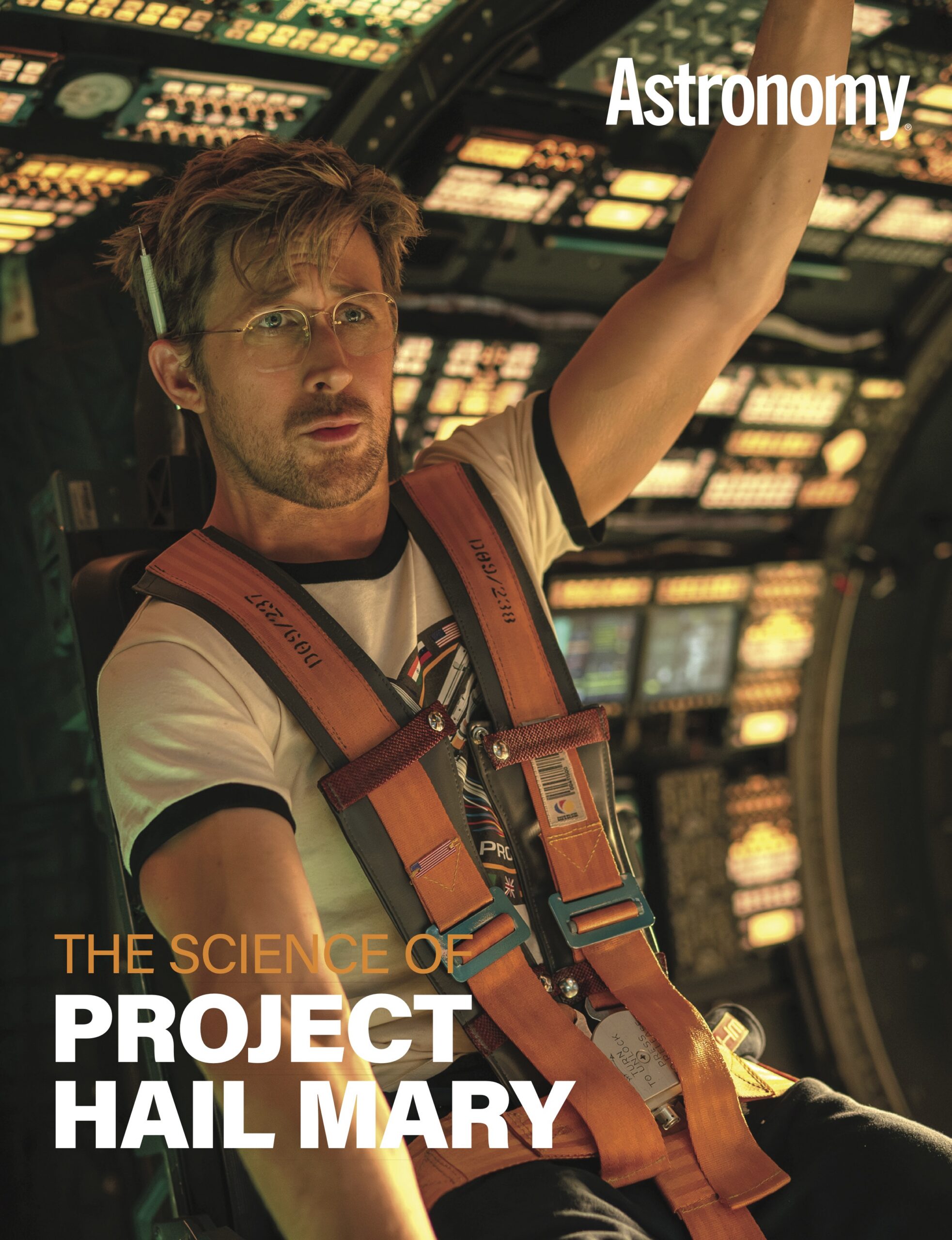
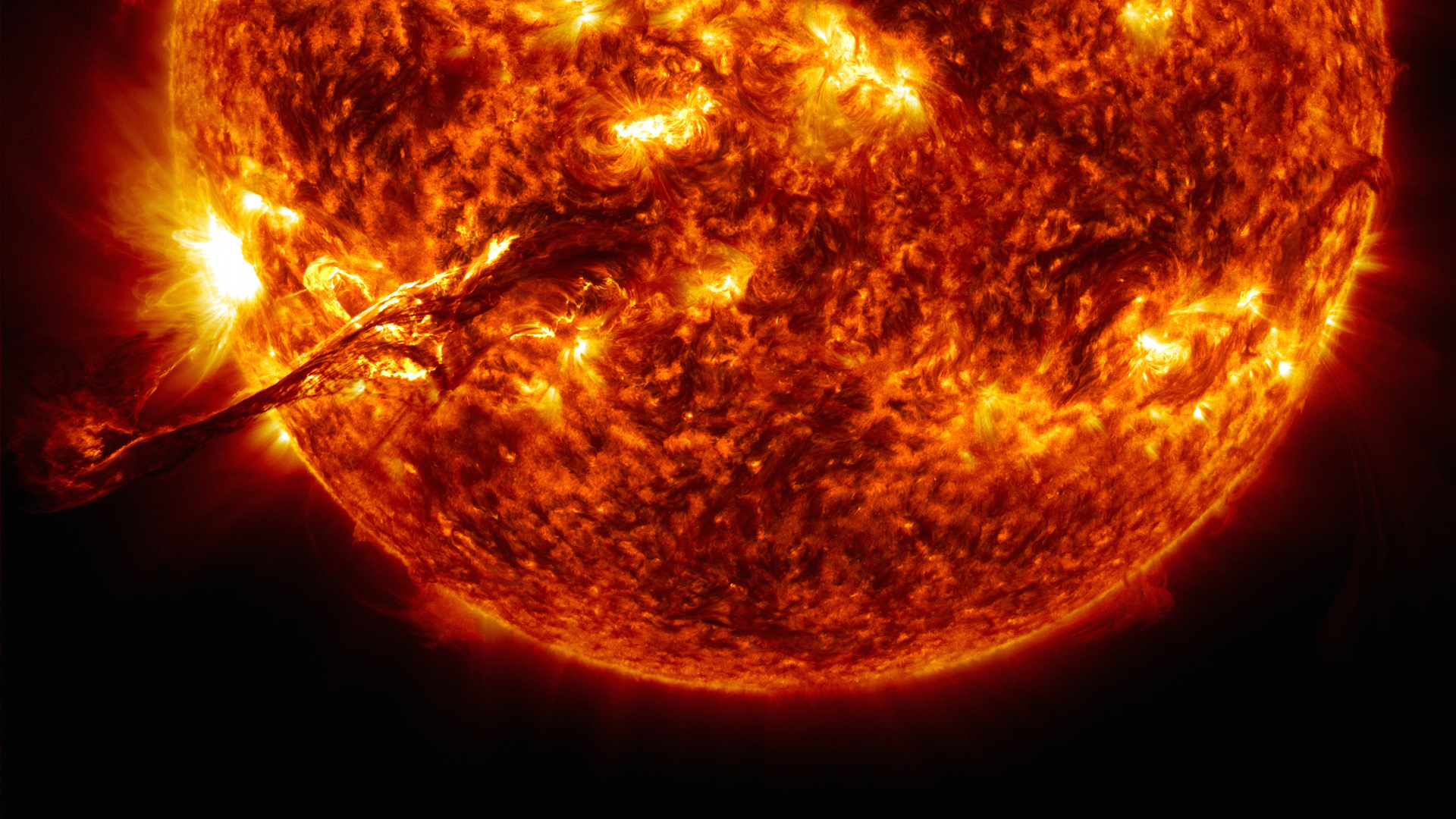
Based on the New York Times bestselling novel by Andy Weir, who also penned The Martian, Amazon MGM Studios’ Project Hail Mary follows science teacher Ryland Grace (Ryan Gosling) as he slowly recalls his mission: to solve the problem of Astrophage, an extraterrestrial life-form consuming the Sun’s energy and sending Earth hurtling toward an ice age. He’s on his way to Tau Ceti, the only nearby star not dimming, to discover why it seems immune. But he won’t have to uncover the answer alone — along the way he meets Rocky, an alien whose sun, 40 Eridani, is suffering from Astrophage as well.
Project Hail Mary opens in theaters March 20. Ahead of the film’s release, Astronomy spoke with Weir about several aspects of the project, from his inspiration for the story to the process of bringing a book to the big screen.
The following interview has been edited for length and clarity. It also contains spoilers for the film.

Astronomy: Could you talk about your inspiration for the story?
Weir: It’s actually several different ideas that I’ve had over the years that I kind of glued together and sanded off the seams. I have, for a long time, wanted a story about first contact. I had this random idea for a story about a guy who wakes up aboard a spaceship with amnesia. And then also, the idea of a mass-conversion-based fuel [a fuel that operates by converting matter into energy].
The mass-conversion-based fuel thing I had included in an abandoned book I was working on called Zhek. Zhek didn’t work, but what if we had that mass-conversion fuel today? We could colonize the solar system — not in some far-flung future, but right now. But how do I explain how we, today, have it? I can’t have a mad scientist invent it. It’s so far beyond our technology. Maybe they could find it in an old, crashed alien spaceship or something. That would be cool, but then you can’t build an infrastructure on it, there’s just the fuel on the ship.
In my original, story, Zhek, black matter absorbed all frequencies of light and then made more black matter out of it. That’s what it was called, black matter. And it was just this technology. And I thought, well, that’s super magical. That’s a little too convenient. Also, if there’s a crashed alien spaceship, then that seems more interesting than a new infrastructural fuel source.
Instead, what if this is a thing that absorbs energy and makes more of itself? That sounds like a life-form. So what if it’s a life-form that can do mass conversion? Well, it would have to live on the surface of stars. And what if it spores out like a mold to get to other stars? That would also explain why it has to do all this mass-conversion stuff, because it needs a lot of energy to go to other stars.
And let’s say that we get ahold of some of this. It’s an extraterrestrial life-form, but it’s just a microbe, so you’re not asking where that civilization is. And then we could get that, and then we breed it up, and we have our space infrastructure, colonizing Mars, and I can do all sorts of cool stuff like that. And then I’m like, oh, we’d have to be really careful to make sure that s— didn’t get onto our Sun. And then I’m like, one Mississippi, two Mississippi… Oh, wait, no, that’s the story. This is how we discovered it, it’s already infected our Sun.
Well, then, what do you do about it? Well, it has to have a homeworld. Wherever it has a homeworld, it probably has a predator. So that would be the one star in the area that isn’t dimming, so they’d probably see that. Then they’d have to make a ship and go there, and they have their mass-conversion fuel so they can. And then oh, that means I can put my amnesia guy in there. And then, hey, I could do first contact! I could have an alien whose species has the same problem. So each thing kind of led to the next. It really worked out very nicely.
Astronomy: Do you come up with problems and then do research to solve them, or does researching present problems and solutions at the same time?
Weir: The latter is what happens most often. A good example is the sequence in The Martian where Watney has to make water for his potatoes. It didn’t even occur to me, except I was researching “How do you make potatoes?” And the moisture content of the soil has to be at least such and such. I did the math and for his farm, he’d need something like 600 liters [about 159 gallons] of water, and there’s just no way they would have brought that much for a Mars mission for six people. So I have to explain where he gets the water, and then that whole plotline came along because of that.
In general I don’t think up a whole bunch of problems. What I like to do is just set things in motion and then see where they lead. The Martian is all one big cascade failure. Project Hail Mary is actually a fairly linear plotline once all the twists are revealed.
Astronomy: The flashback aspect is an interesting storytelling device. What made you decide to use it?
Weir: I’m a huge hypocrite in writing. Among other things, I will tell people: “Never use flashbacks.” And here I am with this whole book full of flashbacks. I hate flashbacks as a consumer, because it’s oftentimes used as a way for an author to cram in some character backstory.
I tried to structure my flashbacks such that you are happy when they happen. I wanted to make sure that sneaking in with the exposition was a revelation of the answers to questions that are on the reader’s mind: “What’s going on? Why is this here?” That’s part of the reason.
The other reason was because if you told the story linearly, all of the characters except for two would disappear after the first act. Once they launch, you’d never see Stratt and the rest ever again, and then you wouldn’t even meet Rocky until the middle of the book. And I wanted Rocky as soon as possible.
Astronomy: Of course in science fiction, we expect fiction. But how realistic does the science need to be for you to be happy with it?
Weir: I’ve got two answers for that. One is as a science-fiction fan, as a reader or a viewer. The other is the way I personally prefer to write.
As a consumer of science fiction, you can violate the rules of physics all you want. You can do whatever you want, as long as you’re consistent. So if you set up some new physics, then I want you to be consistent within the physics. Internal consistency is what I want as a consumer.
As a writer, I want to find the absolute minimum way that I can break the rules and then just do that. In Project Hail Mary, you have to go all the way down to the quantum realm, where the cell membrane of Astrophage has super cross-sectionality, which means neutrinos have a zero percent chance of tunneling through.
Neutrinos routinely just pass clean through the entire planet Earth without colliding with a single atom, right? But for some reason, the cell membrane of Astrophage — which is where it’s turning heat energy into neutrino mass — is also somehow super cross-sectional. Those two things are linked. So, both the method by which it makes neutrinos and the fact that it is super cross-sectional, that’s my little quantum level of bulls— that everything else is based on. [Editor’s note: Astrophage convert heat into neutrinos, which they store and later annihilate to create energy to propel themselves through space to other stars.]
Later on I realized Astrophage would be a perfect radiation shield. Nothing quantum tunnels through it. It doesn’t matter if it’s gamma rays or protons going 0.9999999c [c = the speed of light]. It might kill the Astrophage, that cell, it’s so much energy dumped into it, but it’s not gonna get through. It’s a handy thing. [Editor’s note: Astrophage is used to line spacecraft walls to protect the astronauts within.]
I think one of the most fun things was I worked out the maximum velocity the Hail Mary would have during its trip, and it’s very close to c, right? At that velocity, the interstellar medium would have a drag effect on the ship. Out in between two stars, there’s like one hydrogen atom per cubic meter. But when you’re going that fast, you encounter so many of them that I made the ship actually streamlined. It had to have some aerodynamics to it for the interstellar flight. And that’s kind of cool. Your spaceship has to be a little bit aerodynamic to deal with the drag.
Astronomy: When you’re doing the research, what do you like best?
Weir: The physics. I love the physics. And I like biology. I think evolution is just so cool. I just love seeing the end result of evolution, these incredibly complicated systems that all came out of random chance. I used to write evolution simulators.
And I’ll answer the unasked question of what I dislike, which is: I dislike chemistry. Actually, the worst for me is electronics, or electrical engineering, but that doesn’t come up often in my stories, so it’s not an issue. But chemistry is by far my weakest scientific knowledge base. I’m always grudgingly looking things up about chemistry and going okay, let’s get through this. There is no parallel dimension where I’m a chemist.
Astronomy: How much input did you get on the movie?
Weir: On The Martian, my only job was to cash the check. They chose to involve me, which I was grateful for, but mostly it was just technical questions.
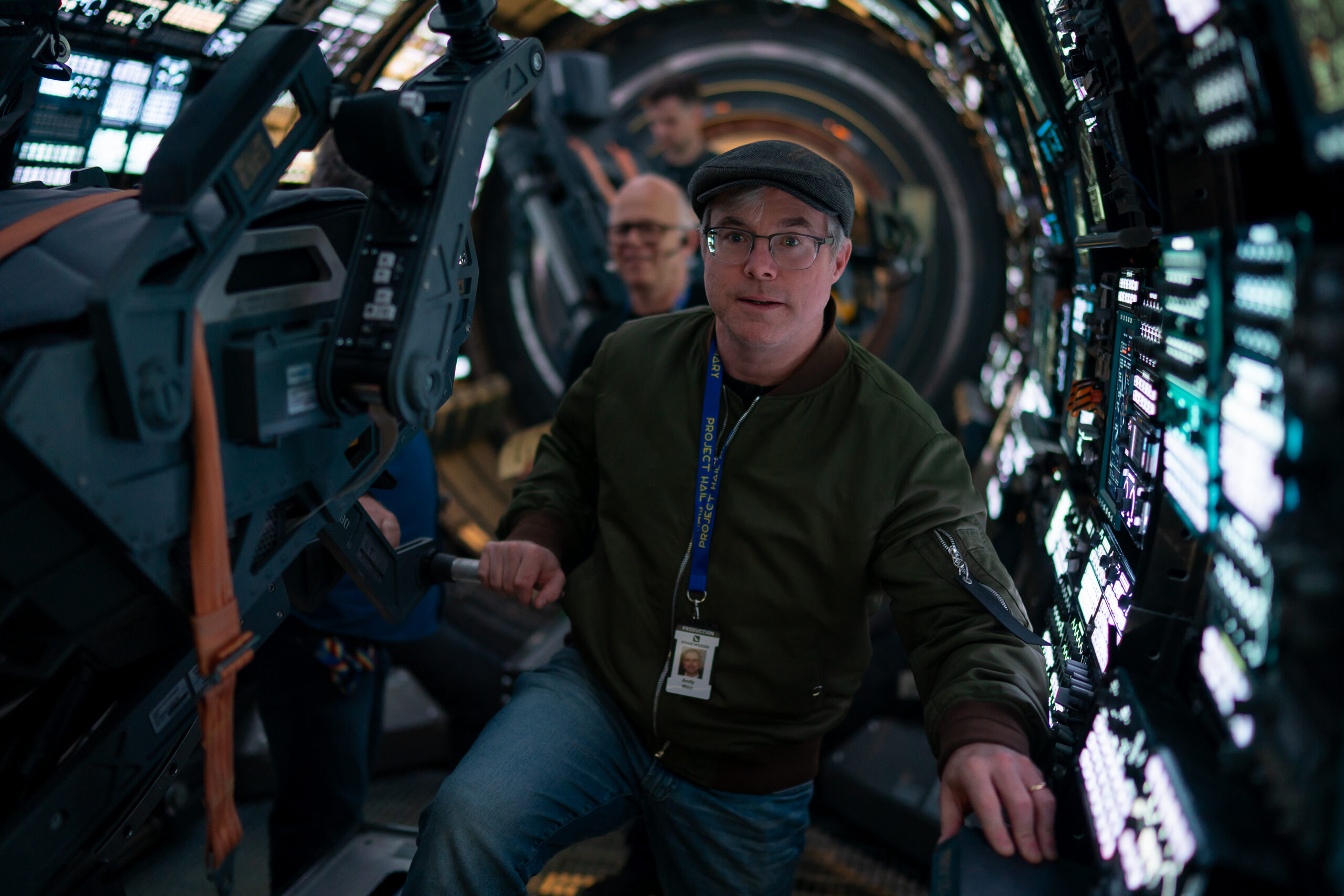
Things are very different on PHM. I’m a producer on the film, so I was involved at every step of the way. I was there for almost the entire shoot, and the directors and the other producers included me on everything. I was used very heavily as a science advisor.
Astronomy: Were there any scenes that you expected to be hard to film that weren’t, or vice versa?
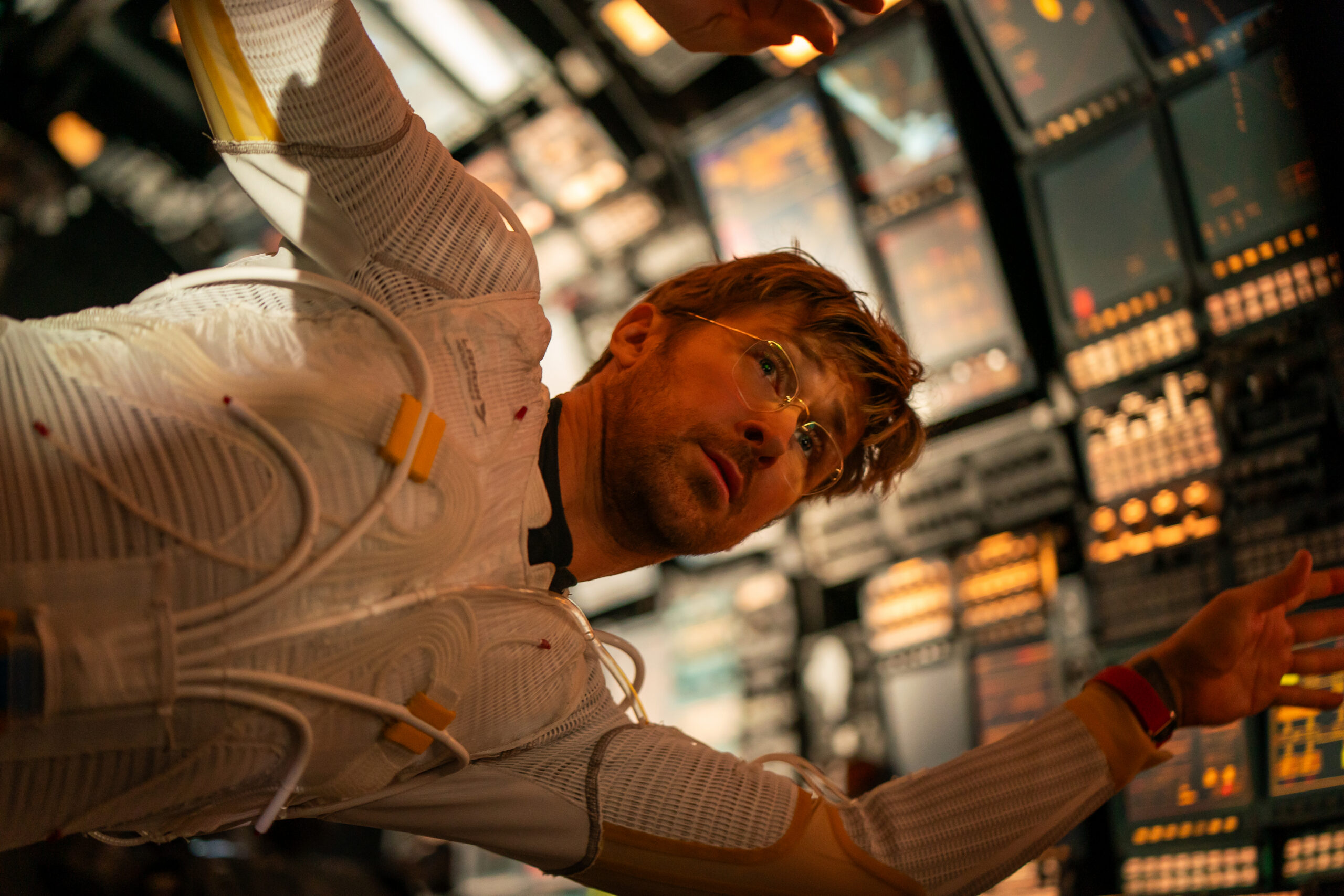
Weir: We all knew that the zero-g scenes were gonna be hard, and we were right. It’s very difficult to be in the wire harness and made to float around, and it’s very physically demanding and physically uncomfortable. And we didn’t use a double; for the most part it’s Ryan hanging from wires all day. It was not comfortable. He’s a professional, though.
The effects are mostly practical. Obviously CGI for things like the exteriors of the spacecraft and all that, but almost all of Rocky you see is a puppet. It took six people to operate him, and there were multiple versions of them. Some are robotic, for things that you can’t do with puppeteering.
I don’t think anything indoors on the Hail Mary is ever a green screen. I mean, out the windows, where there’s space and stuff like that, but yeah, it’s heavily practical. These were huge sets. Like, four sound stages full of just sets. It was really impressive.
Astronomy: Is there any other aspect of writing this story that you’d like to talk about?
Weir: One of the things that always bothers me in science fiction with first contact stuff is, why are there alien species all so close to each other? The Milky Way is 100,000 light-years across, Tau Ceti is 11.9 light-years away, 40 Eridani is 16 light-years away. I mean, these are next door.
So what are the odds that life would separately evolve on each of these three locations? Because Adrian [Astrophage’s homeworld around Tau Ceti], Erid [Rocky’s homeworld], and Earth are all worlds that have their own biospheres. How can that happen? The way I solved it was a panspermia event from Adrian. So, some ancestor of Astrophage seeded out in all directions, and some of them ended up landing on Earth, and some landed on Erid, and probably hit everything all over the place, but only Earth and Erid ended up to be [hospitable] enough that it could survive and reproduce. And then evolution took over from there. That all happened 4 billion years ago, so that allowed me to go, okay, there was only one genesis event. Life only evolved once, instead of three times all right next to each other. It happened to not be here on Earth, but it evolved once, and then it seeded here, and then that also made it so much easier for me, because the cellular biology of Eridians [Rocky’s species], Astrophage, and humans are all pretty much the same. Because that all evolved on Adrian.
Astronomy: This is more of a comment, but Rocky arrives at Tau Ceti with extra fuel because the Eridians don’t know about relativity. And I thought having a character who didn’t know about that was a really cool way to demonstrate the difference between Newtonian physics and relativity.
Weir: Oh, thanks. That wasn’t the reason I did it. First off, I like to say, ignore the tropes. Question every trope. And so what if for once, we met aliens and we’re the advanced ones? And I also thought of how things worked in the real world — let’s say when Asians and Europeans started really trading for the first time. The technology trees of those two different chunks of humanity were vastly different.
And so I was thinking that with the Eridians and the humans. I figured, it’s not like one species is gonna be better at everything. Eridians invented much better materials technology. Xenonite [the Eridians’ composite material] is this kind of magic stuff that I didn’t even bother to explain. And then humans invented computers. Eridians have much better analytical brains, they can do complex math in their head, so they never had to invent computers. But humans invented computers initially to do math, and then it turns out you can do a whole bunch of really cool stuff with computers that leaves Eridians in the dust. They also never discovered radiation, because they’re completely shielded from radiation on the surface of their planet.
The main reason was because I wanted to make sure Rocky had enough fuel for Ryland to go home. So, they had enough fuel for a round trip, but how do I explain why he has an extra 2 million kilograms [4.4 million pounds] to give Ryland? Well, if you incorrectly calculate the travel time and distance and everything for Newtonian physics, you end up thinking you’re going to need a lot more fuel, so you end up with a huge excess.
So by doing this, I can demonstrate that our technologies are variable as to who got what, and then also allow Ryland the fuel to go home. Which allowed me to get to that plot point where Ryland had to decide whether or not to sacrifice his life to save Rocky.
Astronomy: Which is a very important plot point.
Weir: My brother from a rocky mother.
Watch the final trailer for Project Hail Mary ahead of the film’s release in theaters and IMAX March 20.