Astronomy advocacy groups are ringing alarm bells about two proposed satellite constellations, warning that they threaten to change the sky forever.
SpaceX has applied to the U.S. Federal Communications Commission (FCC) to launch up to 1 million satellites as orbital data centers for artificial intelligence. California-based startup Reflect Orbital wants to deploy as many as 50,000 mirrors to low Earth orbit, designed to beam concentrated sunlight back to Earth. These focused spots of light could be used for a wide range of applications from agriculture to search and rescue, according to the company. Reflect Orbital filed its application on July 31, 2025. SpaceX submitted its proposal on Jan. 30, 2026. Both filings are now closed to public comments, but more than 1,800 comments were filed on the Reflect Orbital application alone.
The proposals have drawn criticism from nearly every major astronomical organization. The Royal Astronomical Society (RAS), the European Southern Observatory (ESO), and the International Astronomical Union (IAU) have submitted comments to the FCC opposing the plans. DarkSky International has published open letters to both SpaceX and Reflect Orbital calling for comprehensive environmental review, and the American Astronomical Society (AAS) has issued action alerts urging members of the public to file comments of their own.
“These proposals would not only have a disastrous impact on the science of astronomy, they would also hinder the right of everybody on Earth to enjoy the night sky,” said Robert Massey, deputy executive director of the RAS, in a recent press release.
Threats to astronomy
According to the RAS, SpaceX’s proposed constellation would add thousands of naked-eye-visible satellites to the night sky, in some cases outnumbering visible stars. Reflect Orbital’s mirrors would each cast a beam roughly four times brighter than a full Moon, and the RAS estimates the constellation could make the night sky three to four times brighter.
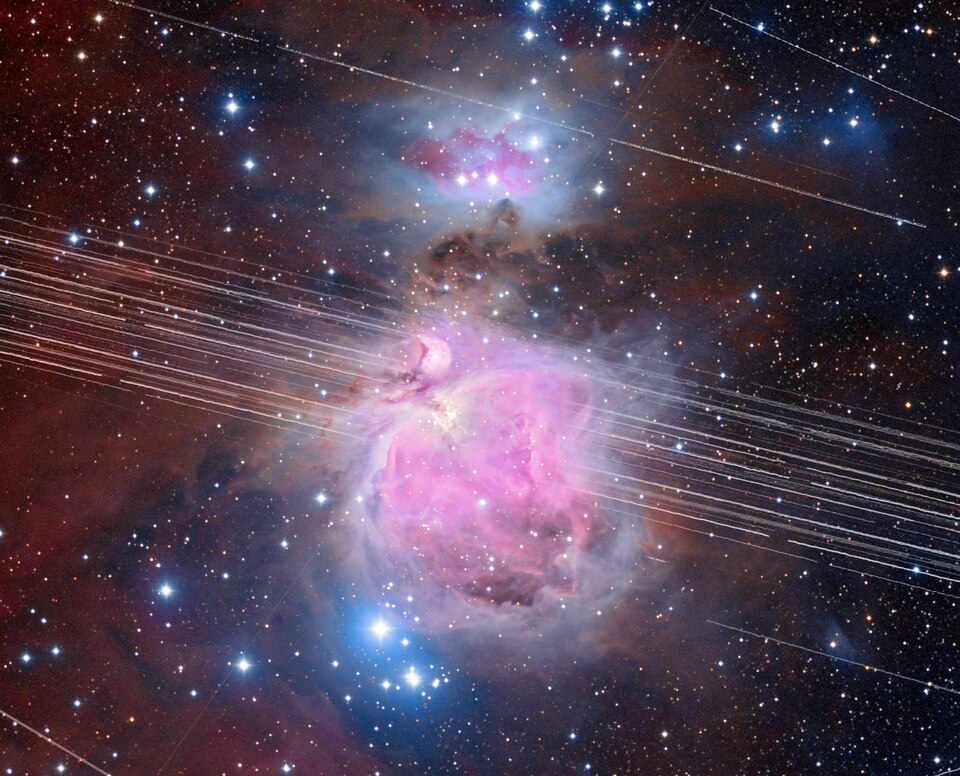
Satellite megaconstellations have already left their mark. Bright streaks from low-Earth-orbit satellites are an increasingly common problem for ground-based observatories, particularly wide-field instruments. And the situation is set to worsen. If SpaceX launches its new constellation, the RAS predicts satellite trails could obscure up to 10% of data captured by the ESO’s Very Large Telescope (VLT).
A December 2025 study in Nature found the damage also extends to space telescopes. According to the study, if all the constellations proposed at that time were completed, one-third of Hubble Space Telescope images would be contaminated, and more than 96% of exposures from future space observatories like NASA’s SPHEREx would be affected.
Environmental impact
Artificial light at night is already a well-documented problem for wildlife — research compiled by DarkSky International shows it disorients migratory birds, disrupts insect pollination, and upends predator-prey relationships. Permanently brightening the night sky will only make matters worse. While the long-term effects of these changes are yet to be fully understood, the RAS warns that the proposals have the potential to collapse nocturnal ecosystems. Because of the interdependence between species, disruptions to nocturnal species may impact day-active animals too. The visible light the constellations will reflect is just one part of a much broader environmental impact.
Because rocket launches deposit black carbon into the stratosphere, the satellites themselves also carry an environmental cost. Connor Barker, an atmospheric researcher at University College London, tells Astronomy, these emissions are roughly 500 times more effective at warming than the same particles released at the surface. Reentering satellites are depositing enough aluminum into the upper atmosphere to rival the contribution from natural meteors. “The space industry right now is basically an uncontrolled and untested geoengineering experiment,” Barker says.
A regulatory gap
One reason these proposals face so little environmental scrutiny is a regulatory gap at the FCC. In 1986, the commission established a categorical exclusion for satellite licensing under the National Environmental Policy Act (NEPA), effectively exempting launches from environmental review. Under NEPA, an agency can override such an exclusion if it identifies an “extraordinary circumstance” — a situation where the environmental impact may be significant enough to warrant a closer look.
But a 2022 Government Accountability Office (GAO) report found the FCC never revisited whether its exclusion should apply to modern megaconstellations. The GAO recommended the agency review whether the exclusion is still appropriate, establish a timeline for periodic reassessment, and clearly define what would qualify as an extraordinary circumstance. Andrew Von Ah, a director in the GAO’s Physical Infrastructure team, tells Astronomy the FCC agreed with those recommendations but has not acted on them.
Ultimately, astronomers worry that these changes would create irreversible damage to one of humanity’s most precious resources. “The stars above us are a valued part of human heritage,” Massey said. “Deploying more than 1 million exceptionally bright satellites would utterly destroy this.”