Looking for a sky event this week? Check out our full Sky This Week column.
October 28: Track Ceres’ movement
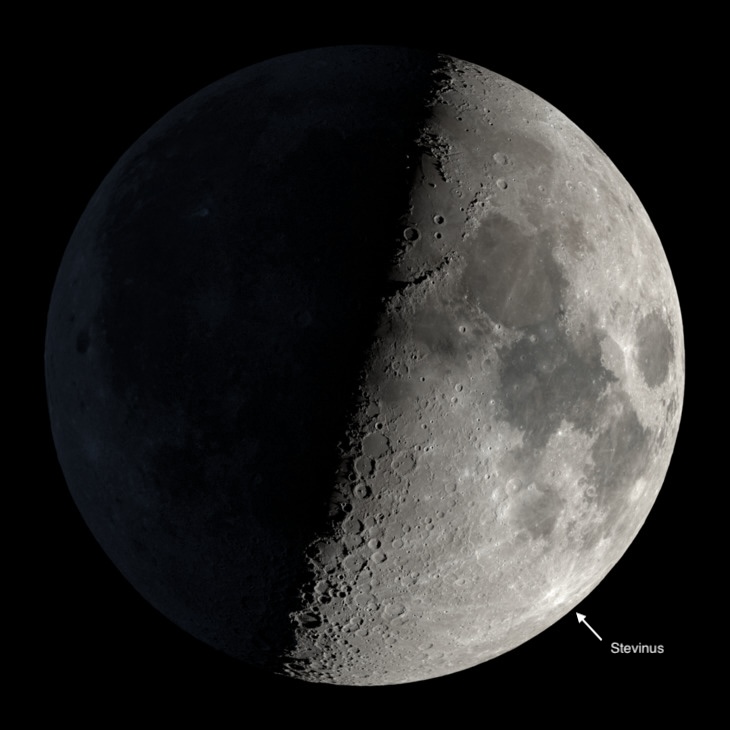
First Quarter Moon occurs at 12:21 P.M. EDT. It’s visible in the south in Capricornus at sunset and remains up almost all evening, setting in the half hour before midnight. The most noticeable feature on our satellite is one that is dynamic — the terminator, the dividing line between night and day, which stands halfway across the visible face of the Moon at First Quarter. Visible on the lit half of the Moon are large, dark areas — these are maria, or seas, although they were formed by lava, not water.
Along the terminator to the south, you’ll spot many large, round craters. Take some time to explore the rugged terrain with a telescope. Also notice the large white feature close to the southeastern limb — this is the crater Stevinus, which is surrounded by bright rays of ejecta (material thrown up and out during the impact that created the crater). This crater has a large central peak — a common feature in impact craters — that can be seen quite well with a telescope.
Sunrise: 7:26 A.M.
Sunset: 6:01 P.M.
Moonrise: 2:29 P.M.
Moonset: —
Moon Phase: Waxing gibbous (55%)
*Times for sunrise, sunset, moonrise, and moonset are given in local time from 40° N 90° W. The Moon’s illumination is given at 10 P.M. local time from the same location.