Looking for a sky event this week? Check out our full Sky This Week column.
November 4: Two shadows and a moon cross Jupiter
The morning begins with Europa crossing Jupiter, following in Io’s footsteps late last night. Its transit began just after 2:40 A.M. EST this morning, and will continue through about 5:30 A.M. EST.
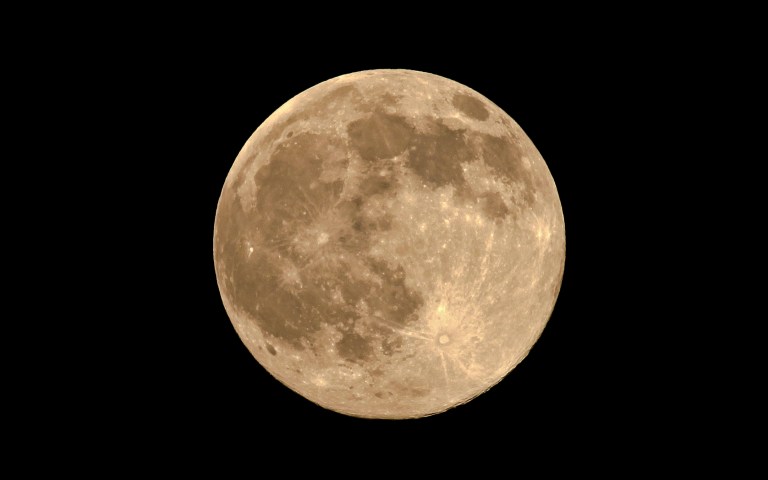
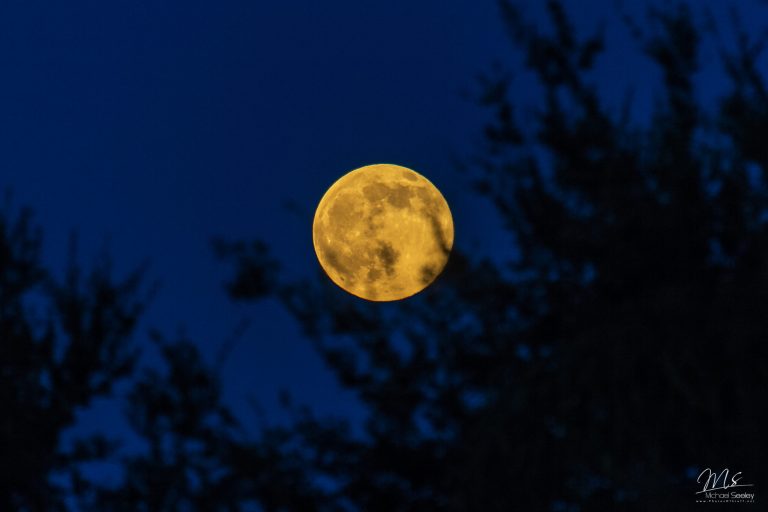
November’s Full Moon occurs at 8:19 A.M. EST. This month’s Full Moon is also called the Beaver Moon.
The Moon also reaches perigee, the closest point to Earth in its orbit, just hours later, at 5:27 P.M. EST. Our satellite is then 221,726 miles (356,833 km) away. When these two events — the Full phase and perigee — coincide, we see a phenomenon called a Super Moon, during which the Moon appears slightly larger and brighter than normal. In this case, as the Moon rises this evening, it appears 33.5’ wide. Compare that to its average size of 31’ — not a huge difference, but you may notice it seems a bit brighter tonight than at other times during the year. The Full Moon rises around sunset and sets around sunrise, so there’s plenty of time to enjoy it, no matter when you step outside to take a look.
This is the second of three Super Moons in 2025, with next month closing out the year with the December Cold Moon as a Super Moon as well. The definition of a Super Moon is a little loose, however, as it is not an official designation. So, outlets often determine their own threshold for how close a Full Moon must be to perigee to qualify. According to Farmers’ Almanac, 2026 will carry three Super Moons as well, in January, November, and December. But according to the Royal Museums Greenwich, only the December Full Moon occurs close enough to perigee to earn “super” status.
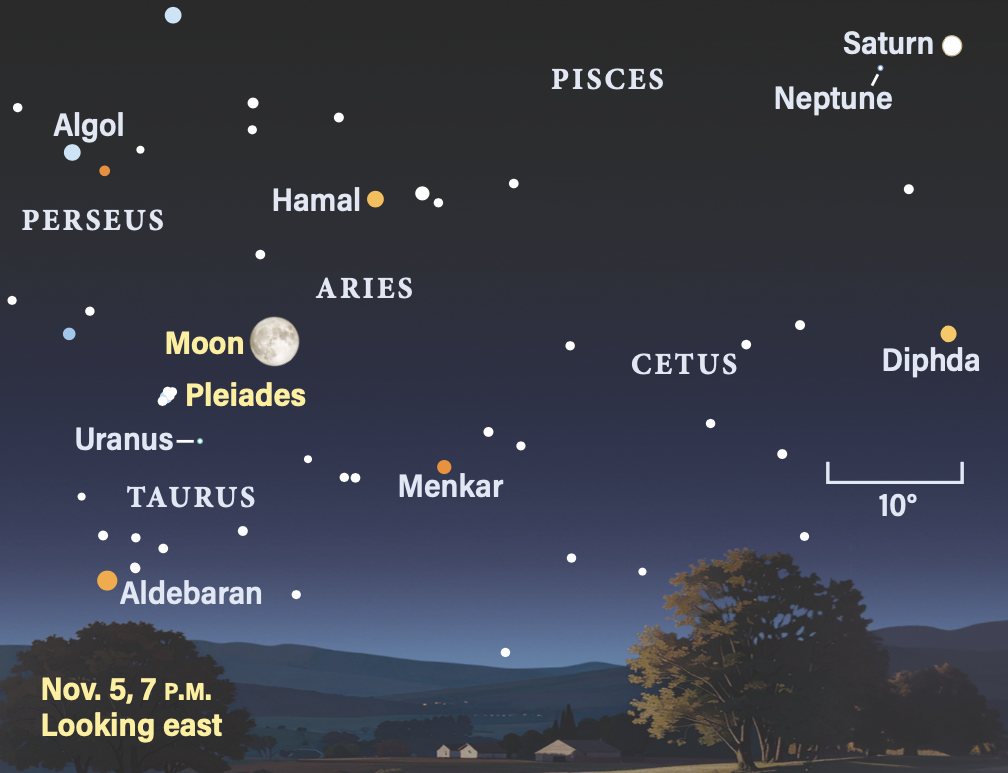
The Moon rises in Aries this evening, leading the Pleiades (M45) into the sky as our satellite stands 10° west of the young group of stars. By tomorrow, their positions will be reversed, with M45 leading the way and the Moon trailing, having moved east of the open cluster.
The Pleiades is a great target for binoculars and small scopes — in fact, the lower the magnification, the better. Even a finder scope will show it well. Roughly 445 light-years away and 100 million years old, this cluster spans 110’ on the sky and contains at least several hundred stars. Its brightest suns, visible to the naked eye, make the shape of a tiny spoon or dipper in the sky — though don’t confuse this with the much larger Little Dipper in the north!
Observers can watch overnight as the Moon crosses the rest of Aries and finally moves into Taurus shortly after 5:30 A.M. EST on the 6th. After both have set for those in the contiguous U.S., the Moon will make its way across several stars in the Pleiades in an occultation visible from parts of Alaska, Asia, and Europe.
Sunrise: 6:34 A.M.
Sunset: 4:53 P.M.
Moonrise: 4:42 P.M.
Moonset: 6:46 A.M.
Moon Phase: Waning gibbous (99%)
*Times for sunrise, sunset, moonrise, and moonset are given in local time from 40° N 90° W. The Moon’s illumination is given at 10 P.M. local time from the same location.