Looking for a sky event this week? Check out our full Sky This Week column.
February 3: Uranus stands still
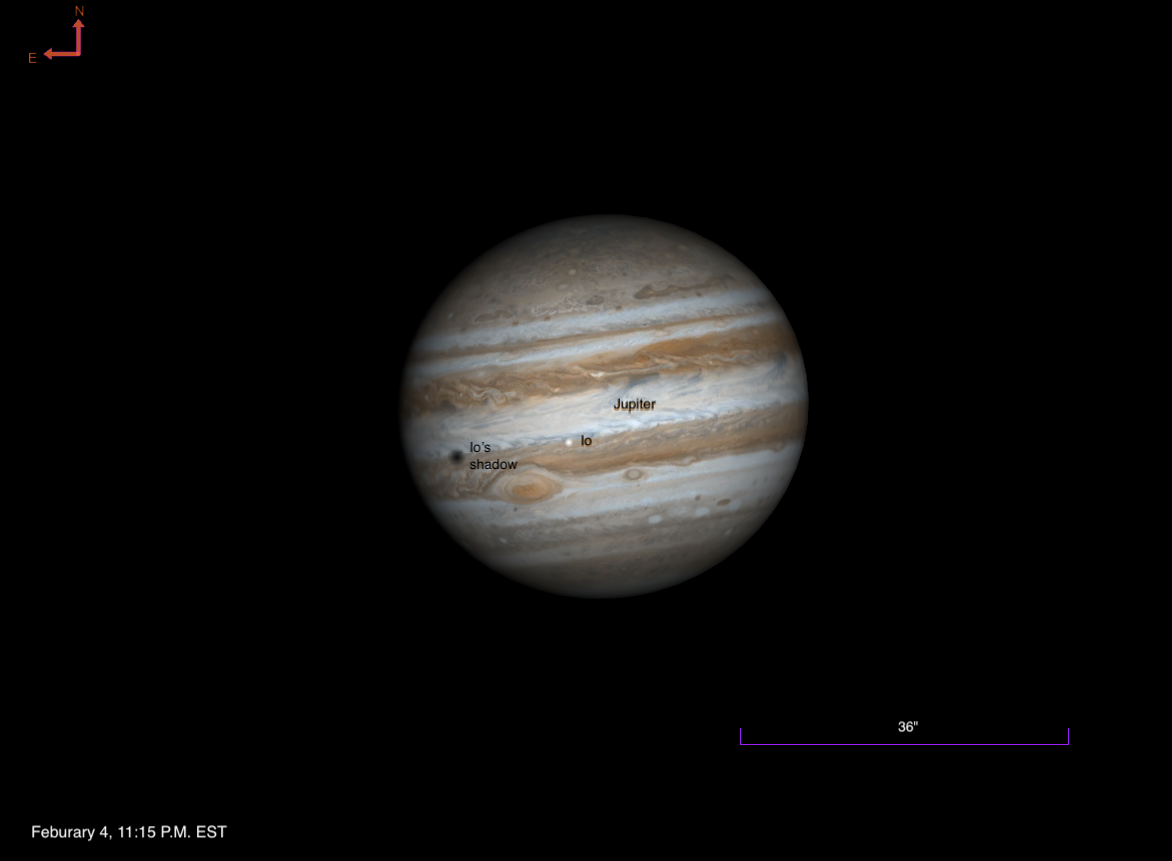
Io and its shadow transit Jupiter this evening, beginning shortly after 10 P.M. EST.
By the time the transit starts, the planet is above the horizon for the entire U.S. In the Midwest, it is high in the south, hanging to the lower right of the stars Castor and Pollux in Gemini the Twins. The gas giant shines at magnitude–2.6, far brighter than either of these stars, dominating the middle of the constellation.
Through a telescope, you’ll see that prior to the transit, Ganymede is alone to Jupiter’s west. On the eastern side of the planet, Io is closest, followed by Europa and then Callisto. Io reaches Jupiter’s southeastern limb at 10:20 P.M. EST and begins to move across the face of the planet. Its shadow appears 35 minutes later, following the moon across as both move from east to west.
Io slips off the disk shortly before 12:40 A.M. EST (now the 5th in the Eastern time zone only), joining Ganymede on the planet’s western side. The shadow continues alone after that, disappearing around 1:15 A.M. EST (now the 5th in the eastern half of the U.S.).
Sunrise: 7:05 A.M.
Sunset: 5:23 P.M.
Moonrise: 8:43 P.M.
Moonset: 8:31 A.M.
Moon Phase: Waning gibbous (88%)
*Times for sunrise, sunset, moonrise, and moonset are given in local time from 40° N 90° W. The Moon’s illumination is given at 10 P.M. local time from the same location.