Looking for a sky event this week? Check out our full Sky This Week column.
March 2: The Moon passes Regulus
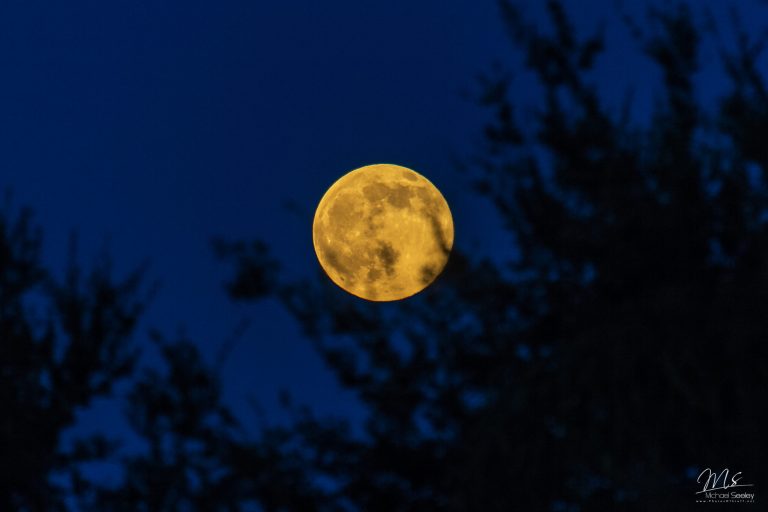
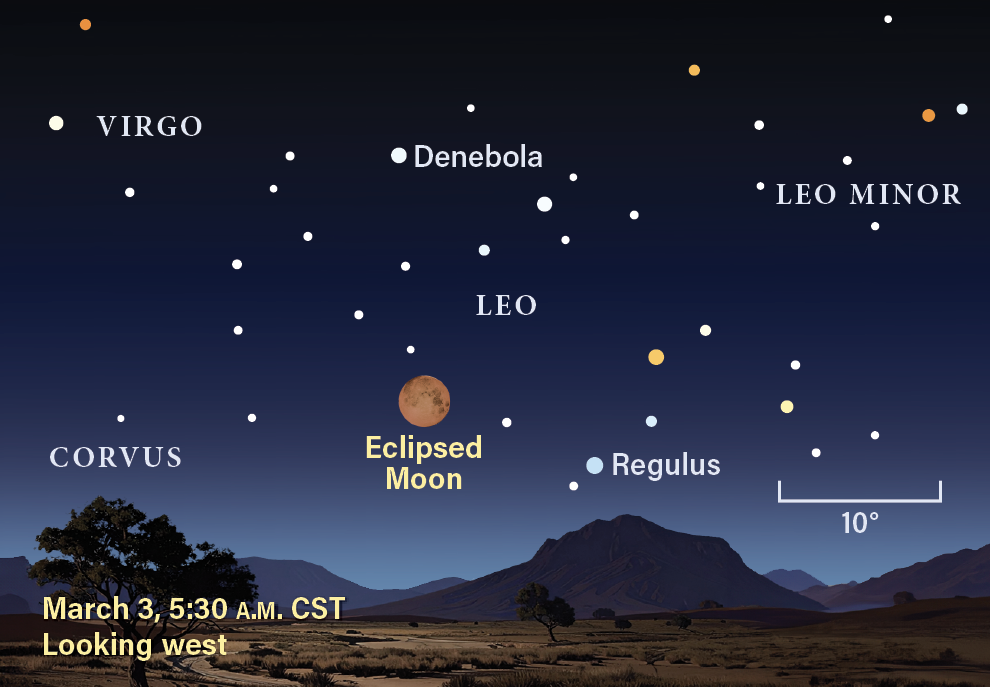
A total lunar eclipse, sometimes called a Blood Moon, occurs over much of the world this morning, including the U.S.
Total lunar eclipses can only take place during the Full Moon. Full Moon officially occurs this morning at 6:38 A.M. EST. The March Full Moon is sometimes also called the Worm Moon. Lunar eclipses are sometimes referred to as Blood Moons as well, because the Moon changes color — often to a dark orange or deep red — as it travels through Earth’s shadow.
The eclipse officially starts this morning at 3:43 A.M. EST as the Moon, currently in Leo, first moves into the outer regions of Earth’s shadow, called the penumbra. Over the next hour or so, our satellite will slowly begin to darken. It will be subtle at first, so give it time if you don’t notice a change immediately. At 4:49 A.M. EST, the Moon reaches the darker inner shadow of our planet, called the umbra. Luna will continue to grow even darker during this time, now quite noticeably, until the start of totality at 6:03 A.M. EST.
Totality is when the Moon truly turns to blood, taking on an orangey or reddish hue as a small amount of sunlight is refracted by our atmosphere onto the lunar surface. The exact color of each eclipse is unique. At this point, many of the nearby stars — previously blotted out by the bright light of the Full Moon — should reappear in the sky around our satellite.
Totality lasts roughly an hour, ending at 6:02 A.M. CST — note the time change, as this is after sunrise (and moonset) for the East Coast and with the Moon low on the western horizon in the Midwest. Then, the eclipse proceeds in reverse, visible largely from the western half of the U.S. as the Moon slowly lightens. It passes out of the umbra at 6:17 A.M. MST, then out of the penumbra at 6:23 A.M. PST, ending the eclipse.
Sunrise: 6:30 A.M.
Sunset: 5:54 P.M.
Moonrise: 6:24 P.M.
Moonset: 6:33 A.M.
Moon Phase: Waning gibbous (99%)
*Times for sunrise, sunset, moonrise, and moonset are given in local time from 40° N 90° W. The Moon’s illumination is given at 10 P.M. local time from the same location.