Looking for a sky event this week? Check out our full Sky This Week column.
March 1: Some last views of Saturn
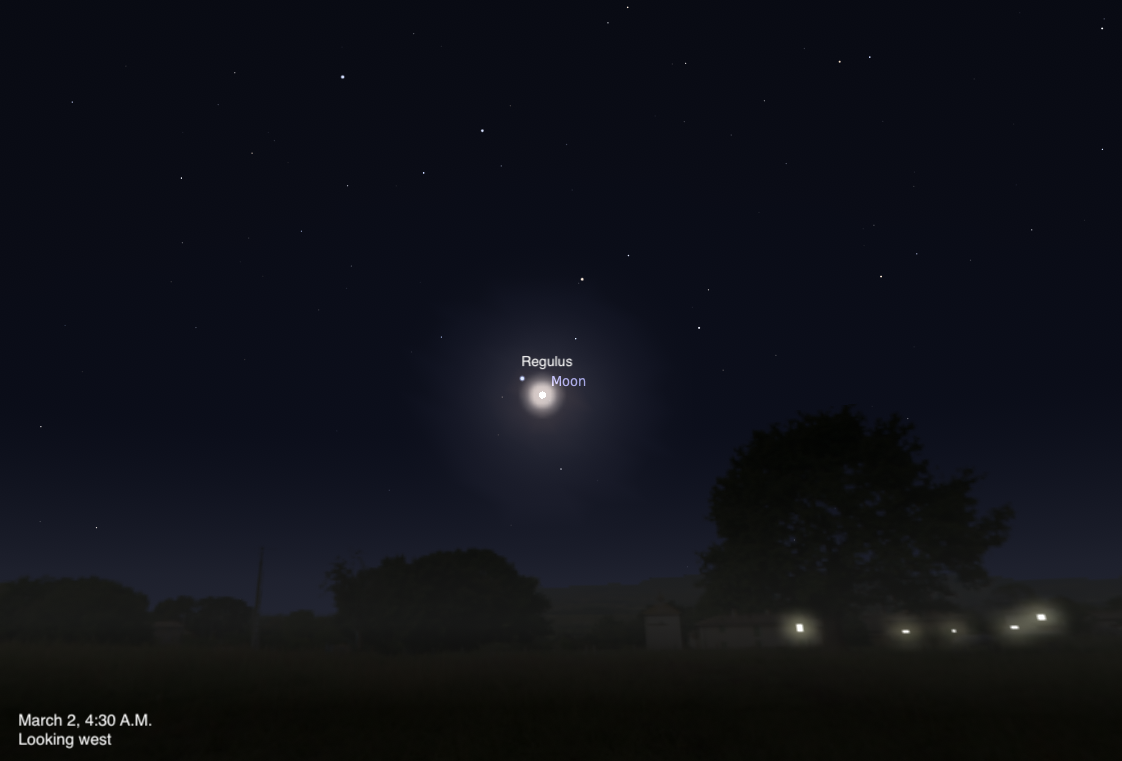
The nearly Full Moon passes just 0.4° north of Regulus at 8 A.M. EST; you can catch the pair close together in the predawn sky, standing roughly 20° high in the west two hours before sunrise. The Moon is located just to the lower right of Regulus, which anchors the famous Sickle asterism of Leo, which to many looks like a backwards question mark.
Regulus is also the bright star marking the heart of the Lion. Shining at magnitude 1.4, it is in actuality a four-star system, which observers can split into the brightest two components with a telescope. (Note the companion is quite far away, some 175”, so you’re not looking for a close double!) Regulus is also located nearly on the ecliptic, the plane of our solar system and the path of the planets, Sun, and Moon, so it is often occulted by other objects as they appear to pass in front of the star from our point of view.
Although not visible in the majority of the U.S., some parts of the world (including Hawaii, Japan, and Russia) will see the Moon pass in front of Regulus today. The visibility and timing of the event are heavily location dependent — you can find more information on the In-The-Sky.org‘s page for the event here.
Sunrise: 6:31 A.M.
Sunset: 5:53 P.M.
Moonrise: 5:17 P.M.
Moonset: 6:09 A.M.
Moon Phase: Full
*Times for sunrise, sunset, moonrise, and moonset are given in local time from 40° N 90° W. The Moon’s illumination is given at 10 P.M. local time from the same location.
Even if you’re not normally an early riser, March 3 is the day to make an exception as a total lunar eclipse, sometimes called a Blood Moon, occurs over much of the world, including the U.S.
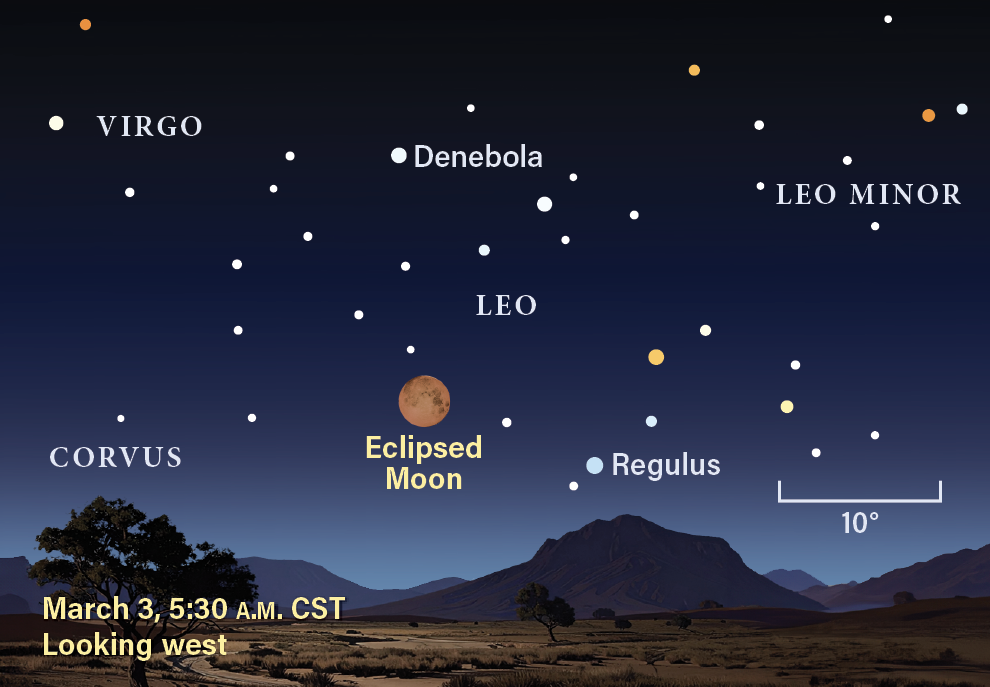
Total lunar eclipses can only take place during the Full Moon. Full Moon officially occurs this morning at 6:38 A.M. EST. The March Full Moon is sometimes also called the Worm Moon. Lunar eclipses are sometimes referred to as Blood Moons as well, because the Moon changes color — often to a dark orange or deep red — as it travels through Earth’s shadow.
The eclipse officially starts this morning at 3:43 A.M. EST as the Moon, currently in Leo, first moves into the outer regions of Earth’s shadow, called the penumbra. Over the next hour or so, our satellite will slowly begin to darken. It will be subtle at first, so give it time if you don’t notice a change immediately. At 4:49 A.M. EST, the Moon reaches the darker inner shadow of our planet, called the umbra. Luna will continue to grow even darker during this time, now quite noticeably, until the start of totality at 6:03 A.M. EST.
Totality is when the Moon truly turns to blood, taking on an orangey or reddish hue as a small amount of sunlight is refracted by our atmosphere onto the lunar surface. The exact color of each eclipse is unique. At this point, many of the nearby stars — previously blotted out by the bright light of the Full Moon — should reappear in the sky around our satellite.
Totality lasts roughly an hour, ending at 6:02 A.M. CST — note the time change, as this is after sunrise (and moonset) for the East Coast and with the Moon low on the western horizon in the Midwest. Then, the eclipse proceeds in reverse, visible largely from the western half of the U.S. as the Moon slowly lightens. It passes out of the umbra at 6:17 A.M. MST, then out of the penumbra at 6:23 A.M. PST, ending the eclipse.