Looking for a sky event this week? Check out our full Sky This Week column.
October 22: Check out the California Nebula
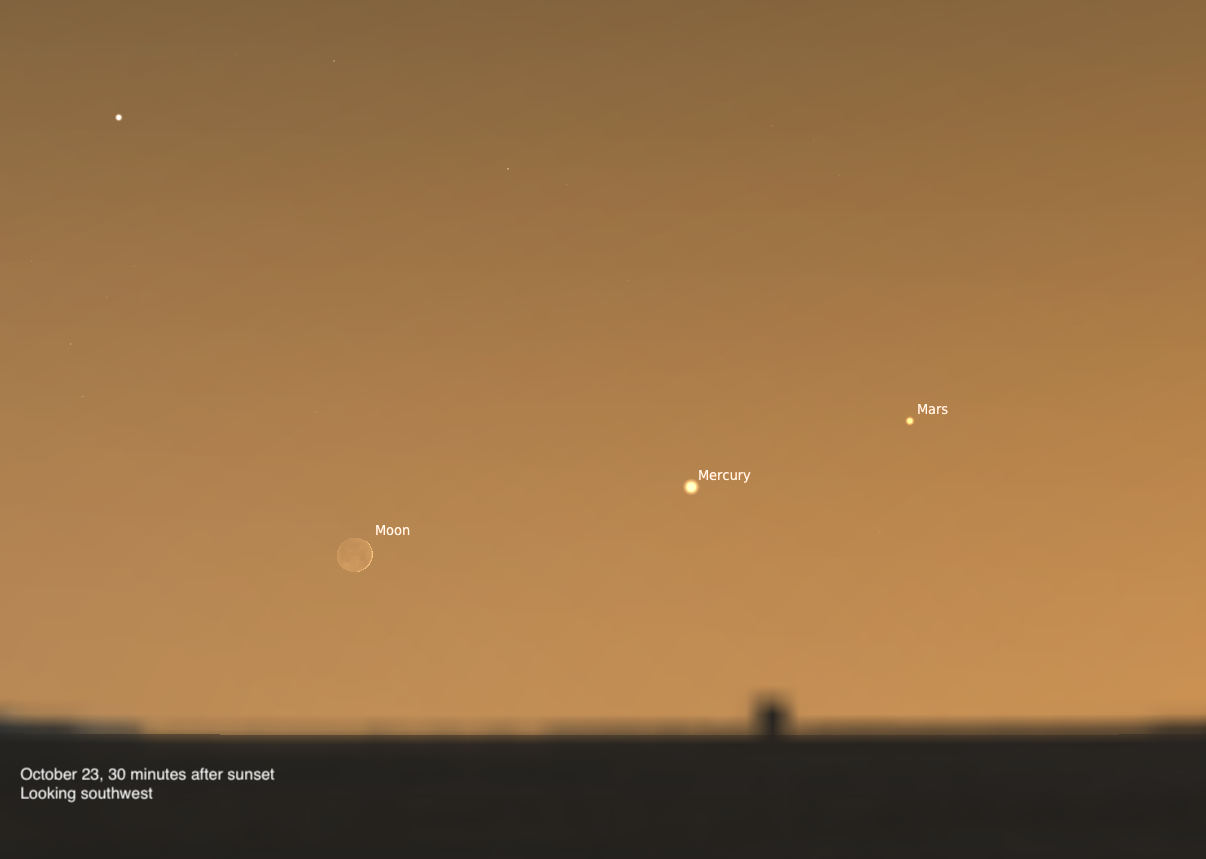
The Moon passes 5° south of Mars at 9 A.M. EDT, then skims 2° south of Mercury at noon EDT. This evening, our satellite reaches apogee, the farthest point from Earth in its orbit, at 7:30 P.M. EDT. At that time, it will sit 252,553 miles (406,445 km) away.
If you’re quick and have a clear southwestern horizon, you can try catching the trio just after sunset. Half an hour after sunset, they are only 3° high in the southwest. The Moon is lowest, with brighter Mercury to its upper right, and fainter Mars to Mercury’s upper right.
At magnitude –0.2, Mercury should be one of the first points of light to appear in the deepening twilight. If you can’t see it by eye it should be easy to identify in binoculars, about 4.5° west of the Moon. Through a telescope, the small planet shows off a 73-percent-lit disk that is 6” wide.
Mars is magnitude 1.4 — much fainter and better observed with optical aid. You can locate it 3° west of Mercury, farther along the same line connecting Mercury and the Moon. Mars’ disk appears 4” wide and is virtually fully lit.
Sunrise: 7:20 A.M.
Sunset: 6:08 P.M.
Moonrise: 9:34 A.M.
Moonset: 6:57 P.M.
Moon Phase: Waxing crescent (6%)
*Times for sunrise, sunset, moonrise, and moonset are given in local time from 40° N 90° W. The Moon’s illumination is given at 10 P.M. local time from the same location.