Looking for a sky event this week? Check out our full Sky This Week column.
September 4: Get in a workout
Titan, Saturn’s brightest moon, orbits its parent world with a period of about 16 days. You’ll find this moon passing near Saturn today and tomorrow, when it will be northeast and northwest of the ringed world, respectively.
Now rising around 9 P.M. local daylight time and standing highest around 3 A.M. in the early-morning sky, Saturn is visible to the naked eye — it’s easy to find, too, as the brightest light in the region of southern Pisces and northern Cetus. By midnight, it’s already more than 30° high in the southeast, so late-night observers can get in on the action as well as early risers. By 3 A.M. the planet stands 50° high in the south.
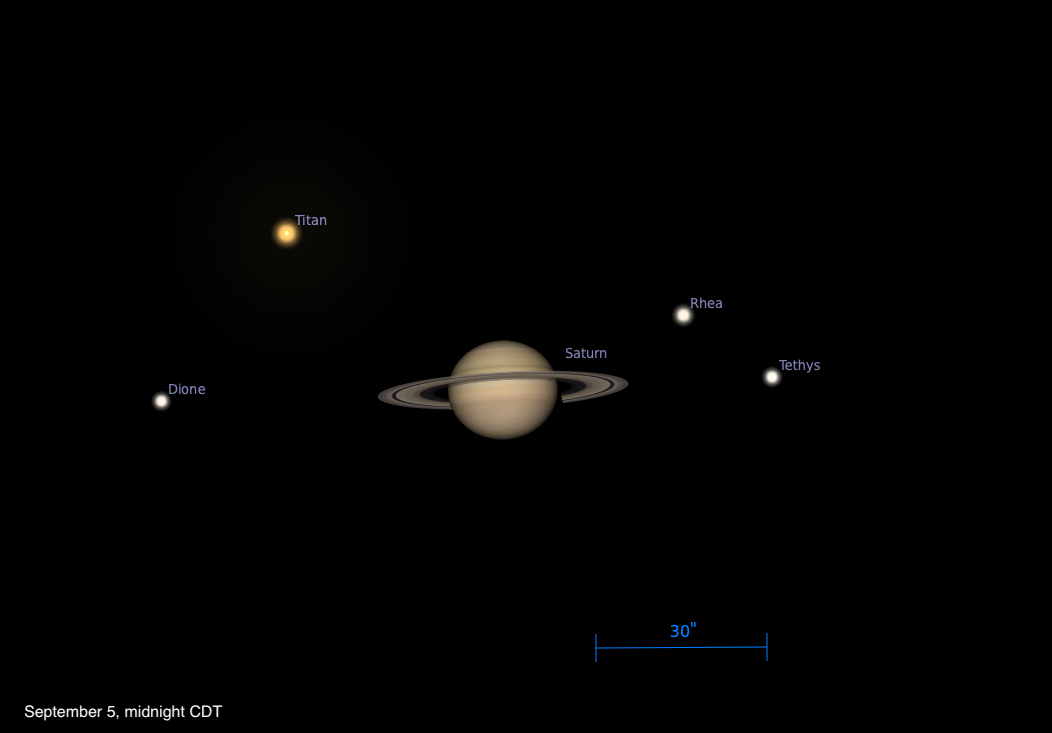
By midnight Central time on the 5th, Titan is less than an arcminute from Saturn, sitting just northeast of the planet. Several other, fainter moons cluster closer in — you’re most likely to spot 10th-magnitude Rhea, Tethys, and Dione. At midnight CDT, the latter lies alone to Saturn’s east (southeast of Titan), while the other two are west of the planet. Their positions change quickly, though, so they may be in different spots if you take a peek at a different time.
Titan is moving westward, skimming north of the ringed world. By the time Saturn rises tomorrow evening, the 6th, in the Midwest, Titan will already be some 41” northwest of the planet, and continuing to pull away. On this day, Tethys lies east of Saturn, while Dione and Rhea are to the planet’s west, south of Titan.
Sunrise: 6:31 A.M.
Sunset: 7:25 P.M.
Moonrise: —
Moonset: 4:01 P.M.
Moon Phase: Waning crescent (30%)
*Times for sunrise, sunset, moonrise, and moonset are given in local time from 40° N 90° W. The Moon’s illumination is given at 10 P.M. local time from the same location.
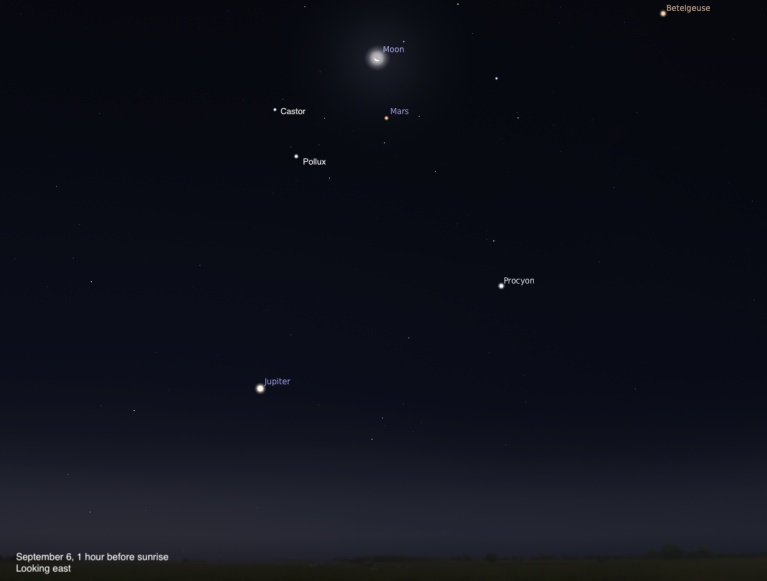
The waning crescent Moon lies in Gemini on September 6, not far from the 3rd-magnitude star Epsilon (ε) Geminorum, roughly around where western twin Castor’s knee would be. Mars is also in Gemini, closer to the midsection of the eastern twin, Pollux. You can catch the lovely celestial pairing before dawn: Mars rises around 2 A.M. local daylight time, and an hour before sunrise, the pair has reached some 40° high in the east, with Jupiter also visible to their lower left, in the constellation Cancer.
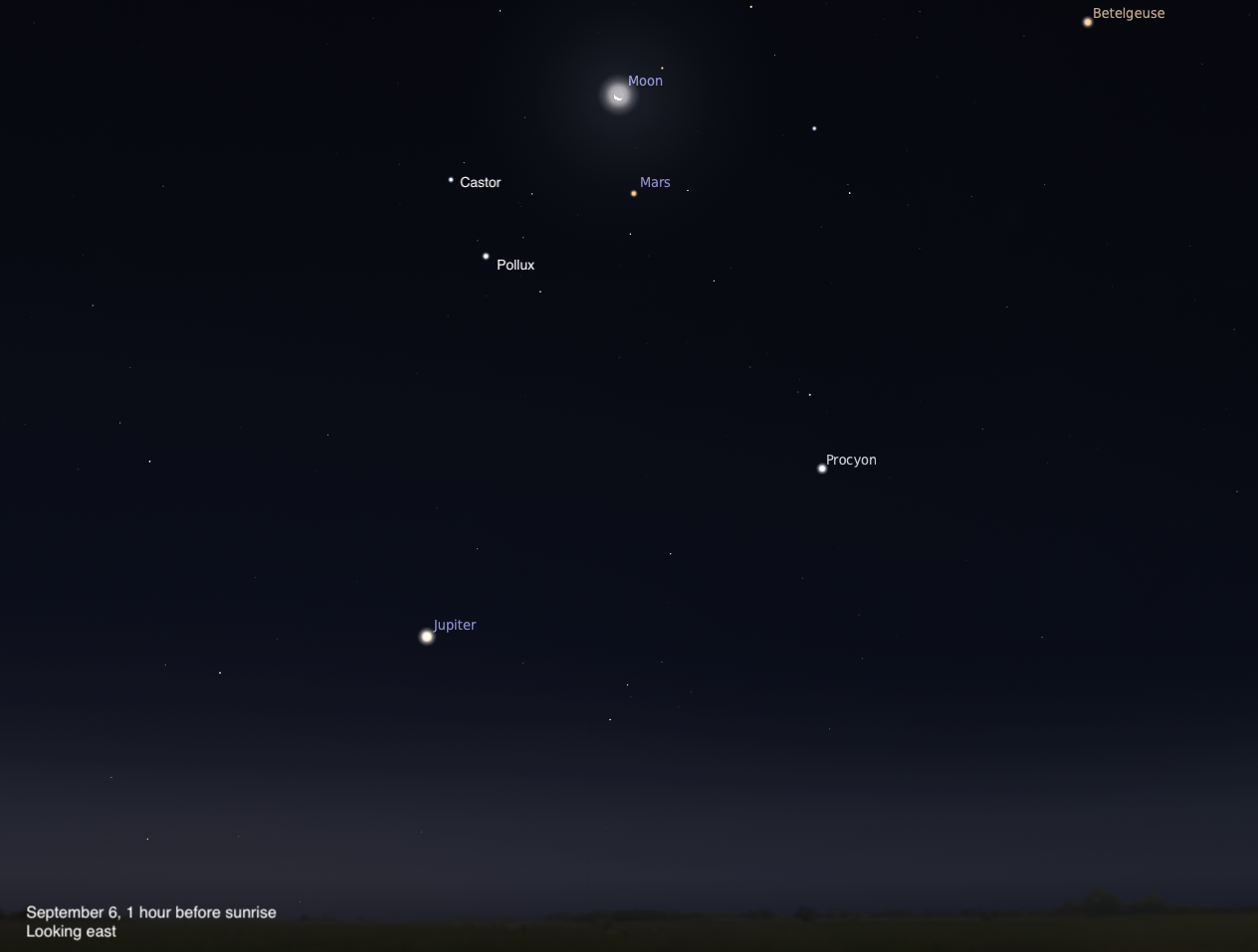
Mars still appears pretty tiny in a telescope, just 5” across. It will slowly grow larger over the coming months as its distance from Earth decreases, but for now, surface detail is impossible to see. However, you can easily note its reddish color — compare that to, say, white-hued Castor and yellow-hued Pollux, the bright stars marking heads of the Twins.
Closer to the horizon, brighter Jupiter is sitting in eastern Cancer about 7.2° east of M44, the Beehive Cluster. Through a telescope, the gas giant stretches an impressive 32” and is flanked by its Galilean moons. Early in the morning, Io and Callisto lie west of the world and Europa and Ganymede are to the east. Observers in the Central and Mountain time zones can try to catch Io disappearing into Jupiter’s long, dark shadow around 5:35 A.M. CDT, although the sky will be starting to brighten in the Midwest and the planet will be only a few degrees high in the Mountain time zone. Pacific Coast observers will see only the three other moons, as Io reappears right around sunrise in the Pacific time zone.
Alison Klesman is senior editor of Astronomy magazine. She holds a Ph.D. in astronomy and has studied a variety of topics, from minor planets to supermassive black holes.