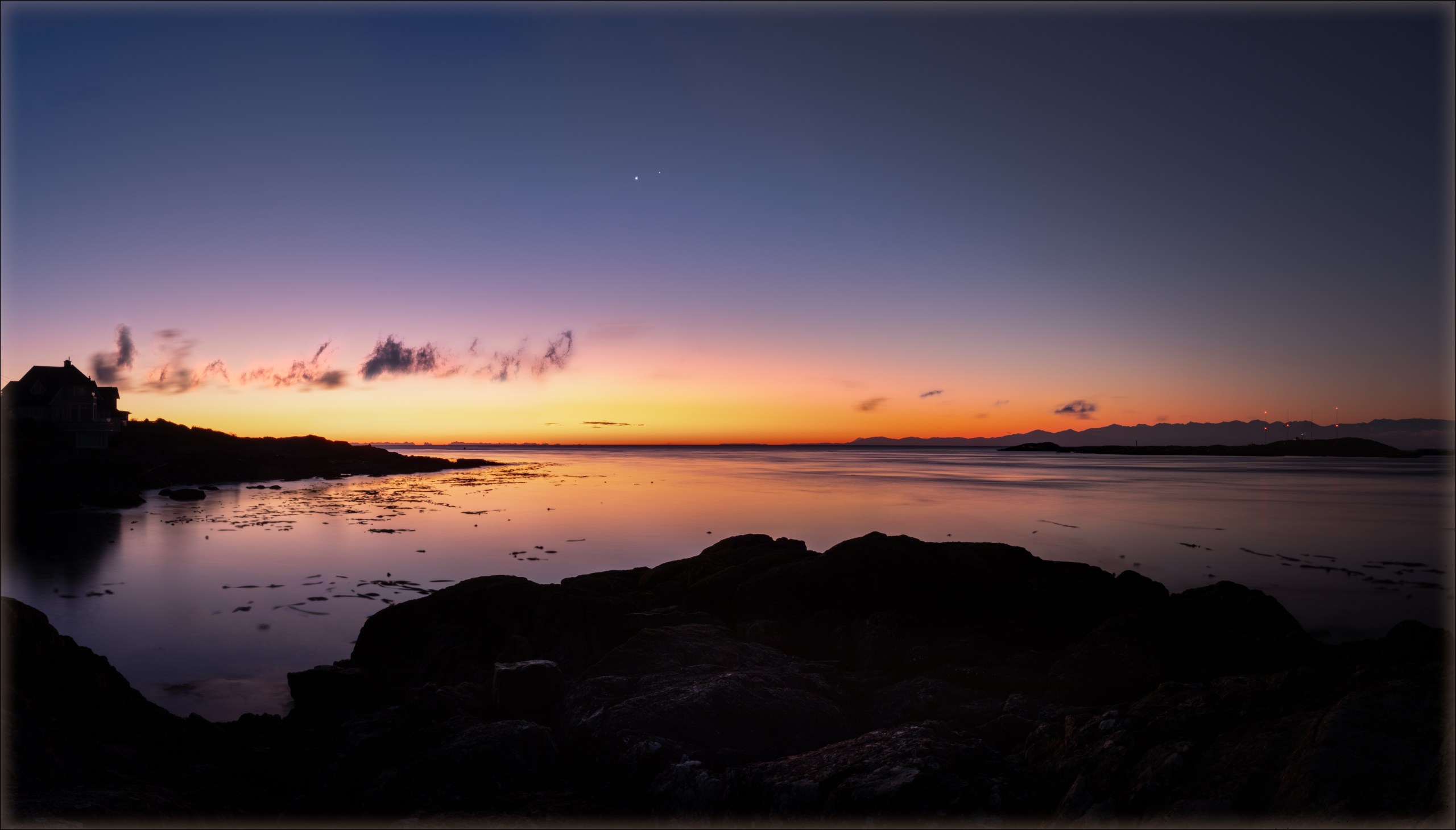
September begins with a lovely sight in the western evening sky: brilliant Venus appears just 2° to the left of Spica, the brightest star in the constellation Virgo the Maiden. The gap between the two widens as the month progresses, with Venus climbing above the blue-white star.
The view of Venus through a telescope remains spectacular all month. The inner planet begins September with a disk that appears 30″ across and 39 percent lit. By month’s end, Venus spans 47″ and the Sun illuminates just 16 percent of its Earth-facing hemisphere. Even the smallest scope will deliver stunning views.
It may surprise you that the thin crescent appears so bright, but up to a certain point, at least, Venus’ growing size more than compensates. The planet actually shines brightest in September, peaking at magnitude –4.8 on the 19th.
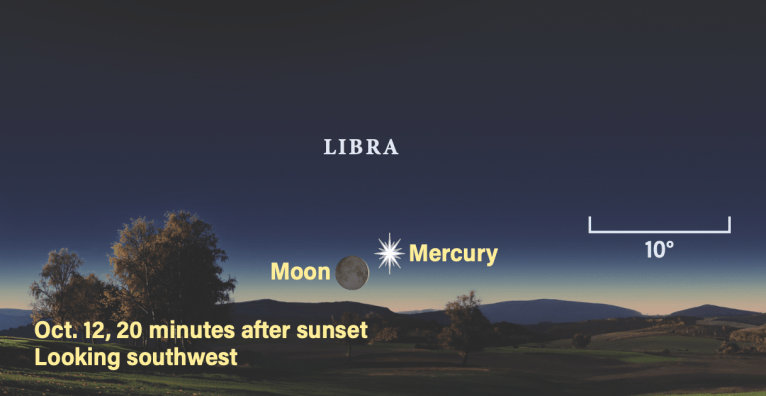
Mercury joins Venus in the evening sky around midmonth and climbs higher as the month progresses. The innermost planet also passes Spica, skimming 1° from the star Sept. 26. Mercury then shines at magnitude –0.2, noticeably brighter than the star but only 1 percent of Venus’ brilliance. A telescope shows the planet’s 5″-diameter disk and gibbous phase.
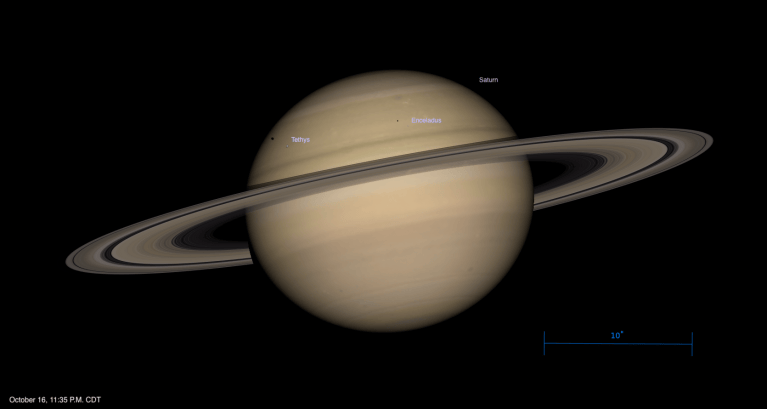
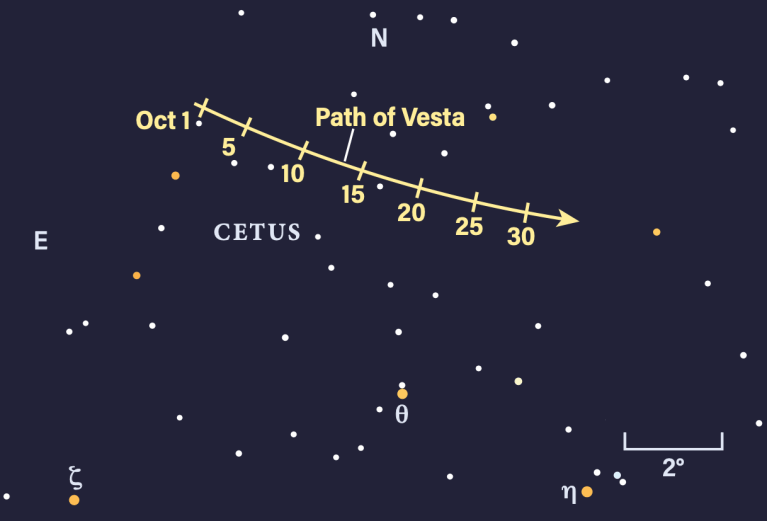
As Venus dips toward the western horizon, look for Saturn rising in the east. The ringed planet moves slowly westward against the stellar backdrop in advance of its early October opposition. It lies near the border between Pisces the Fish and Cetus the Whale, crossing from the former into the latter during September’s first week. Glowing at magnitude 0.4, the planet easily outshines the stars in this region.
Spectacular views await anyone who targets Saturn with a telescope. In mid-September, the planet measures 20″ across while the rings span 44″ and tilt 8° to our line of sight. Small scopes also reveal four moons: 8th-magnitude Titan and 10th-magnitude Tethys, Dione, and Rhea.
Mars rises about three hours before the Sun all month. It begins September in central Gemini, between the two lines of stars that mark the Twins’ bodies. Its eastward motion carries it into the dim constellation Cancer the Crab on Sept. 25. That same morning, the Red Planet forms a straight line with Gemini’s two brightest stars, Castor and Pollux. Magnitude 1.2 Mars matches Pollux’s brightness while Castor appears slightly fainter. A telescope reveals a 5″-diameter disk but no detail.
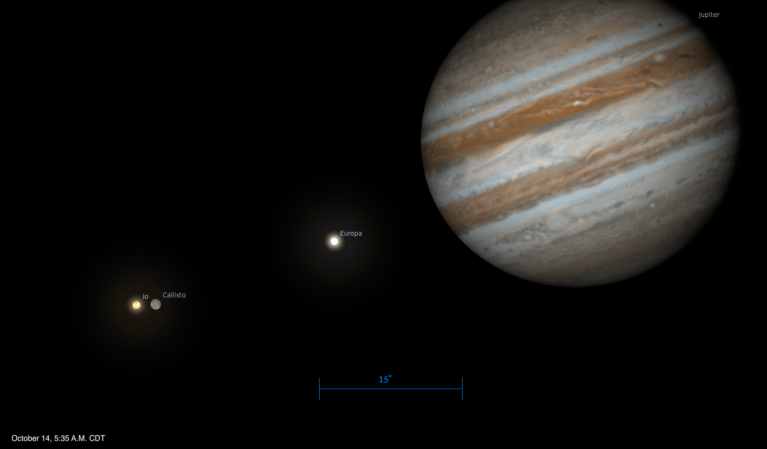
Better views await observers of Jupiter, particularly in late September. The giant planet rises more than two hours before the Sun at month’s end and stands nearly 15° high an hour before sunup. It then shines at magnitude –1.9, easily the brightest point of light in the morning sky.
Jupiter starts September in Cancer and moves into Leo the Lion on the 23rd. When you point a telescope at the gas giant at month’s end, you should see at least a couple of dark bands crossing its 33″-diameter disk. And you definitely will see its four bright moons, which change relative positions from one morning to the next.
A waxing crescent Moon occults Antares in Scorpius on Sept. 17. Observers in southeastern Australia will have the best view. From Hobart, Tasmania, Antares disappears behind the Moon’s dark limb at 13h51m UT with Luna 8° above the horizon. From Melbourne, the star vanishes seven minutes later with the Moon 2° lower.
The starry sky
The constellation Serpens the Serpent is the only one divided into two parts. It came upon this split naturally. Classical star charts depicted the Serpent being handled by Ophiuchus the Serpent-bearer. So, when Belgian astronomer Eugene Delporte defined the official constellation borders a century ago, it was impossible to avoid chopping either Ophiuchus or Serpens into two pieces.
And so it was that Serpens ended up in two parts, with Serpens Caput representing the creature’s head and Serpens Cauda its tail. Like the great ship Argo, which French astronomer Nicolas Louis de Lacaille divided in three in the 1750s, the two halves of Serpens share a single set of Greek letters. Unlike Argo, however, the International Astronomical Union still considers Serpens’ two parts to be one constellation.
An intriguing fact about the two halves is that the tail lies mostly in the southern celestial hemisphere with a slight intrusion into the north (to a declination of about 6°) while the opposite is true of the head, which stretches from the north to a southerly declination of –4°. The stars with Greek letters from Alpha (α) to Epsilon (ε) all reside in Serpens Caput; Zeta (ζ) marks the first in Serpens Cauda. Both halves appear in the northwest after darkness falls this month.
Serpens Caput holds two fine telescopic objects, and I hope you’ll forgive me for crossing the celestial equator to highlight these.
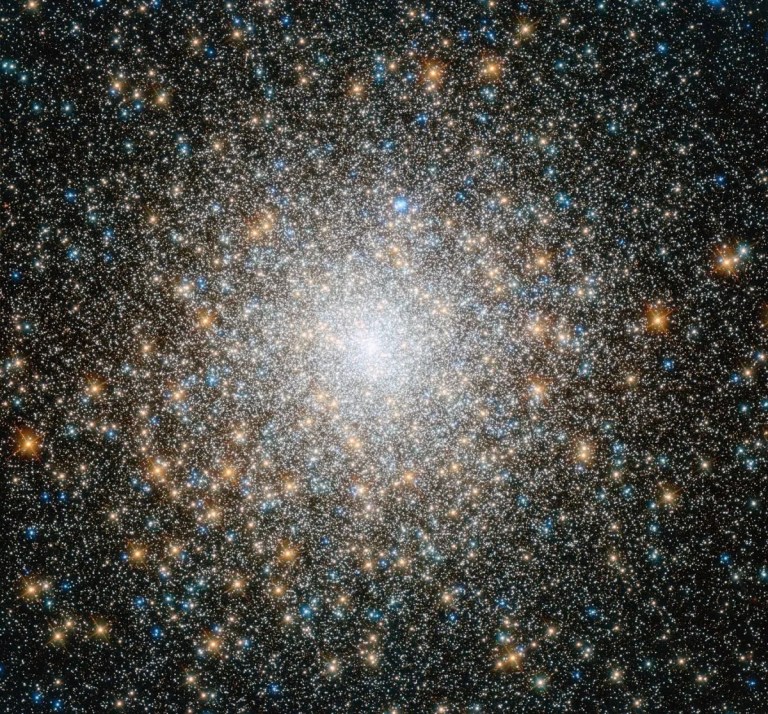
First up is the wonderful globular cluster M5, located 8° southwest of Alpha Ser. German astronomer Gottfried Kirch discovered this object in 1702 but could not resolve it. Modern 10-centimeter or larger scopes deliver exquisite views and show many individual stars.
The other highlight is the easy double star Delta (δ) Ser some 5° northwest of Alpha. Its components shine at magnitudes 4.3 and 5.2 with a 4″ gap between them. The pair forms a lovely sight even through small instruments, especially when using a moderately high magnification.
Star Dome
The map below portrays the sky as seen near 30° south latitude. Located inside the border are the cardinal directions and their intermediate points. To find stars, hold the map overhead and orient it so one of the labels matches the direction you’re facing. The stars above the map’s horizon now match what’s in the sky.
The all-sky map shows how the sky looks at:
10 p.m. September 1
9 p.m. September 15
8 p.m. September 30
Planets are shown at midmonth
Dr. Martin George is an astronomy speaker and writer who currently serves as Chair of International Development and Elections at the International Planetarium Society.