Venus is the brightest object in the west after sunset, reaching its greatest illuminated extent this month. Neptune reaches opposition, with Saturn in the same region of sky. Uranus could be visible from dark skies without optical aid; we’ll tell you where to look. Mars is slowly brightening, while Jupiter is ready for observing in the morning sky.
There’s limited viewing of Mercury this month due to its unfavorable location on the ecliptic, which is inclined at a low angle relative to the western horizon. Look for it near the Moon on Sept. 12, when they stand some 11° apart and at the same altitude. Mercury shines at magnitude –0.6. Your observing window is only five to 10 minutes, as the pair sets shortly before 8 p.m. local daylight time from 40° north. From a spot with a clear western horizon, look 20 minutes after sunset. You’ll see Venus first, 18° east of the Moon and 8° high. The Moon is only 2° high and setting. Those in the desert southwest with a flat horizon and a dry, transparent sky may be the only ones to catch the view.
Mercury begins to spring up out of the solar glow at the end of the month, although the low angle of the ecliptic still favors Southern Hemisphere observers.
Venus dominates the evening sky and is best seen early in the month. On the 1st it stands 10° high in the west 30 minutes after sunset. As the sky darkens, you’ll spot Spica 1.5° above it. Venus sets by 9 p.m. local daylight time.
If you look west at the same time each evening, you’ll see Venus drop in altitude. For example, at 8:30 p.m., Venus stands 5° high on the 1st and is only 2° high by the 7th. A crescent Moon joins Venus Sept. 13 and 14, lying 6° west of the planet on the 13th and nearly 7° east of it on the 14th.
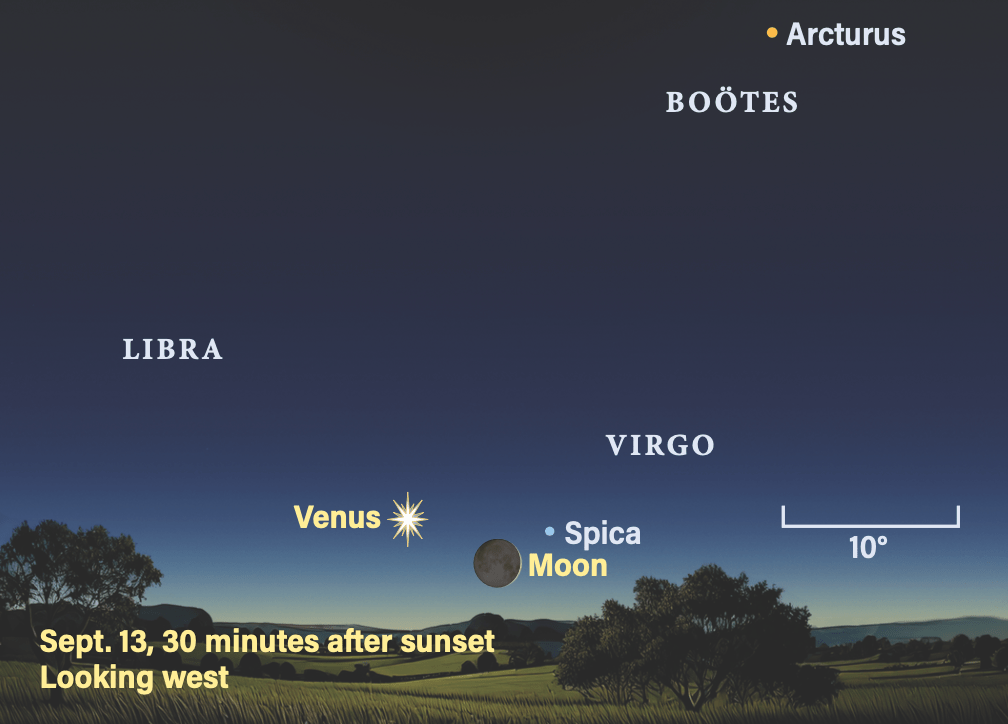
Venus reaches its greatest illuminated extent, now a dazzling magnitude –4.8, on the 18th. Setting earlier each evening, it is gone within about an hour of sunset. Through a telescope, Venus exhibits a 26%-lit disk spanning 39″. By the 21st, Venus stands 38° east of the Sun but its declination of –19° places it very low in the sky during Northern Hemisphere twilight.
On the last day of the month, try spotting both Venus and Mercury just 1° and 2° above the western horizon, respectively, 30 minutes after sunset. You’ll need a flat western horizon and very transparent skies to see them both. Mercury stands 9° from Venus.
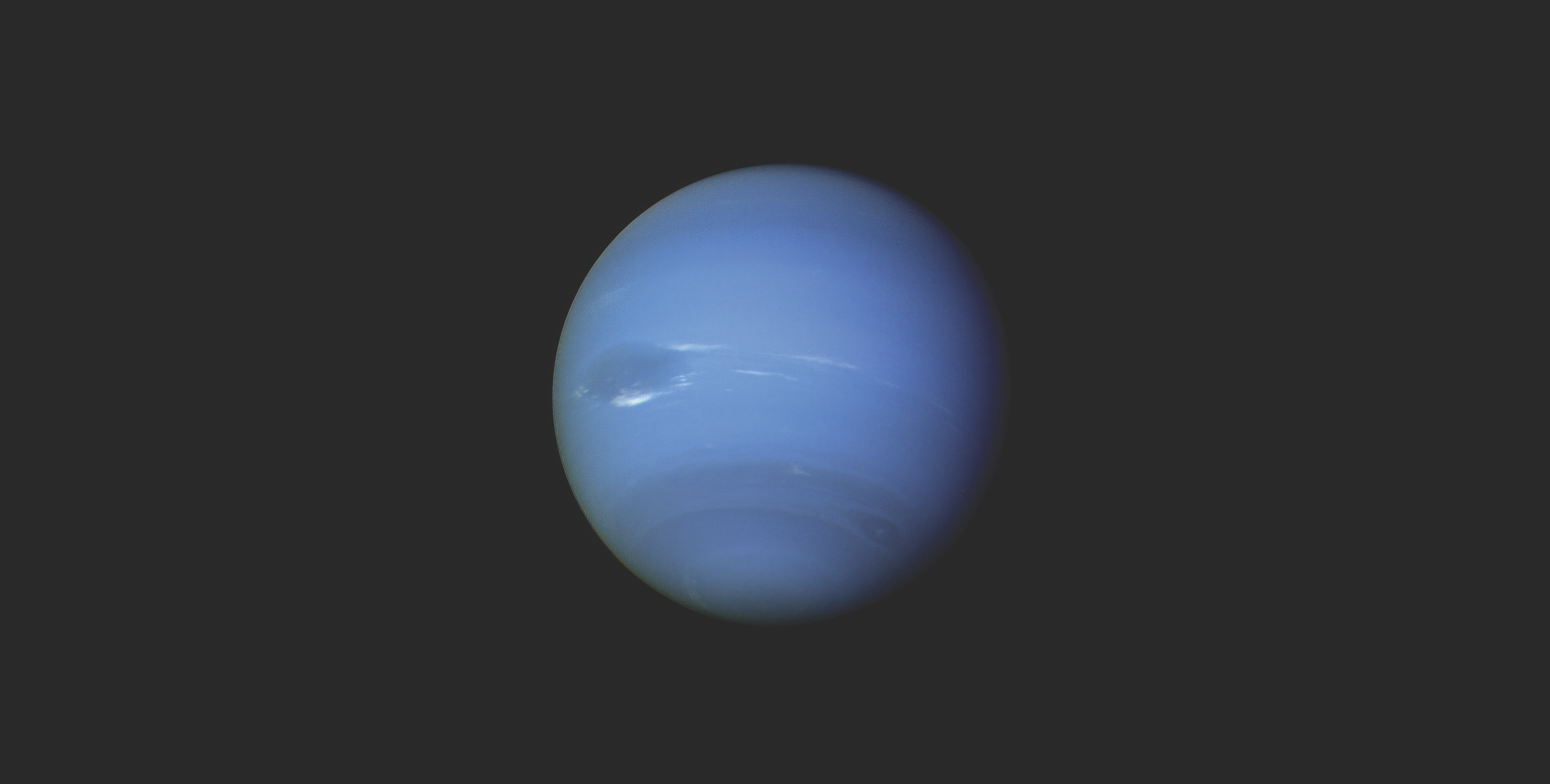
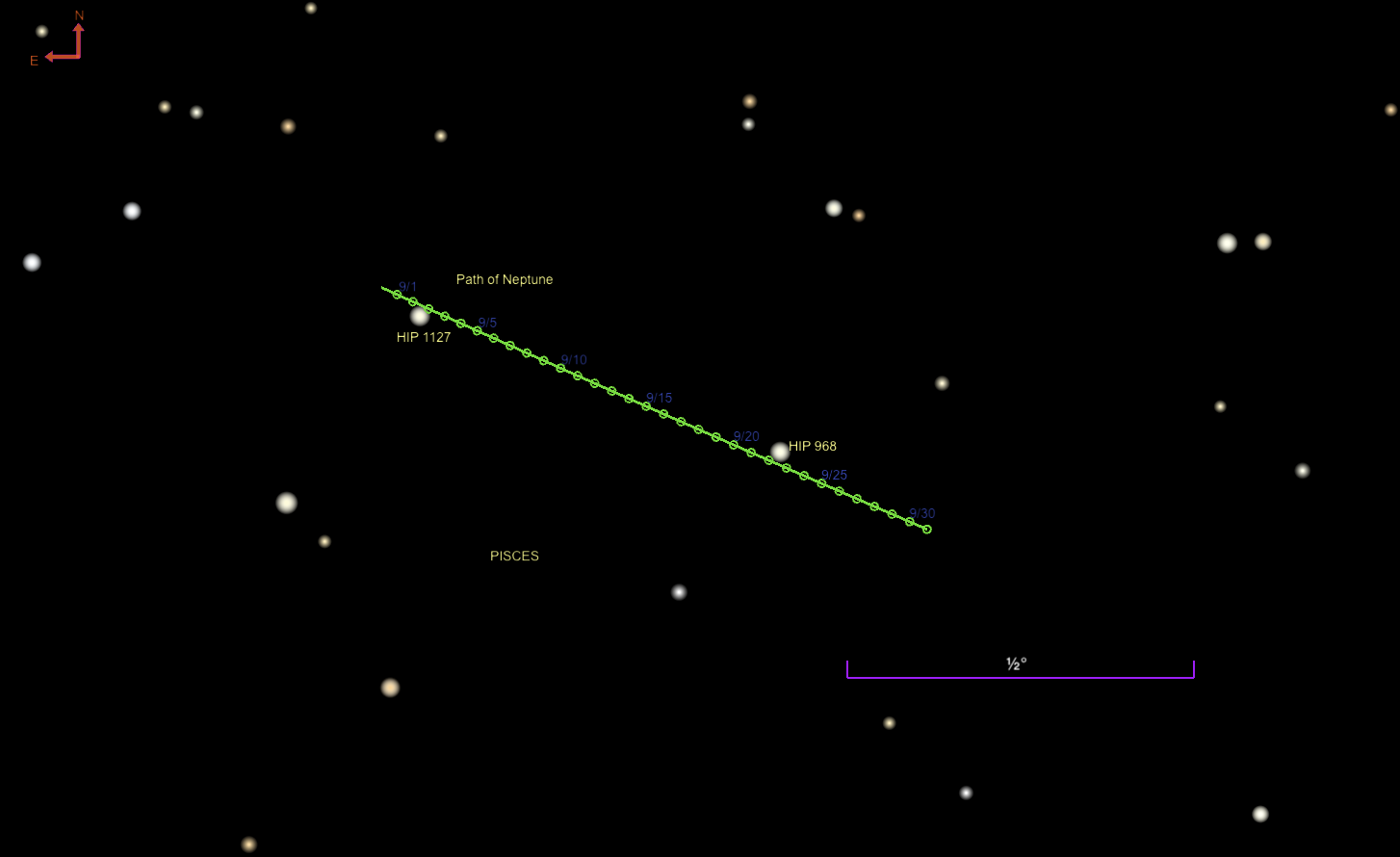
Neptune rises in the east as the Sun sets in the west, marking the time the distant planet reaches opposition, which occurs Sept. 25. At magnitude 7.7, it’s within reach of binoculars.
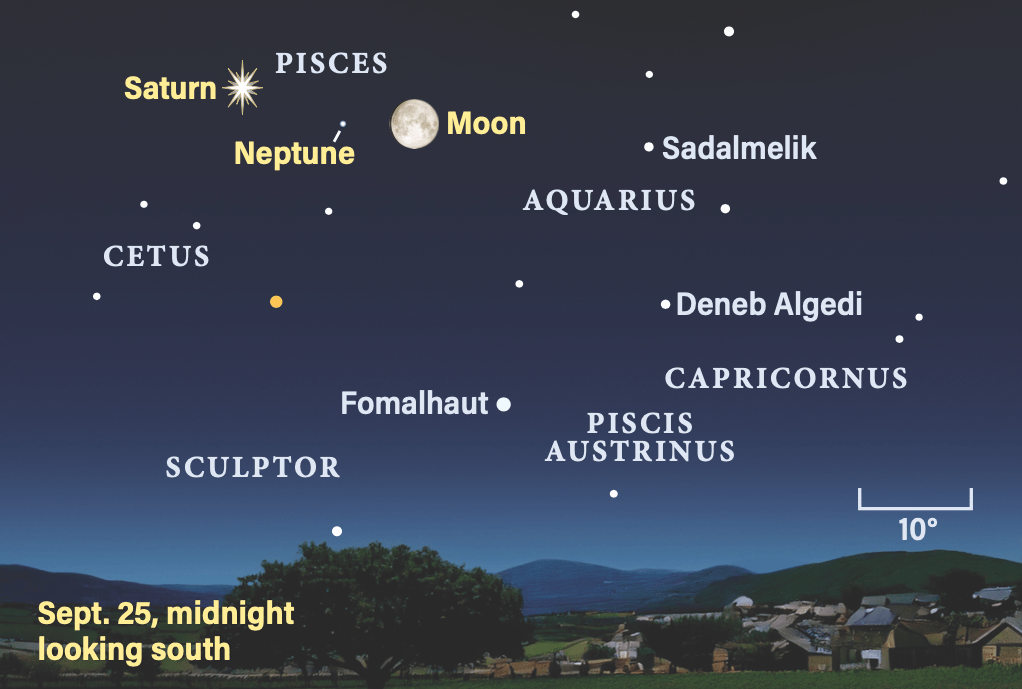
Neptune lies in southern Pisces, with no bright stars nearby. Saturn is 9.5° to its east, and an imaginary line drawn down the eastern side of the Square of Pegasus points right at Neptune’s location.
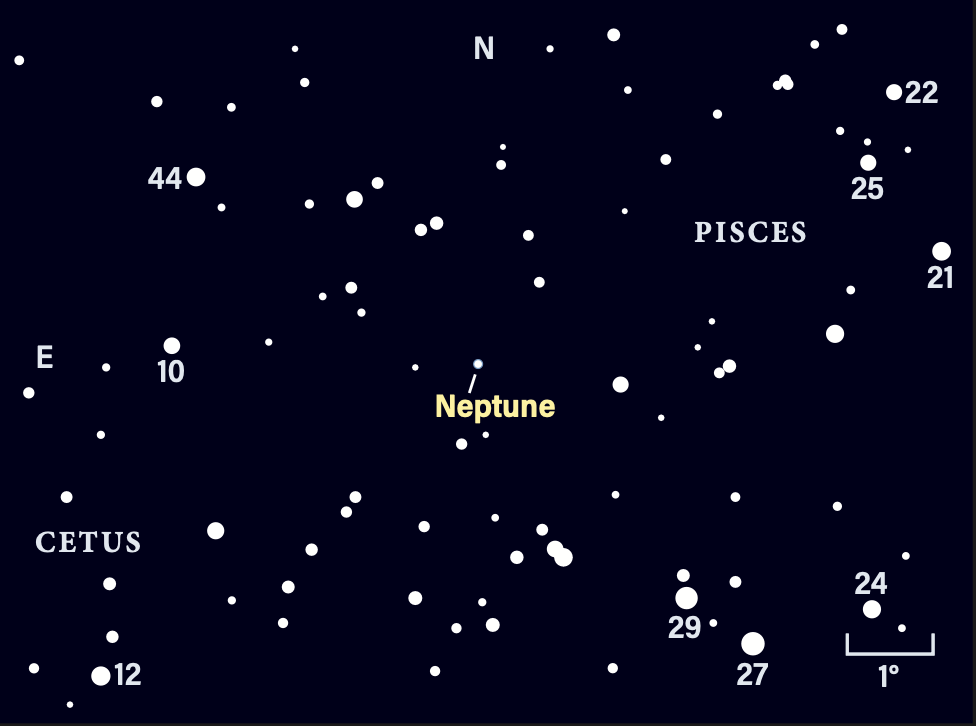
As you scan this region, you’ll come across a large parallelogram of 4th- and 5th-magnitude stars consisting of 27, 29, 30, and 33 Piscium. Neptune lies about 4° northeast of 29 Psc, the northeasternmost star in the parallelogram. Try on Sept. 3, when Neptune stands within 1′ of a magnitude 8.6 field star (HIP 1127). The bluish glow of Neptune contrasts well with the yellowish main sequence star. Neptune has a similar encounter on the 24th, standing 1.5′ from another yellow main sequence star (HIP 968), which shines at magnitude 8.7. Neptune looks distinctly nonstellar in comparison, its disk spanning 2″.
Click on the images below for larger versions to help you better find Neptune’s position relative to the background stars.
On the night of Neptune’s opposition, a Full Moon stands to the lower right of Saturn, with Neptune 9° southwest of the ringed planet. Saturn dominates Pisces, starting the month at magnitude 0.4 and brightening by 0.1 magnitude as it approaches next month’s opposition. Both Saturn and Neptune are best observed around midnight, when they are high in the southeastern sky.
In early September Saturn rises around 9 p.m. local daylight time, and by 7 p.m. on the 30th, when it is well up by 8 p.m. and visible all night. Saturn’s rings are opening, tilted by more than 8° early in September, although they narrow slightly throughout the month.
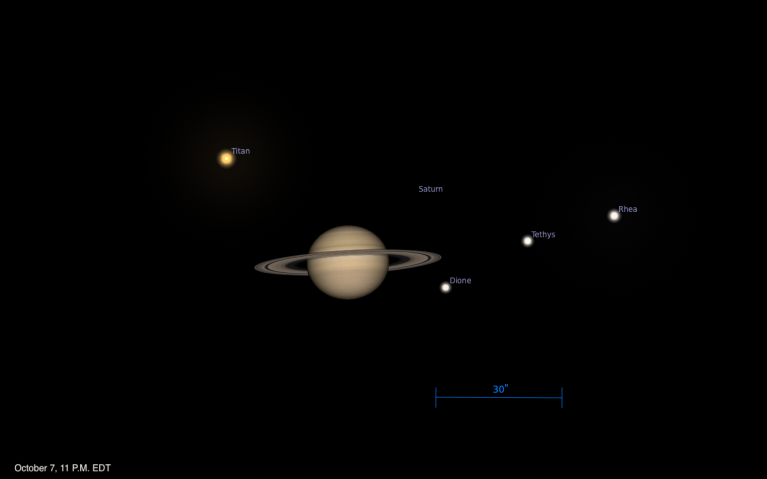
Titan, Saturn’s brightest moon, wings around the planet every 16 days. You’ll find it close to Saturn on the 5th and 6th, when it lies northeast and northwest of the planet, respectively. On the 13th and 14th, Titan lies southwest and southeast of Saturn, respectively.
On Sept. 21/22, Titan again stands northeast of Saturn and is very close to a magnitude 10.6 field star. Titan passes some 2″ south of the star at 1:17 a.m. EDT on the 22nd (still late on the 21st for the western half of the U.S.). Titan returns south of the planet Sept. 29 and 30.
Tethys continues a series of transits and shadow transits. These are a challenge for advanced observers. One occurs the morning of Sept. 11, between about 4 a.m. EDT and 5 a.m. CDT (note the time zone change: The event ends only half an hour before sunrise on the East Coast). A second occurs overnight on Sept. 12/13, from around 1 a.m. to 3:30 a.m. EDT on the 13th (still late on the 12th in other time zones). A third event occurs Sept. 14, starting shortly after 10 p.m. EDT and lasting about 2.5 hours.
Dione skims the northern pole of Saturn Sept. 12 between about 2:55 a.m. and 3:35 a.m. EDT (note this event begins just before midnight PDT on the 11th). Its shadow precedes the moon by about 50 minutes, appearing shortly after 2 a.m. EDT. As Dione approaches the northeastern limb, Tethys is lining up to enter the planet’s extended shadow to its southwest. Tethys begins to dim about 2:10 a.m. EDT.
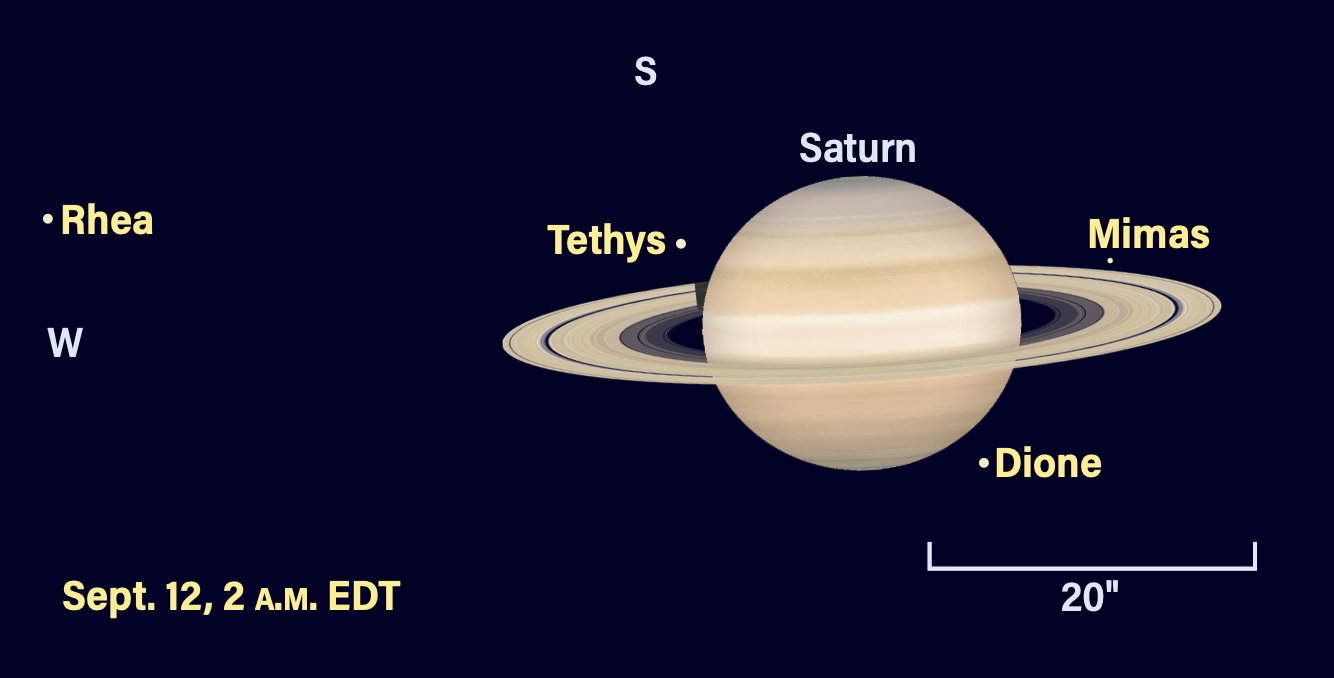
Iapetus passes through inferior conjunction Sept. 12. You’ll find it located 1.9′ due north of the planet on the night of Sept. 12/13. It’s heading toward western elongation early next month, when its brighter hemisphere faces Earth. As it does so, Iapetus brightens from 11th magnitude in mid-September to 10th magnitude by the end of the month. Follow Iapetus as it moves west. On the 30th, it stands 9.5′ west of Saturn.
Uranus is midway between the Pleiades and Hyades star clusters. It spends the month between 5th-magnitude Omega (ω) Tauri and 4th-magnitude 37 Tauri, which stand 3.3° apart and are easily spotted with your eyes or in binoculars. Uranus is 1° northwest of fainter Omega on Sept. 1. The ice giant ends its prograde (eastward) path on the 10th, when it halts and resumes a retrograde (westward) track.
Uranus shines at magnitude 5.7, potentially visible to the unaided eye from a dark location with a moonless sky. It’s a perfect month to try this feat: The pair of guide stars mentioned above makes it easy to locate the position of the planet.
This distant world is so far away — 1.78 billion miles — that even though it spans about 4 Earth diameters, through a telescope it appears as a tiny, 4″-wide disk.
Mars is located in central Gemini as September begins. The Red Planet rises shortly before 2 a.m. local daylight time on the 1st, and by 1:30 a.m. on the 30th. A waning crescent Moon joins Mars the morning of Sept. 6, some 6° away.
Mars moves eastward against the background stars and crosses into Cancer Sept. 25. It brightens from magnitude 1.2 to 1.1 during the month, similar in brilliance to Pollux. Mars passes 6° due south of this star at midnight on the 18th.
Mars remains a tiny 5″ across, too small for easy visual observation. Experienced imagers will be targeting the world, however, already searching for potential dust storms hiding its features. It reaches opposition in February.
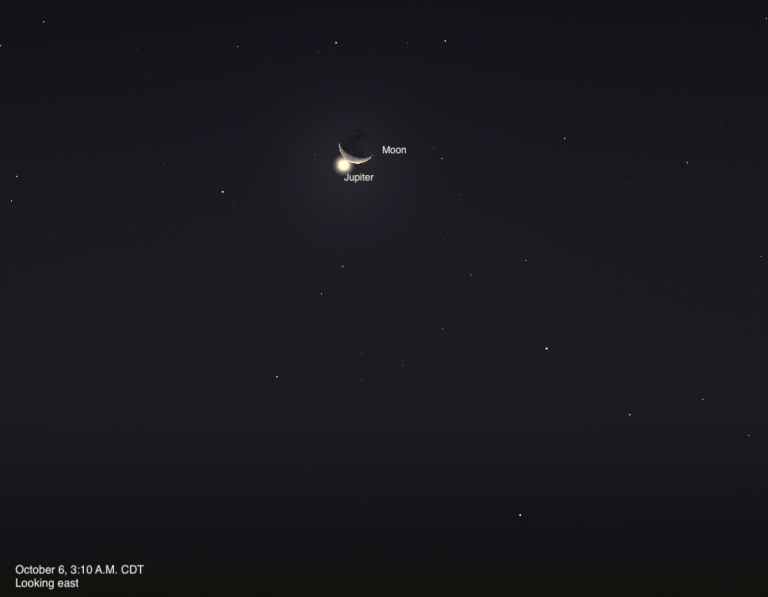
Jupiter is in Cancer as September begins, glowing at magnitude –1.8. It rises shortly after 4 a.m. local daylight time on Sept. 1, not long before twilight breaks. A beautiful waning crescent Moon stands 5° from Jupiter the morning of Sept. 8.
Jupiter crosses into Leo Sept. 24 and ends the month standing nearly 11° northwest of Regulus, Leo’s brightest star. By this time Jupiter has brightened to magnitude –1.9. It’s a good time for observing the gas giant, as it is nearly 30° high in the east by 5:30 a.m. local daylight time around the start of twilight.
In a telescope, Jupiter reveals its banded atmospheric structure: two dark equatorial belts, with more subtle features north and south of those belts.
The four Galilean moons occasionally transit the disk. The window of observability for these events is currently narrow. Notably, Ganymede — the largest moon — transits on Sept. 29. The transit takes more than three hours and is visible across the U.S. Observers in the eastern half of the country see the event begin at 5:24 a.m. EDT. The western U.S. sees Ganymede leave at 6:02 a.m. PDT.
Earth reaches its autumnal equinox Sept. 22 at 8:05 p.m.
Rising Moon: No glory for Galileo
We have dressed the Moon’s face with the honor roll of great scientists and philosophers of human history. The bigger the name, the more impressive its feature, generally, with the best craters reserved for the pre-telescopic thinkers.
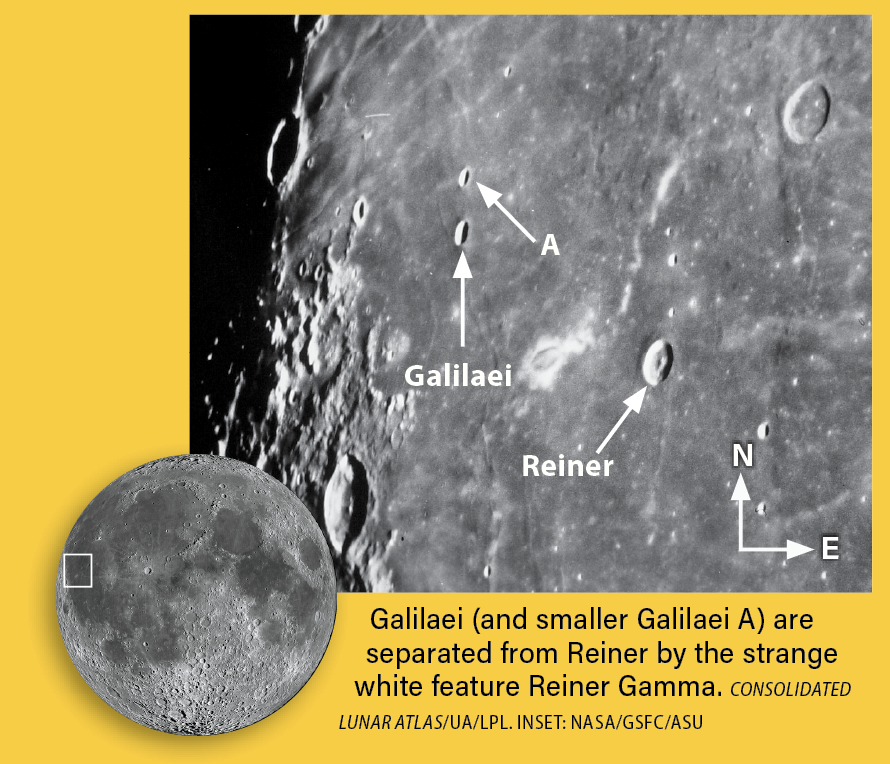
Galileo must have rubbed the lunar cartographers the wrong way, then, because his crater is half the size of and less prominent than the one named for his friend and student, Reiner. Appropriately though, they appear near each other as isolated islands in the large western “sea” named Oceanus Procellarum. Look for them due west of Copernicus, the dominating large crater with prominent rays near the middle of the Moon’s disk.
Spanning nearly 10 miles in diameter, Galilaei is a classic sharp-rimmed crater, young in that it formed well after the huge lava upwellings that characterized the earlier parts of the Moon’s existence.
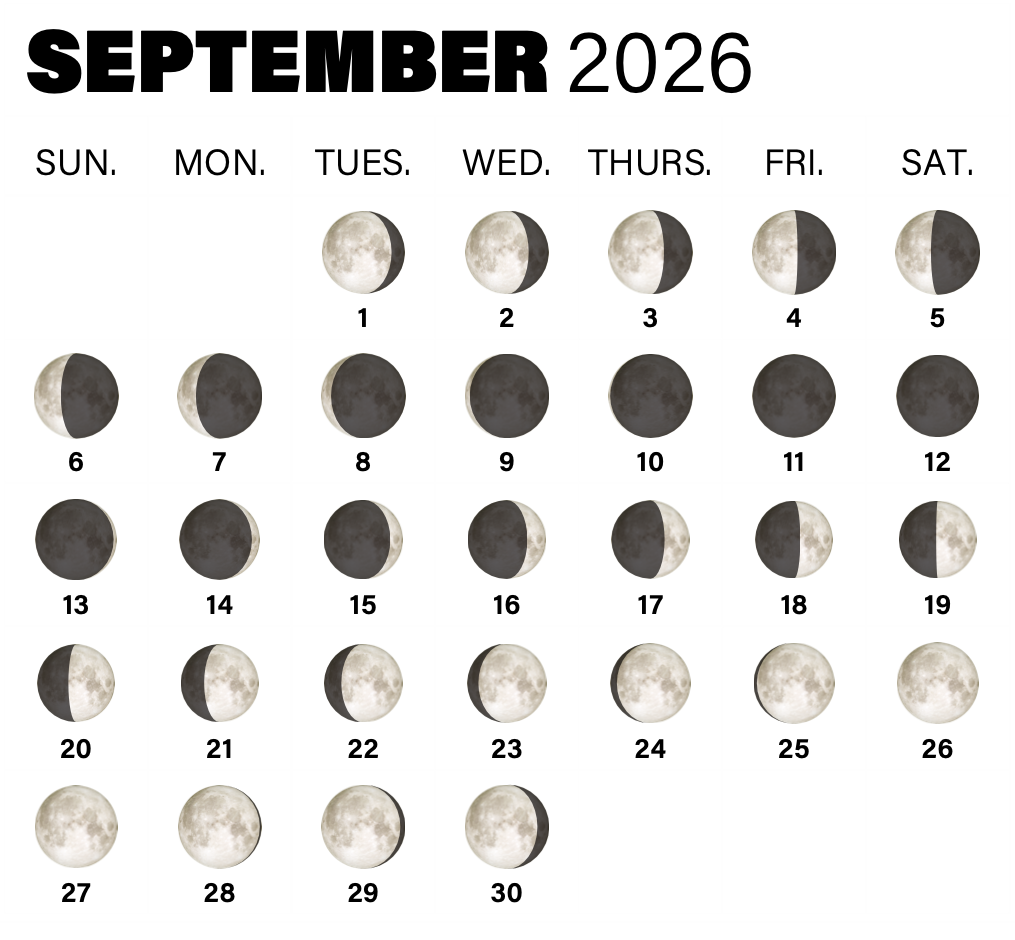
On the 23rd, look for the gorgeous hills, rilles, and ridges. Note the super-long, sinuous wrinkle ridge snaking through Galilaei and its junior, A. The craters break up the ridge, solid evidence that the impacts came after the lava of Procellarum solidified. Just to the northeast lies a fantastic field of volcanic domes called the Marius Hills. Can you see the thin rille Rima Galilaei wriggling along the hills’ western flank?
The weird stuff becomes visible on the 24th, the Sun now high enough in the lunar sky that albedo (brightness) features catch the eye more than shadowed topographic ones. Use a filter to reduce the intensity of light coming through the eyepiece. A most curious splotchy white feature, Reiner Gamma, lies between Galilaei and Reiner. Apollo missions confirmed this is not topographic in origin, but like other white splotches on the farside, is quite magnetic. To date, there is no widespread agreement as to what it is or how it formed — a lasting lunar mystery!
Meteor Watch: Many lights
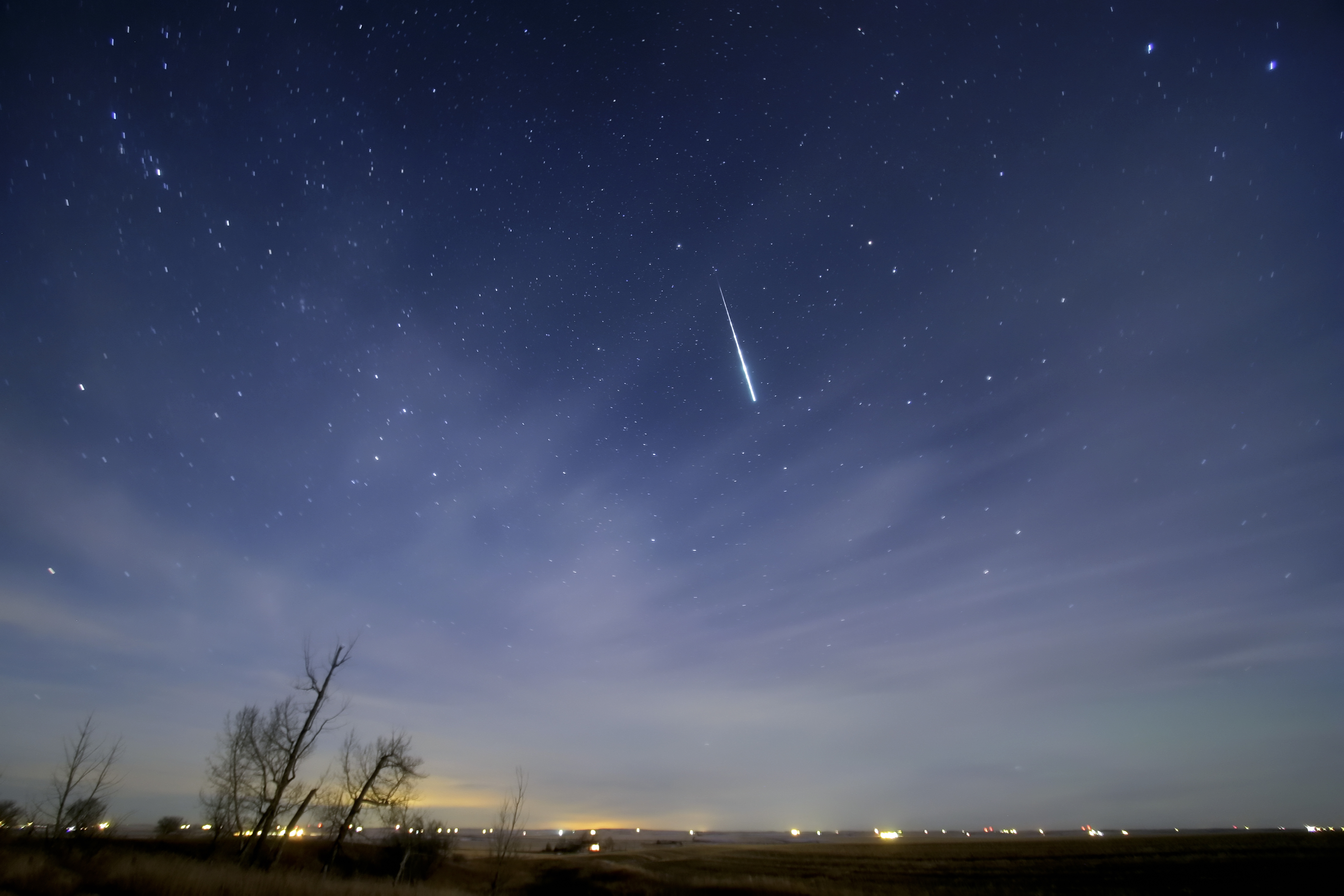
No major meteor showers occur in September. There is, however, an elusive glow from the meteoritic debris that fills the inner solar system. It is visible in the east before dawn when there’s no Moon. This is the zodiacal light, a cone-shaped glow aligned with the ecliptic. Look for it at least an hour before dawn, reaching up through Leo toward where Jupiter sits.
With a New Moon Sept. 10, the following seven to 10 days are a good time to view this glow, with the Moon limited to the evening sky. Travel well away from any city; higher altitude also aids viewing this light. Avoid streetlight glow from cities to your east.
While observing the planets in the morning sky, also keep an eye on the sky for sporadic meteors, and possibly a fireball. Random meteors add to the splendor of a night under the stars. There’s always something special happening in the sky.
Comet Search: Gone fishin’
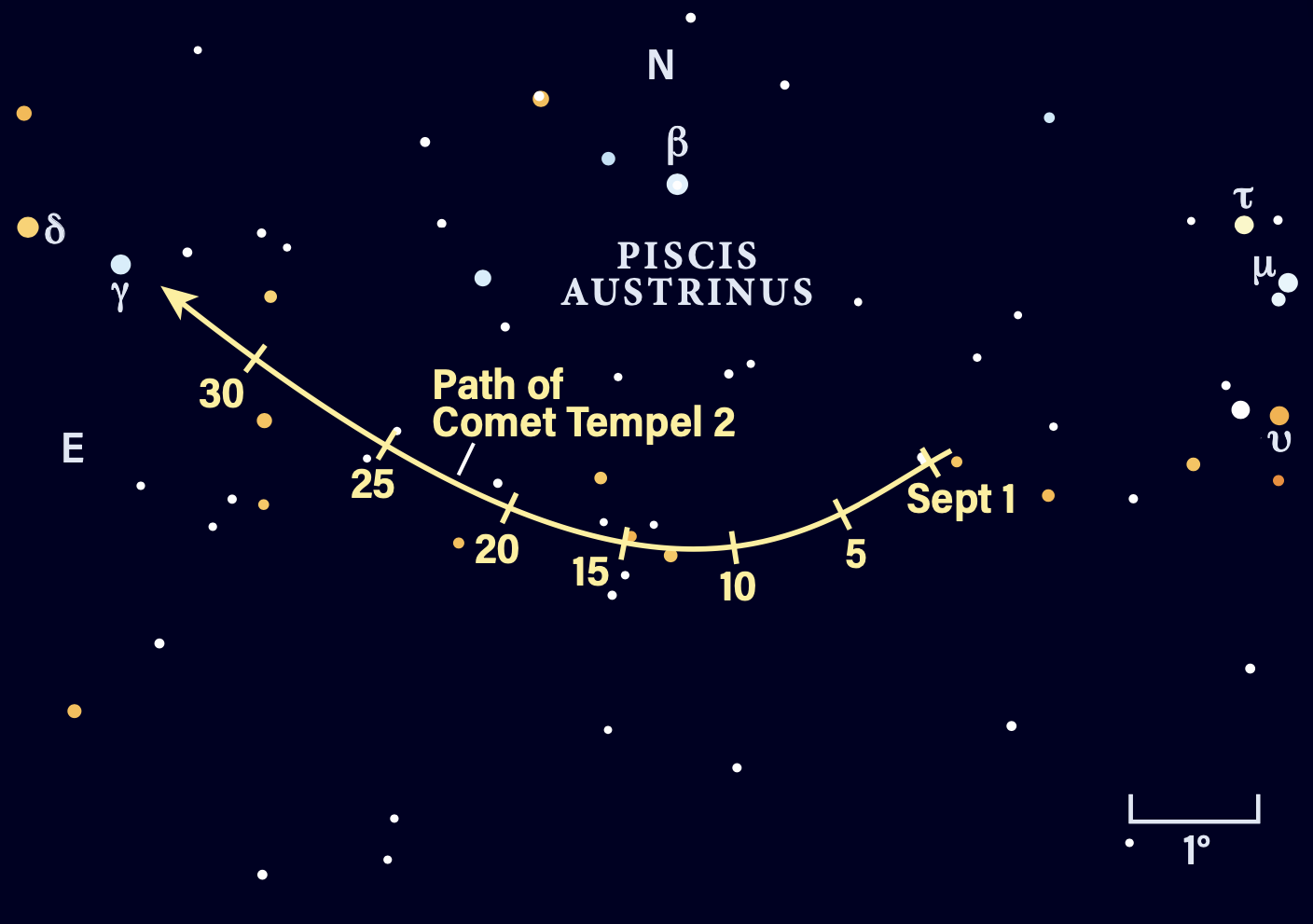
Getting upstaged by a surprise visitor is pretty common for comets like 10P/Tempel (also called Tempel 2). We’ll take one, but Tempel 2’s respectable 8th magnitude will keep us well entertained as autumn begins. The classic green diatomic carbon glow might just be seen in larger scopes.
Look low in the south beginning around midnight to find Fomalhaut in Piscis Austrinus swimming near the horizon, then shift another binocular field to the southwest. After a quick peek in binoculars and under low power in a scope, bump up the magnification to 150x if the night allows, revealing a bizarre galaxylike shape. The glow from the outflow of dust should be flattened and better defined with an off-center false nucleus.
Discovered in 1873 by Wilhelm Tempel, this is a short-period comet, circling the Sun in 5.36 years. It never gets closer than Mars, nor as far as Jupiter, tracing out a moderately asteroidlike path. The extra time past the decimal means we only get reasonable apparitions every 16 years, and the next won’t be as good as this one.
Locating Asteroids: Studious search
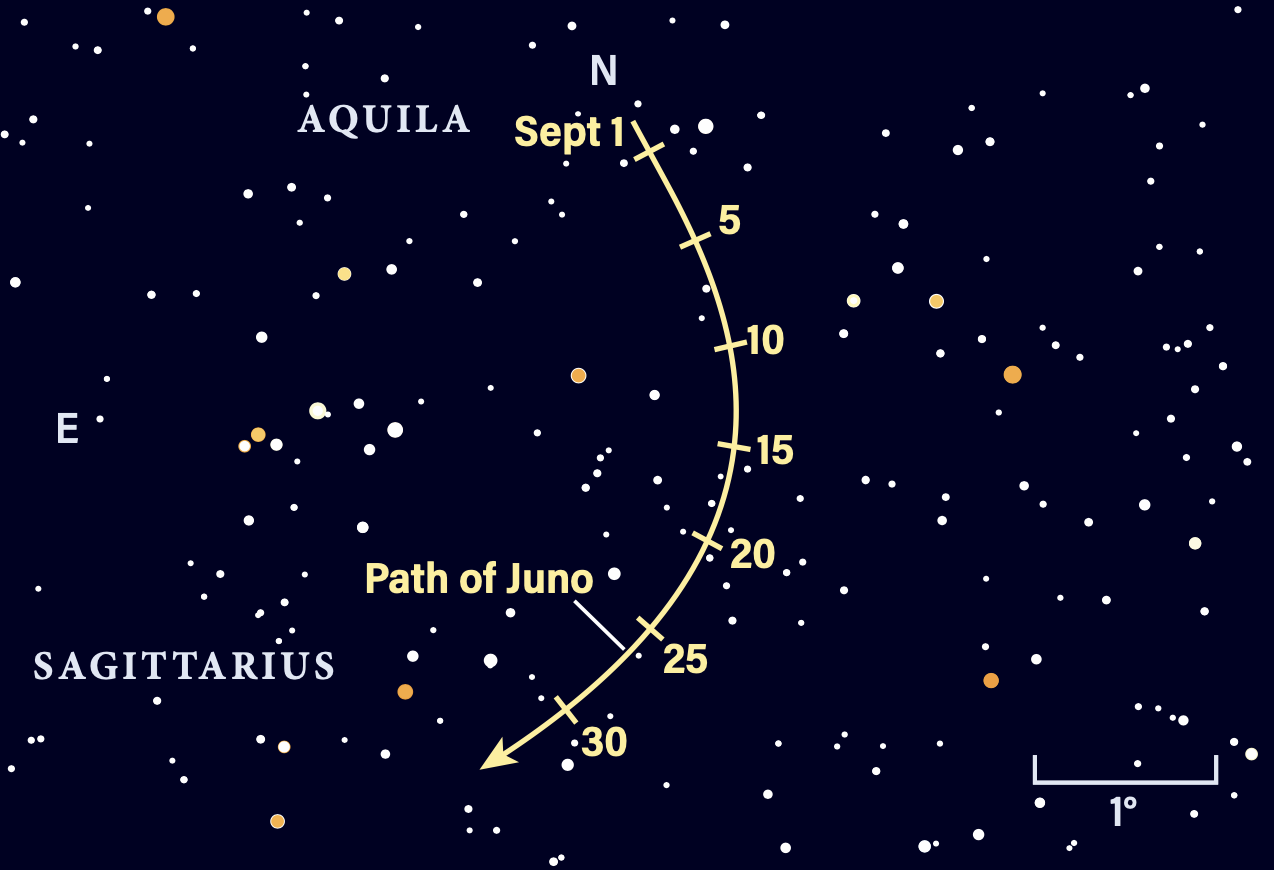
The magnitude of an asteroid follows the same rules as that of Mars: Not only does it have to be close to Earth to shine brightly, it also needs to be close to the light source: the Sun. This month we’ve got a bit of both, adding up such that asteroid 3 Juno starts the month at magnitude 9.4, then slowly drops off as Earth pulls ahead on the solar system race track. In 2031, Juno will be two magnitudes brighter as these parameters fully combine.
Whether you are star-hopping or go-to-ing, you’ll need a methodical search technique to home in on a point about halfway between the Scutum Star Cloud and the marvelous golden double star Alpha (α) Capricorni. Sept. 18 to 21 is the best time to catch 145-mile-wide Juno as it passes through a random collection of 9th- to 10th-magnitude stars. A view at 80x will net you eight to 10 dots, one of which will be Juno. Come back in a night or two to see which one moved. That’s how Karl Harding found it in 1804.
Other nights, Juno may be the only dot in the field. That’s when you should deliberately slew the scope toward bright stars on the chart or in a planetarium app to confirm that they enter the field as expected.
Also check out Juno’s Little Gem of a neighbor: NGC 6818 is a planetary nebula of similar magnitude to Juno, about 3° to the south. An OIII filter will make it pop out of a suburban sky.
Star Dome
The map below portrays the sky as seen near 35° north latitude. Located inside the border are the cardinal directions and their intermediate points. To find stars, hold the map overhead and orient it so one of the labels matches the direction you’re facing. The stars above the map’s horizon now match what’s in the sky.
The all-sky map shows how the sky looks at:
10 p.m. September 1
9 p.m. September 15
8 p.m. September 30
Planets are shown at midmonth
Martin Ratcliffe is a planetarium professional with Evans & Sutherland and enjoys observing from Salt Lake City. Alister Ling, who lives in Edmonton, Alberta, is a longtime watcher of the skies.