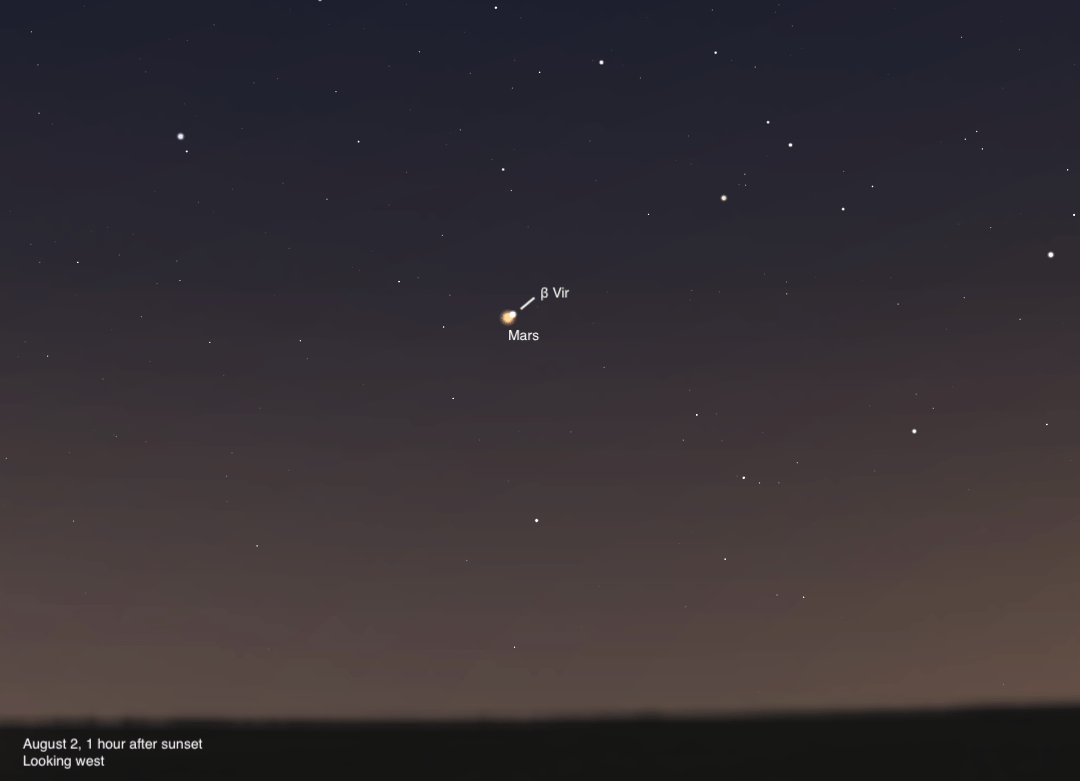
Mars is now moving through Virgo, sitting low in the western sky after sunset. Shining at magnitude 1.6, the planet is at its faintest for the year; in the coming months, it will slowly start brightening again, but with a price. It’s now closing in on the Sun from our point of view, heading for solar conjunction early next year. It will remain visible only until about mid-November before it drops entirely from view.
Tonight, though, the Red Planet is still some 10° high an hour after sunset. It is passing close to 4th-magnitude Beta (β) Virginis, also called Zavijava, and today Mars stands just 8′ southeast of this star. They are readily visible together in binoculars or a telescope, presenting a nice contrast between the star’s pinpoint white glow and the planet’s ruddy, 4”-wide disk. Mars is too far from us to really see surface features, as it is now some 197 million miles (317 million km) away. But compare that with Zavijava, a relatively nearby star, which sits 36 light-years distant.
According to stellar expert Jim Kaler, Zavijava is a relatively Sun-like star with about a quarter more mass than our Sun. It is a little less than twice as wide and about 3.5 times as bright as our star.
Sunrise: 6:00 A.M.
Sunset: 8:12 P.M.
Moonrise: 3:06 P.M.
Moonset: —
Moon Phase: Waxing gibbous (61%)
*Times for sunrise, sunset, moonrise, and moonset are given in local time from 40° N 90° W. The Moon’s illumination is given at 12 P.M. local time from the same location.
For a look ahead at more upcoming sky events, check out our full Sky This Week column.