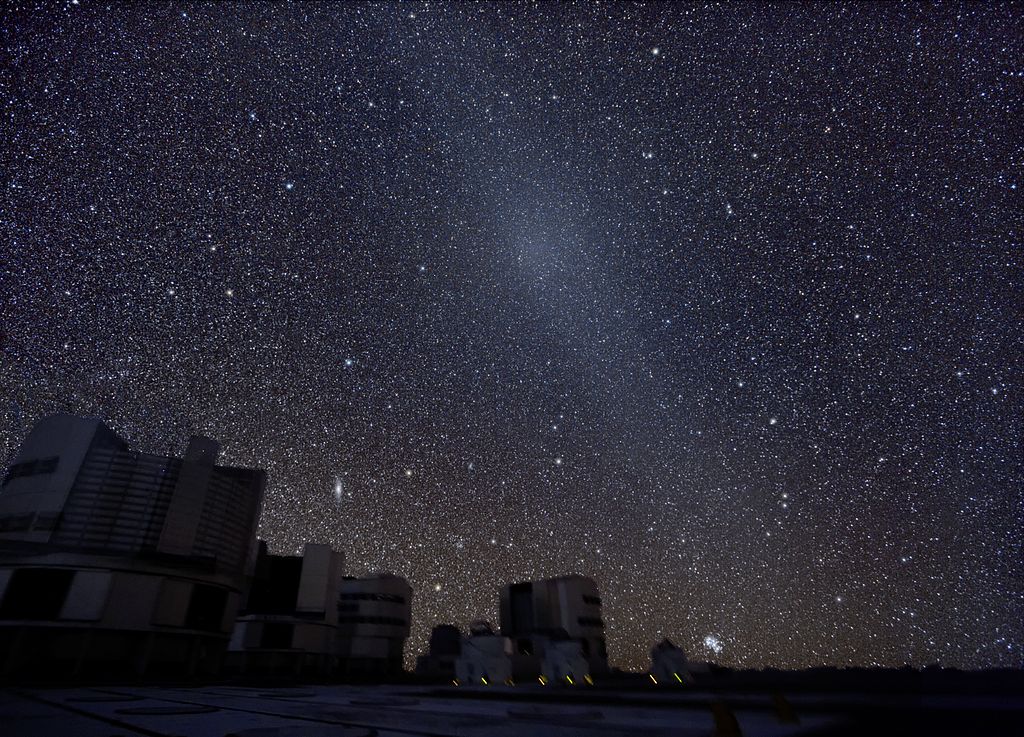
If your observing site has a limiting magnitude of 6 or better, you have an opportunity to see an elusive sight known as the gegenschein. Simply look toward whatever constellation of the zodiac is opposite the Sun, once that constellation has risen past about 25° altitude. Astronomers call this location the antisolar point. And although an altitude of 25° is a lower limit, your best chance will be to try to see it at local midnight, when it lies on the meridian.
Now you won’t be able to spot the gegenschein, no matter how dark your site is, if the Milky Way is opposite the Sun. Our galaxy’s glow washes out the much fainter glow of the gegenschein. So, if the Scorpius-Sagittarius region or Gemini are opposite the Sun, wait a month and try your search again. This basically eliminates June, July, December, and January. Also, when a bright planet like Jupiter, or Mars at its brightest, is at opposition, its light also will overwhelm the gegenschein.
History
There’s a pretty good case to be made that the German explorer Alexander von Humboldt was the first to spot the gegenschein. He probably saw it in March 1803 on a journey from Lima, Peru, to Mexico, and was the first to name it gegenschein, a German word that means “counterglow.” Later historians have ascribed the discovery to Danish astronomer Theodor Brorsen, who observed and recorded it in 1854.
American astronomer Edward Emerson Barnard made an independent discovery of the gegenschein October 4, 1883, from Nashville, Tennessee. He wrote that he was “struck with the appearance of a large hazy mass of light south of the zenith and near Alpha Pegasi.” He thought it might be a thin cloud.
He continued to observe it, noting that it moved eastward along the ecliptic at a rate of about 1° per day. He thought it might be a comet and sent a note to that effect to another comet hunter, American astronomer Lewis Swift. Swift wrote back that it wasn’t a comet that Barnard had seen, but a zodiacal light phenomenon always opposite the Sun. Swift, a discoverer of 13 comets, lamented to his friend that he had never seen it.
To see it
First (if it’s not one of the months I mentioned above), head to a dark observing site when the Moon isn’t up. Dark adapt your eyes. Locate the antisolar point and let it rise at least one-third of the way above the horizon. You’ll have better luck at midnight, but you might see it before (or after) then. Good luck!