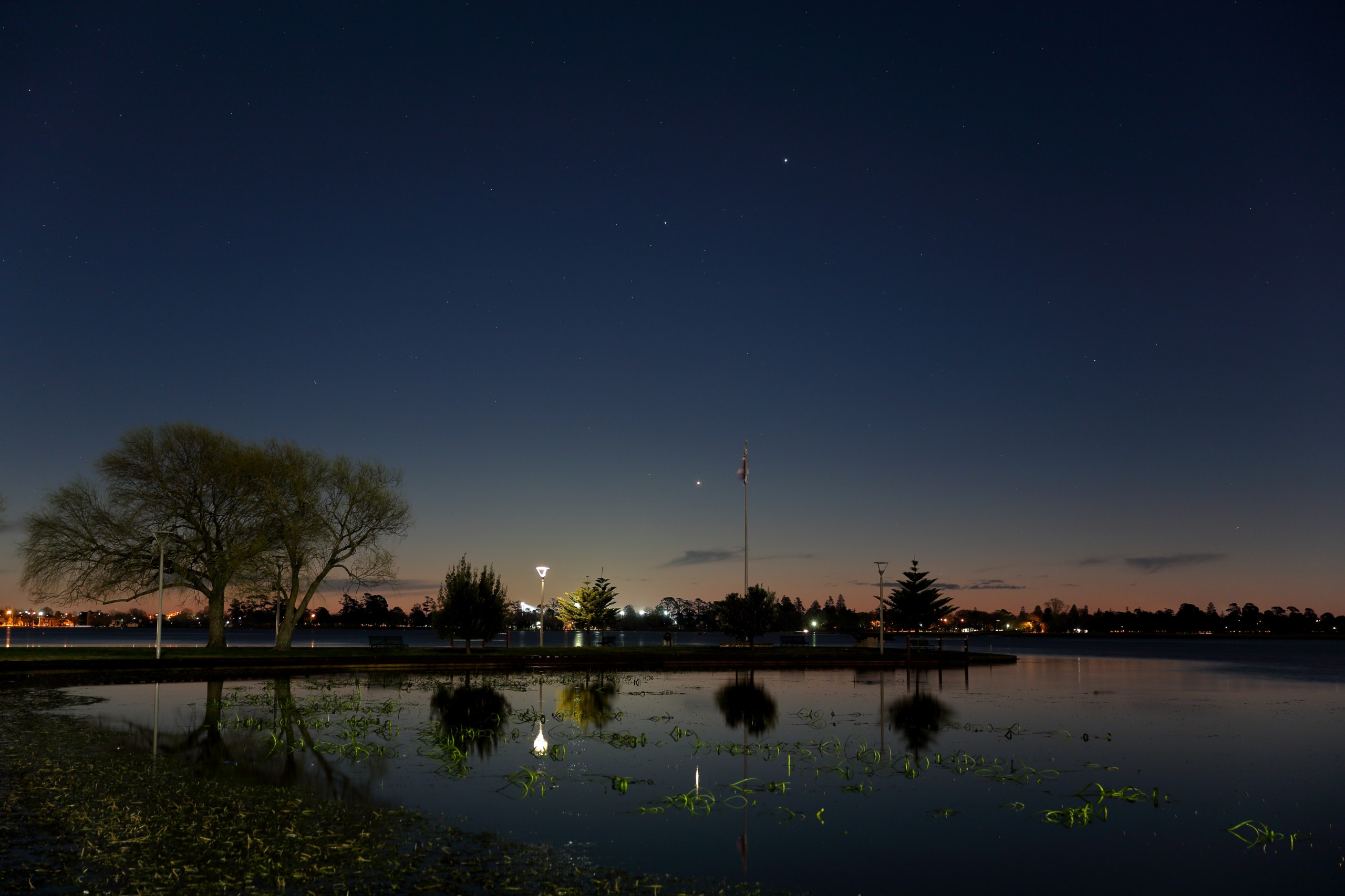
June evenings offer a great chance to view three bright planets. Jupiter, Venus, and Mercury gather in the northwestern sky as darkness settles in, creating a grand sight to the naked eye and worthy targets through a telescope.
Jupiter has been wandering through Gemini the Twins since the dawn of 2026. Shining at magnitude –1.9, it easily bests the constellation’s two brightest stars, Castor and Pollux. The giant planet exits Gemini and enters neighboring Cancer the Crab on June 22.
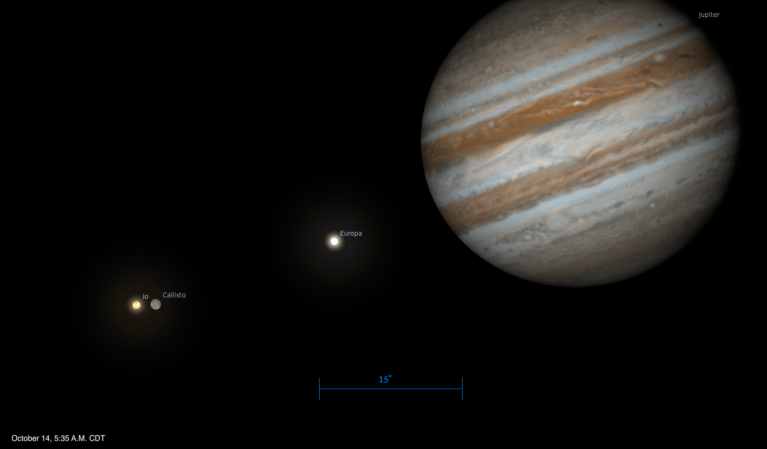
Jupiter is always an attractive telescopic sight. Although it now appears low in the sky, take a few moments to study it up close. The gas giant displays a stunning disk measuring 32″ across in mid-June. Look for a pair of parallel dark belts, one on either side of a bright equatorial zone. More subtle features appear during moments of good seeing. You should also see the planet’s four brightest moons, which change relative positions from night to night.
Although brilliant Venus begins June in Gemini, below Jupiter, it moves rapidly eastward and crosses into Cancer on the 11th and Leo on the 28th. Keep an eye out June 9, when magnitude –4.0 Venus has an attractive conjunction with Jupiter. The inner planet then lies 1.6° due north (lower right) of its larger sibling. Casual skygazers often call my planetarium at times like these wondering what they are seeing.
Follow Venus through a telescope this month and you’ll see its disk grow larger while its phase wanes. On June 1, the inner planet appears 13″ across and 80 percent lit; on the 30th, it spans 16″ and the Sun illuminates 70 percent of its Earth-facing hemisphere.
Our third evening object appears best in mid-June. Mercury reaches greatest elongation on the 15th, when it lies 25° east of the Sun and stands 8° above the northwestern horizon an hour after sunset. The innermost planet shines at magnitude 0.5 from its perch to the lower left of Venus and Jupiter.
A telescope provides a nice view of Mercury. At greatest elongation, it shows an 8″-diameter disk that’s 40 percent lit. Its size increases and its phase decreases as the month progresses.
Saturn rises after midnight local time all month. It begins June among the background stars of Cetus the Whale but crosses into Pisces the Fish within the next few days. The marine creatures feature no star brighter than 2nd magnitude, so the magnitude 0.8 planet stands out.
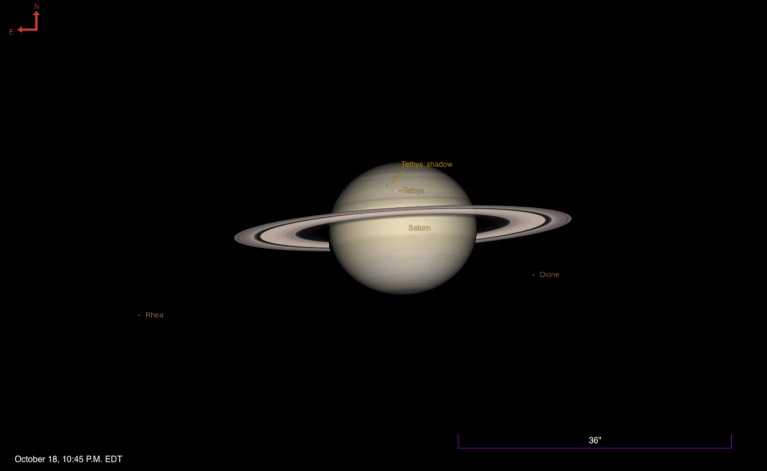
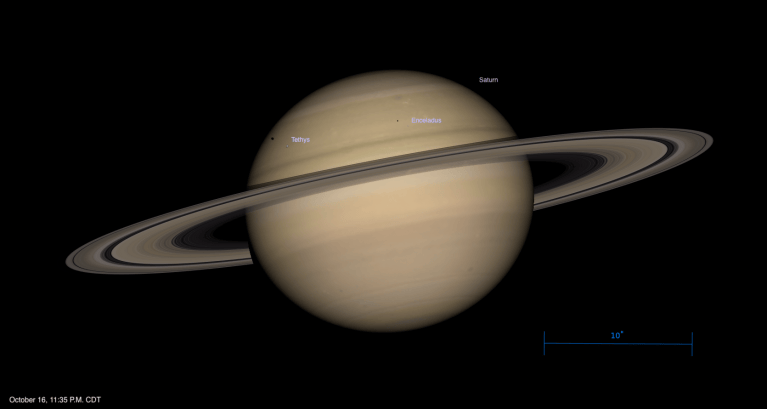
As we move further from its early 2025 ring-plane crossing, Saturn grows more spectacular when viewed through a telescope. On June 15, the planet shows a disk measuring 17″ across the equator while the ring system spans 39″ and tilts 9° to our line of sight. Also keep an eye out for Saturn’s brightest moons. Eighth-magnitude Titan shows up in any telescope, while a 10-centimeter instrument also reveals 10th-magnitude Tethys, Dione, and Rhea.
Mars moves rapidly eastward relative to the background stars, nearly keeping pace with the Sun. That’s why it rises around the same time every morning, within about 10 minutes of 4:30 a.m. local time. The Red Planet starts June in Aries the Ram and passes into Taurus the Bull on the 19th. At month’s end, Mars stands within 5° of the stunning Pleiades star cluster (M45). Unfortunately, the ruddy world remains a disappointment through a telescope, showing a featureless disk just 4″ across.
The Moon occults three bright objects in June. On the 17th, a thin crescent Moon passes in front of Venus for observers in northeastern South America. Two days later, Luna targets the blue-white star Regulus for those in southern Africa and much of Madagascar. Finally, on June 27 (the 28th local time), the nearly Full Moon occults the red supergiant star Antares from southeastern Australia and New Zealand.
The starry sky
Few astronomers have had a bigger impact on the science than American Henrietta Leavitt (1868–1921). More than a century ago, she discovered that Cepheid variables make superb distance indicators for stars in the Milky Way and galaxies beyond. She found a strong relationship between the period of their variation and their luminosity (or absolute magnitude).
One of my favorite Cepheids is Eta (η) Aquilae, which lies just north of the celestial equator in Aquila the Eagle. It comes into view in the east in late evening and climbs high in the north after midnight local time.
For a more southerly Cepheid, look no further than Norma the Square. This constellation contains two fine open star clusters: NGC 6067 and, 4° to the south-southeast, NGC 6087. The latter is also the 89th entry in the Caldwell catalog, a compendium of deep-sky objects the English astronomer Sir Patrick Moore complied.
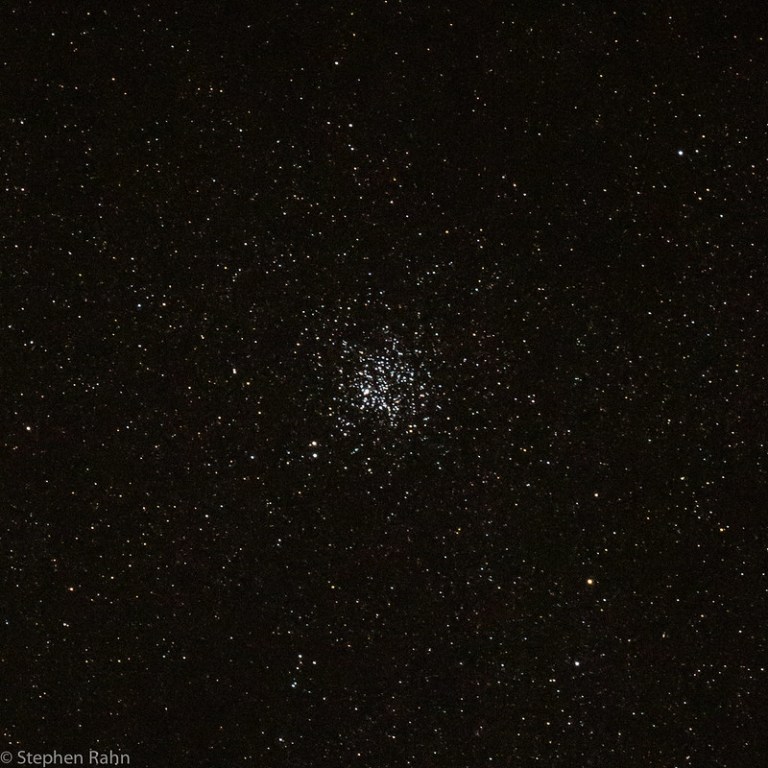
Caldwell 89 shines at magnitude 5.4 and, while it shows up to the naked eye from a dark site, it’s a splendid sight through binoculars or a small telescope. It contains a bright Cepheid variable, S Normae, that varies between magnitudes 6.1 and 6.8 over a period of 9.75 days. It’s easy to identify because it’s the brightest star in the cluster. Observe it for a week or two to see if you can detect its change in brightness.
S Nor shines brightly enough that astronomers once thought it might be a foreground object. But researchers confirmed that it belongs to the cluster in 1955.
Star Dome
The map below portrays the sky as seen near 30° south latitude. Located inside the border are the cardinal directions and their intermediate points. To find stars, hold the map overhead and orient it so one of the labels matches the direction you’re facing. The stars above the map’s horizon now match what’s in the sky.
The all-sky map shows how the sky looks at:
9 p.m. June 1
8 p.m. June 15
7 p.m. June 30
Planets are shown at midmonth