Amateur astronomers, take note: A wonderful celestial event known as a total lunar eclipse will occur in the skies above North America during the morning hours of Tuesday, March 3.
Lunar eclipses happen when the Sun, Earth, and the Moon align, in that order. When this alignment is precise, Earth’s shadow falls upon the Moon, obscuring it from direct sunlight. This doesn’t happen every month, because the Moon’s orbit is tilted to that of the Earth-Sun plane. So, most months our satellite is above or below the point (called a node) where an eclipse can happen.
This eclipse’s visibility takes in a significant portion of the globe. Observers located across North and South America, Asia, and Australia, as well as the Arctic and Antarctica, can see at least some of the event — provided it’s clear.
What’s happening
The progression of a lunar eclipse is divided into several distinct phases, each marked by specific contact times with Earth’s shadow. To complicate things just a bit, our planet’s shadow has two primary components: the penumbra, which is the fainter, outer part where the Earth partially blocks the Sun’s light; and the umbra, the darker, central part where Earth completely blocks direct sunlight.
The initial phase, the beginning of the penumbral eclipse, starts at 08:43:57.6 Coordinated Universal Time, which, when I convert it to Eastern Standard Time, I will call 3:43 a.m. EST. (Observers don’t have to know the times more accurately than which minute each part of the eclipse will start or end.)
At this precise moment, the Moon’s leading edge will contact the outer, diffuse portion of Earth’s shadow. During the penumbral phase, the reduction in lunar brightness is subtle and can be challenging to see, especially during the first half-hour. But eventually you’ll see the Moon gradually dim. Over the first 1 hour 6 minutes of the eclipse, you’ll see Luna’s face continue further into the penumbra.
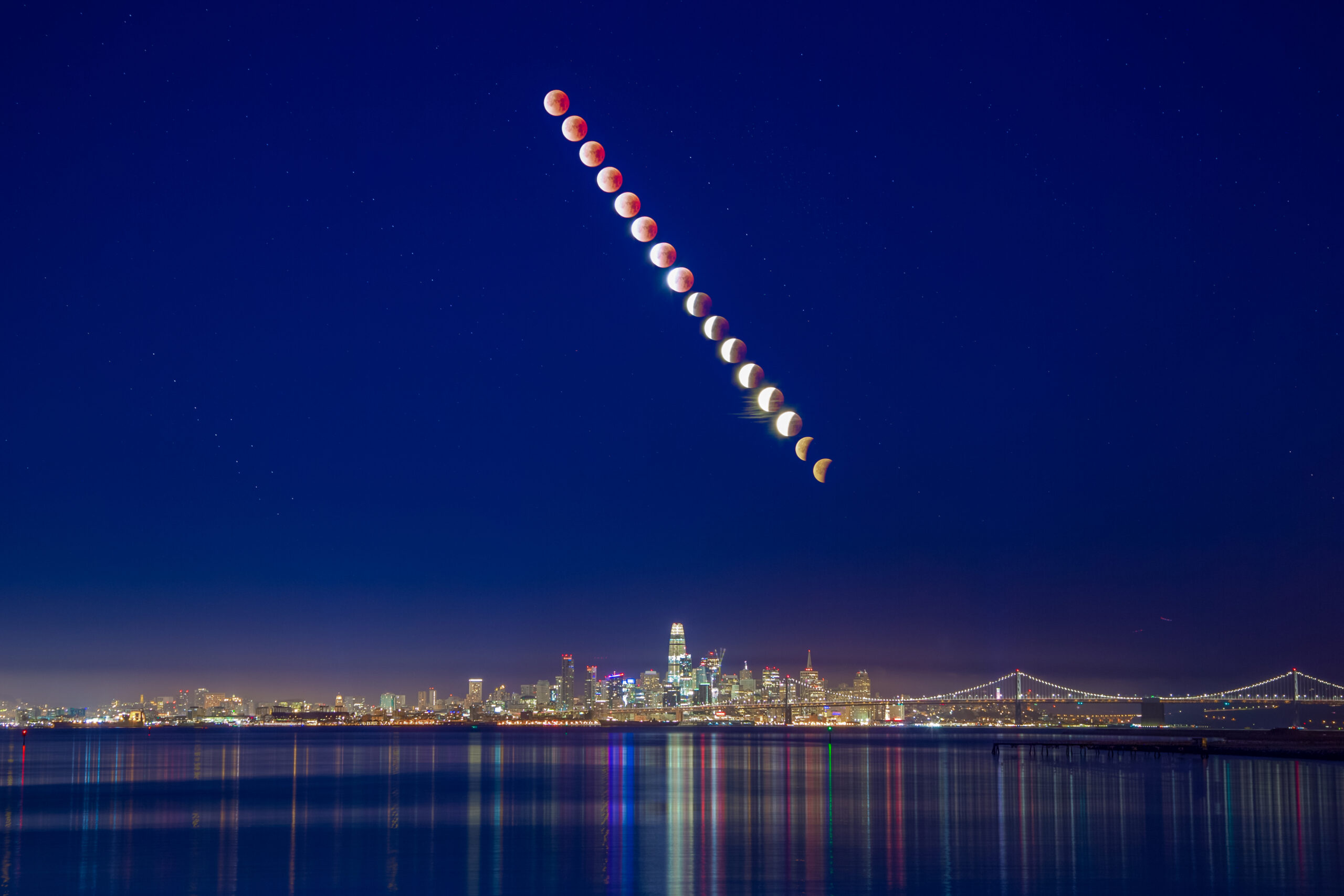
A much more discernible phase, the partial eclipse, begins when the Moon’s leading edge makes contact with Earth’s umbra. This will happen at 4:49 a.m. EST. From this point forward, a distinct, curved portion of the Moon’s disc will appear darkened because Earth is progressively blocking more and more direct sunlight. As the Moon continues eastward through the umbra (while simultaneously setting and moving westward across the sky because of Earth’s rotation), more of its surface will turn dark. This first half of the partial eclipse will last for 1 hour 14 minutes.
A colorful Moon
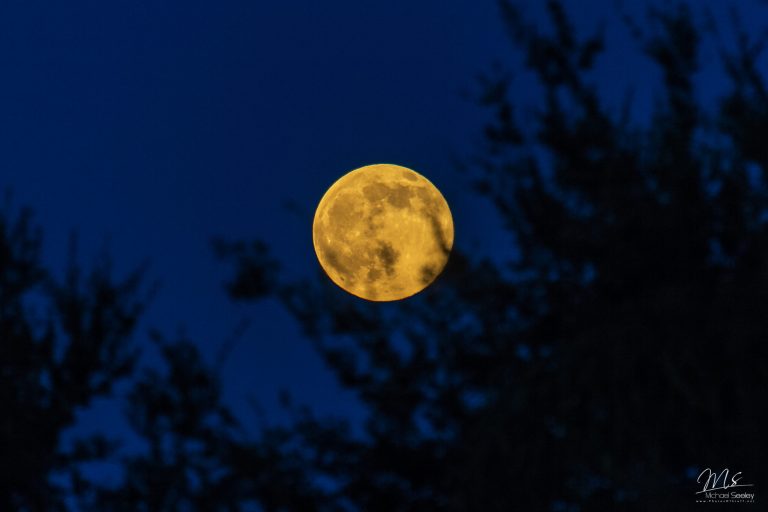
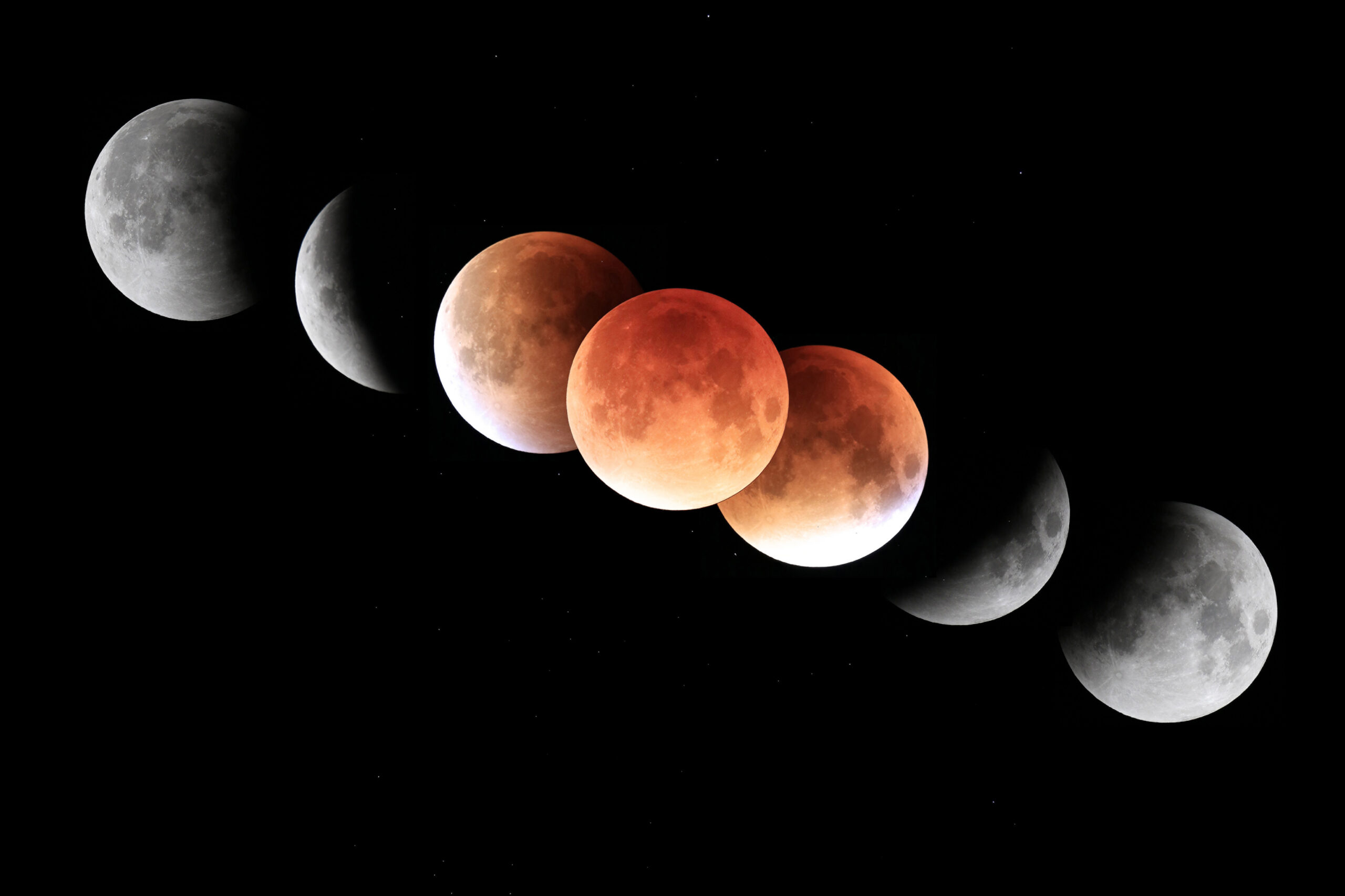
The total phase, the most visually striking part of the eclipse, begins at 6:03 a.m. EST. At this instant, the trailing edge of the Moon fully enters the umbra, so the whole lunar disc will now be covered by Earth’s deepest shadow. Despite this, the Moon won’t disappear entirely from view. Instead, it typically takes on a reddish or coppery hue, a phenomenon commonly referred to as a Blood Moon.
This reddish coloration is a result of sunlight being refracted and scattered by Earth’s atmosphere. While Earth blocks direct sunlight from reaching the Moon, a small amount of light manages to bend around the edges, passing through our planet’s atmosphere.
As the light moves through the air, shorter wavelengths, such as blue and green, are scattered more efficiently by atmospheric particles. (This also explains why the daytime sky appears blue.) Longer wavelengths, such as red, yellow, and orange, scatter less and thus continue through the atmosphere. This reddish light then hits the Moon, producing its characteristic reddish tint.
The exact shade of red can vary significantly from one eclipse to another. The main factor influencing coloration is the amount of dust and clouds present in Earth’s atmosphere at the time of the eclipse. Volcanic eruptions, for instance, can inject large quantities of aerosols into the stratosphere. Such events lead to particularly dark or intensely red lunar eclipses.
Seeing totality?
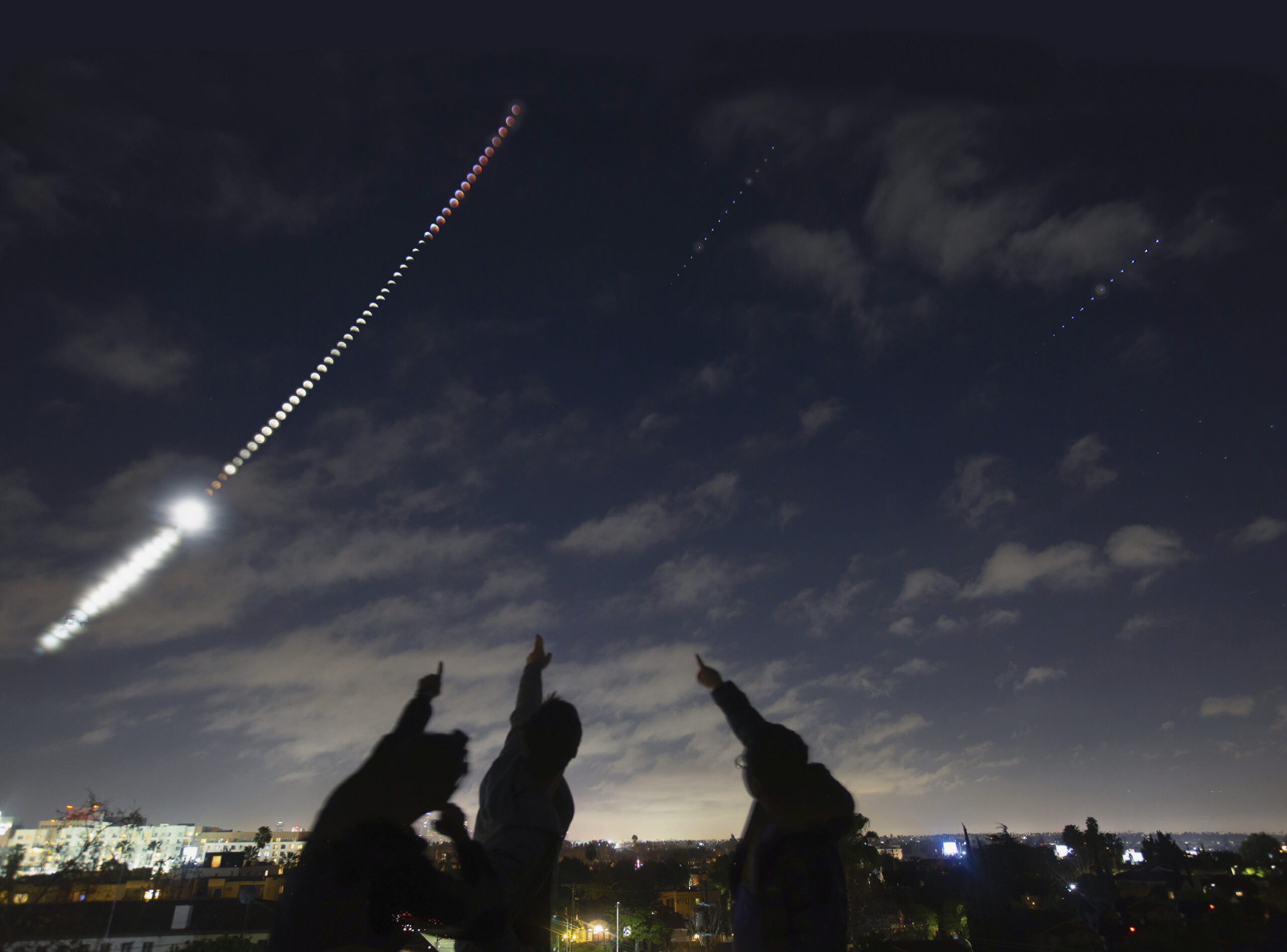
Unfortunately, totality starts too late for those in the Eastern Time Zone. Even in Indianapolis, which lies at the western edge of the zone, the Moon will set on March 3 at 7:17 a.m., so it will be quite low in the west and the sky will be bright. The Central Time Zone fares better. On its western edge, say in Amarillo, Texas, moonset is also at 7:17 a.m. But that’s Central Time, so totality there will start at 5:03 a.m. CST. The sky will be getting lighter (astronomical twilight begins at 5:49 a.m.), but your chances of seeing some of totality are good if your sky to the west is clear.
The point of greatest eclipse, when the Moon is closest to the center of Earth’s shadow, will happen at 6:33 a.m. EST. At this time, the Moon’s path intersects the umbra at its deepest point during the event. The end of totality will occur at 7:02 a.m. EST. It’s at this point that the leading edge of the Moon begins to emerge from the umbra. The Moon will rapidly lose its color as direct sunlight once again falls on its visible surface, creating a sharp contrast with the remaining shadowed portion. Lunar totality will last a worthy 59 minutes. We all wish solar totalities were that long!
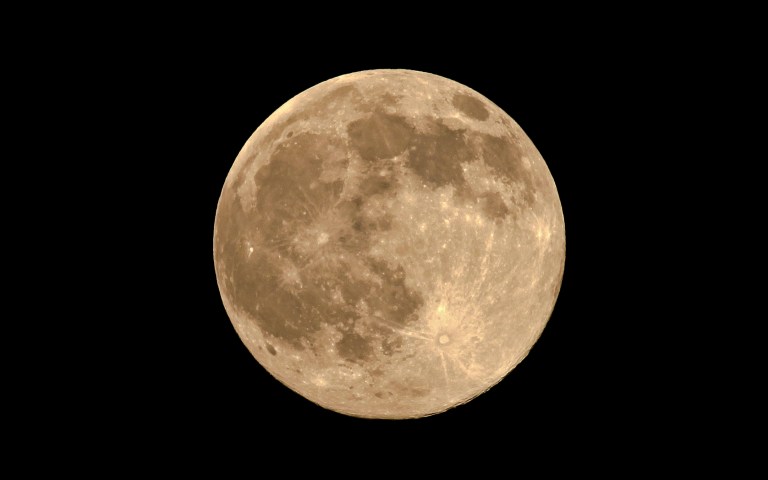
Because lunar eclipses happen at Full Moon, you won’t see many stars when our satellite is at peak brightness. As the eclipse progresses, however, more and more stars will pop into view. During totality, the Moon will lie at the northeastern tip of the constellation Sextans, which is faint even at New Moon.
North of the Moon, the wonderful constellation of Leo the Lion will emerge. It’s likely that you’ll be able to spot Leo’s brightest star, magnitude 1.4 Regulus (Alpha [α] Leonis), all night long. As the event moves toward totality, watch the other stars of Leo gradually appear.
Part two
The second half of the partial eclipse begins at 7:02 a.m. EST and concludes at 8:17 a.m. EST. During this period, you’ll see the reverse of the first partial phase, which began more than two hours prior. The bright, crescent-shaped portion of the Moon will steadily grow larger as it transitions out of the umbra and back into the penumbra. The curvature of Earth’s shadow (That’s right: Our planet isn’t flat!) will again be evident on the shrinking dark segment of the Moon.
Finally, the penumbral eclipse will end as the Moon exits Earth’s lighter, outer shadow. This final contact will happen at 9:23 a.m. EST. The Moon is once again fully illuminated by direct sunlight — a Full Moon in the sky. The entire event, from the initial contact with the penumbra to the final exit from it, spans 5 hours 39 minutes.
Observe this eclipse
Here’s the good news: You don’t need any equipment or eye protection to view a lunar eclipse. The Full Moon is always easy to see and the light striking your eyes is just reflected, not direct, sunlight. That said, most observers agree that the most pleasing views of the Moon, especially during totality, are through binoculars. Models marked 7×50 or 10×50 will serve well. Higher-power models accentuate the involuntary motions of your hands and arms — though if you mount them on a tripod, they’ll work fine.
All eclipses demonstrate orbital mechanics and the makeup of shadows in the solar system. The March 3 total lunar eclipse gives us just such an opportunity to witness Earth’s shadow cast upon its one natural satellite during an exact lineup of three celestial bodies.
My advice: Go out and experience this event, even if you can only see part of it. The next total lunar eclipse won’t happen until New Year’s Eve 2028, and it’s not a favorable one for the U.S. A slightly better one, mainly for the eastern U.S., will happen June 25, 2029.
More than three years is a long time to wait. So, set up a lawn chair, make a warm drink, grab a blanket, and experience what I like to call sublime celestial geometry. Good luck!
Editor’s note: This story has been updated from the version that appeared in print. It includes the correct day of the week for the eclipse and updated times for the phases of the eclipse, as well as a correction to the erroneous statement that total lunar eclipses occur at New Moon.