Credit: Artwork: NASA/ESA/Elizabeth Wheatley (STScI)/Science: Andrea Dupree (CfA)
At the 247th meeting of the American Astronomical Society, this one held in Phoenix on January 4-8, Andrea Dupree of the Center for Astrophysics|Harvard & Smithsonian presented a talk entitled, “Discovery of the Wake Caused by Siwarha — the Betelgeuse Companion.”
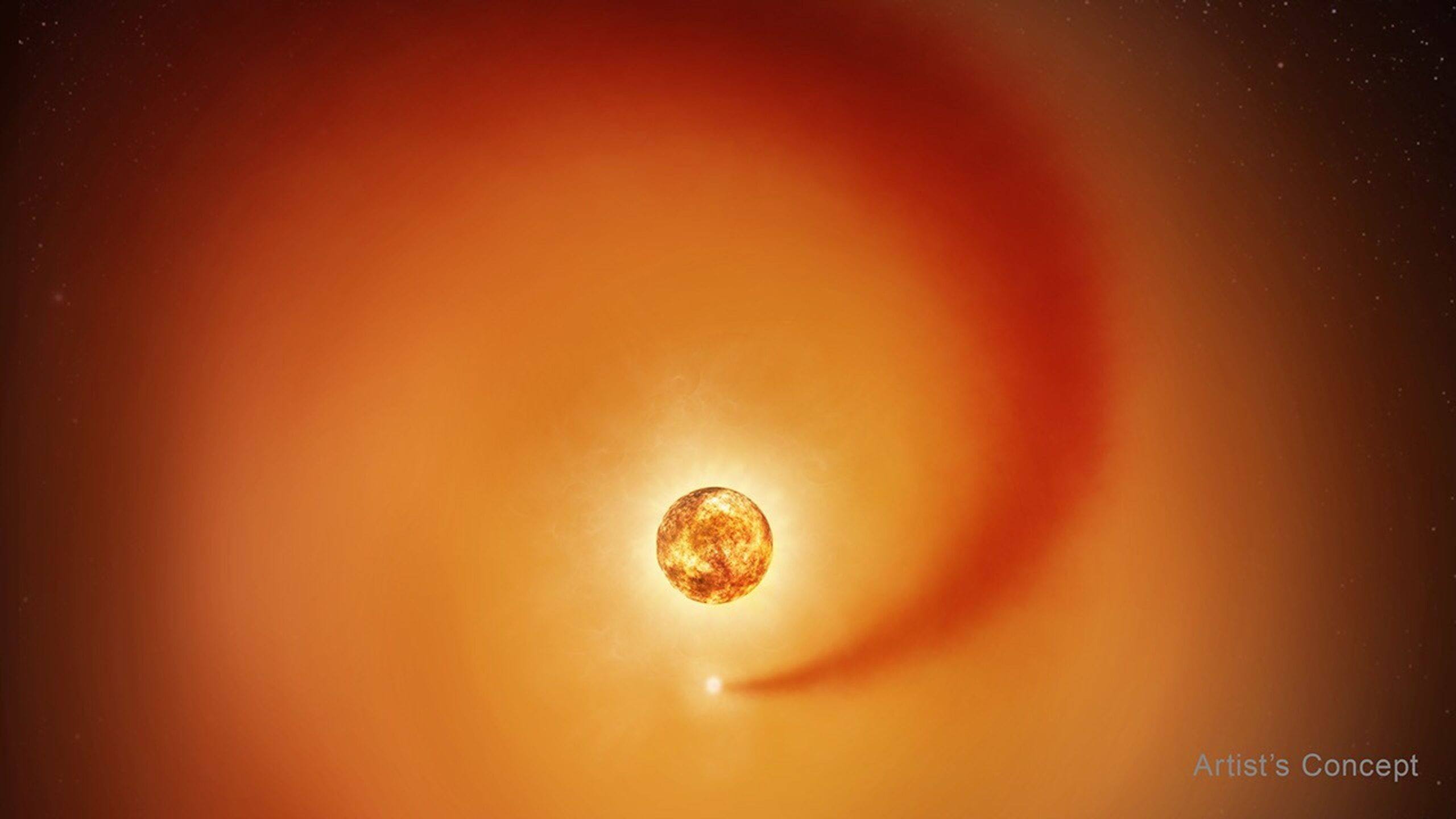
The red supergiant star Betelgeuse (Alpha Orionis) is the second brightest star in the constellation Orion the Hunter. It lies approximately 650 light-years from Earth and is larger than 400 million Suns. Until recently, astronomers believed it to be a single star. But in July 2025, a companion was announced based on observations in 2020 and 2024 using the ‘Alopeke imaging instrument at the Gemini North Observatory. Now follow-up observations have revealed that the companion is creating a wake through Betelgeuse’s atmosphere.
A visible trail
The team, from the Center for Astrophysics|Harvard & Smithsonian, used the Hubble Space Telescope and ground-based instruments at the Fred Lawrence Whipple Observatory atop Mt. Hopkins, Arizona, and the Roque de Los Muchachos Observatory, which is located on the island of La Palma in the Canary Islands. The researchers detected changes in Betelgeuse’s spectrum and in the speed and direction of gases in the star’s outer atmosphere caused by a wake (a trail of denser material). These changes in the star’s atmosphere are indicative of a companion star, which astronomers have named Siwarha.
The trail appears every six years as the companion crosses in front of Betelgeuse. This observation confirms the computer modeling astronomers have done.
“It’s a bit like a boat moving through water. The companion star creates a ripple effect in Betelgeuse’s atmosphere that we can actually see in the data,” said Dupree, the lead study author. “For the first time, we’re seeing direct signs of this wake, or trail of gas, confirming that Betelgeuse really does have a hidden companion shaping its appearance and behavior.
“The idea that Betelgeuse had an undetected companion has been gaining in popularity for the past several years, but without direct evidence, it was an unproven theory,” said Dupree. “With this new direct evidence, Betelgeuse gives us a front-row seat to watch how a giant star changes over time. Finding the wake from its companion means we can now understand how stars like this evolve, shed material, and eventually explode as supernovae.”
Because the name “Betelgeuse” means the hand of al-Jawzā, the name Siwarha, which means her bracelet in Arabic, was recognized by the IAU Working Group on Star Names on September 22.