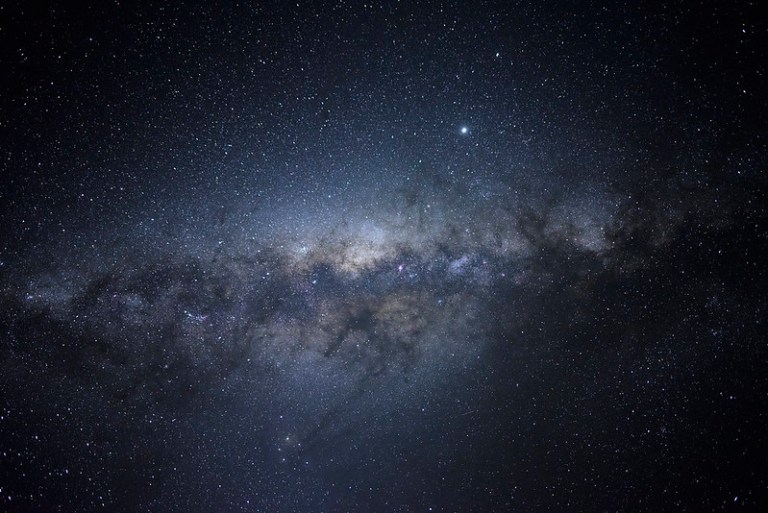
The center of the Milky Way is an extreme place. In addition to housing our galaxy’s supermassive black hole, it also contains a 700-light-year-wide region of dense gas called the Central Molecular Zone (CMZ). This CMZ holds nearly 80 percent of all the cold, dense gas in the galaxy — the key ingredient for forming new stars. Yet despite its many young, massive star clusters — as astronomers would expect — some regions of the CMZ are strangely quiescent. And much of the gas within the CMZ is moving in large flows at supersonic speeds, zipping around at hundreds of thousands of miles per hour.
While we know well how molecular clouds of cold gas form stars in the calmer outer regions of the galaxy, we don’t know exactly how the extreme environment of its center, with so much going on, might alter the process. That’s because the CMZ does not easily give up its secrets. Studying it with traditional telescopes is difficult, as thick veils of dust block much of the visible light from this region. So, astronomers must turn to other wavelengths, including the radio regime, where the Atacama Large Millimeter/submillimeter Array (ALMA) in Chile is designed to look. Radio telescopes pierce through intervening material to get a clear view of the cold gas and dust that are otherwise invisible to our prying eyes.
Now, in the largest ALMA image ever created, the cold, dense gas of the CMZ shines in exquisite, never-before-seen detail. Covering more than 650 light-years in breadth, the image shows not only larger structures such as filaments and clouds of gas light-years long, but smaller features down to individual stars. And it’s not just a pretty picture — the data used to create the image allowed astronomers to pick apart the composition of the gas in the CMZ, identifying dozens of molecules such as silicon monoxide, methanol, and ethanol.
A proxy for early galaxies
Ours “is the only galactic nucleus close enough to Earth for us to study in such fine detail,” said European Southern Observatory astronomer Ashley Barnes, part of the ALMA CMZ Exploration Survey (ACES) team that collected the data, in a press release. Uncovering its secrets not only tells us more about our own galaxy, but also offers a peek into other galaxies as well. “We believe the region shares many features with galaxies in the early universe, where stars were forming in chaotic, extreme environments,” said ACES principal investigator Steve Longmore of Liverpool John Moores University in the UK. But those intriguing early galaxies also lie far from us, making them impossible to observe in great detail. So, astronomers hope to use the Milky Way’s CMZ as a proxy.
In addition to releasing the image, the ACES team is publishing their data in a set of six papers, accepted by Monthly Notices of the Royal Astronomical Society. And the team isn’t planning to stop here — an upcoming upgrade to the ALMA array should improve the view even further, offering more fine detail and additional chemical information, Barnes said: “In many ways, this is just the beginning.”