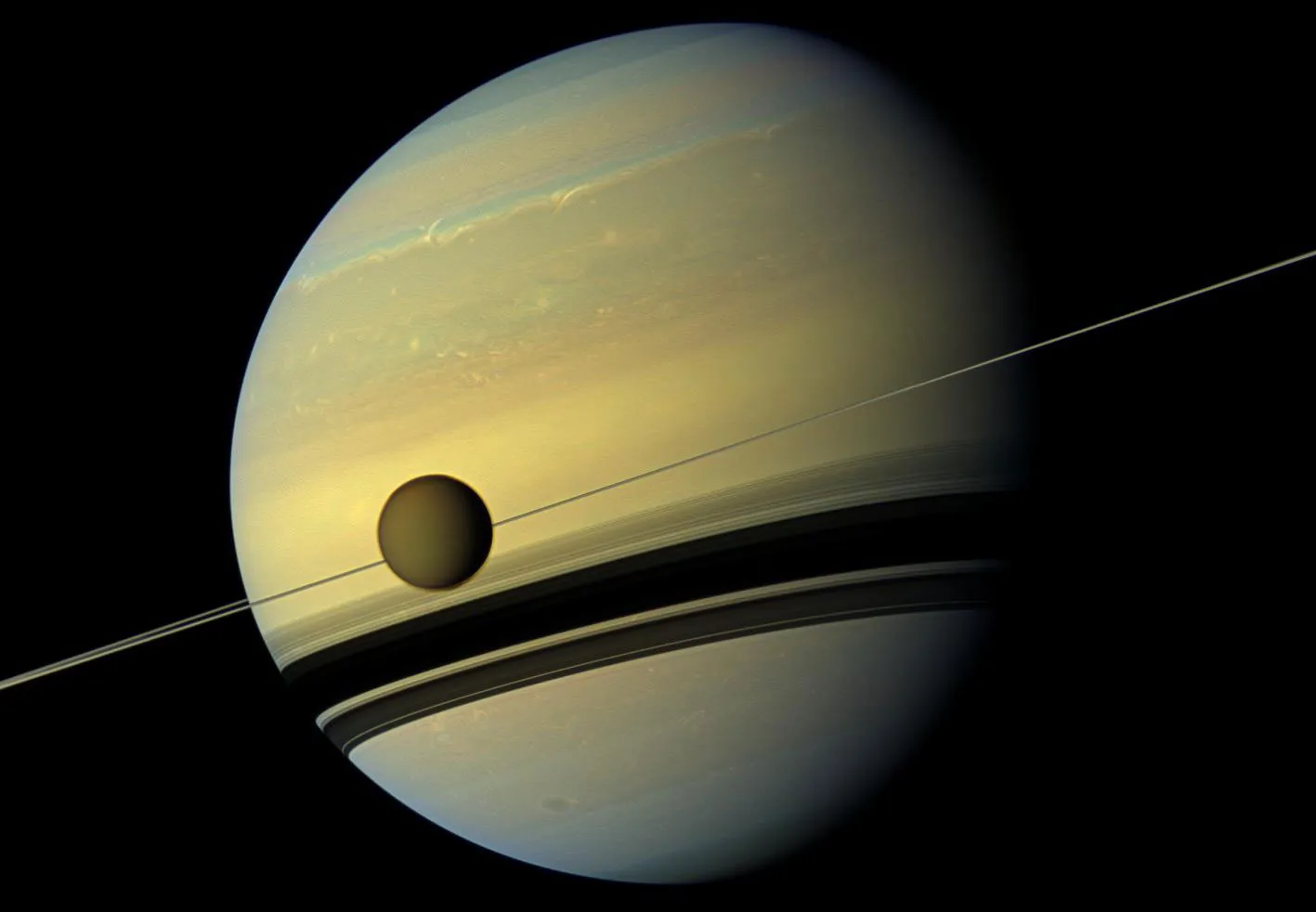
A study led by SETI Institute scientist Matija Ćuk proposes that Saturn’s bright rings and its largest moon, Titan, may have both originated in collisions among its moons. This study was accepted for publication in The Planetary Science Journal and the preprint is available here.
Near the end of its 13-year mission, NASA’s Cassini spacecraft measured how Saturn’s internal mass was distributed. That has an effect on the planet’s precession, which is the change in the orientation of its axis. Previously, scientists thought Saturn’s precession period matched Neptune’s. But Cassini showed that Saturn’s mass is slightly more concentrated, changing its precession rate so it no longer matches Neptune’s. Researchers at MIT and UC Berkeley proposed that Saturn once had an extra moon, which was ejected after a close encounter with Titan and broke up to form the rings.
Two become one
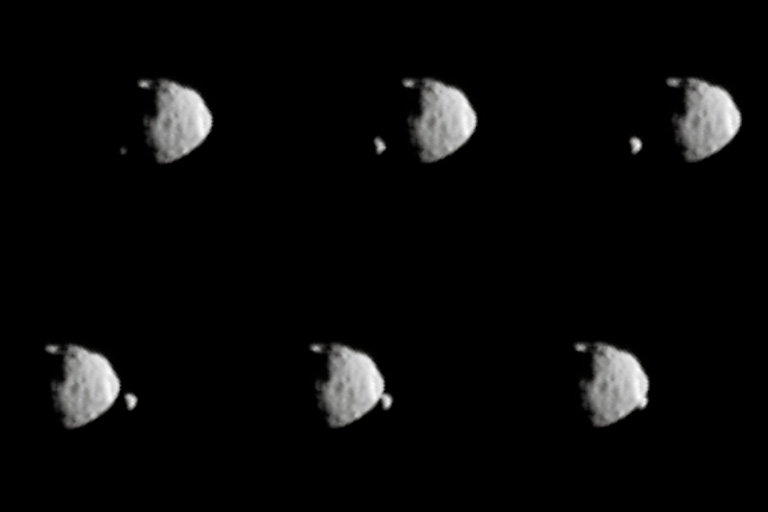
The SETI Institute-led study used computer simulations to show that the most likely outcome was a collision of the extra moon with Titan. Saturn’s small, misshapen, constantly tumbling moon Hyperion has its orbit locked with Titan’s.
“Hyperion, the smallest among Saturn’s major moons provided us the most important clue about the history of the system,” said Ćuk in a press release. “In simulations where the extra moon became unstable, Hyperion was often lost and survived only in rare cases. We recognized that the Titan-Hyperion lock is relatively young, only a few hundred million years old. This dates to about the same period when the extra moon disappeared. Perhaps Hyperion did not survive this upheaval but resulted from it. If the extra moon merged with Titan, it would likely produce fragments near Titan’s orbit. That is exactly where Hyperion would have formed.”
This new model suggests Titan formed from a merger between two earlier moons: a “Proto-Titan,” nearly as large as Titan itself, and a smaller “Proto-Hyperion.”
Where do the rings come from?
More than a decade ago, members of the SETI Institute team proposed that the rings are debris from collisions between medium-sized moons closer to Saturn. Most of the debris would reassemble into moons, but a fraction would be scattered inward to form rings.
For years, it was thought this inner-moon collision was triggered by the Sun’s gravity, but new research finds it happened as a result of the Titan merger. Titan’s large mass and eccentric orbit can destabilize inner moons, sending them toward collisions with neighbors. While the timing of this second cataclysm is unclear, it must have occurred after Titan’s merger, consistent with the rings’ estimated age of about 100 million years.
Researchers hope that NASA’s Dragonfly mission, arriving at Titan in 2034, will provide data to confirm this. The octocopter will analyze the surface’s geology and chemistry, and it could reveal evidence that Titan resulted from a massive moon collision half a billion years ago.