Mission Highlight: Starship Flight 14
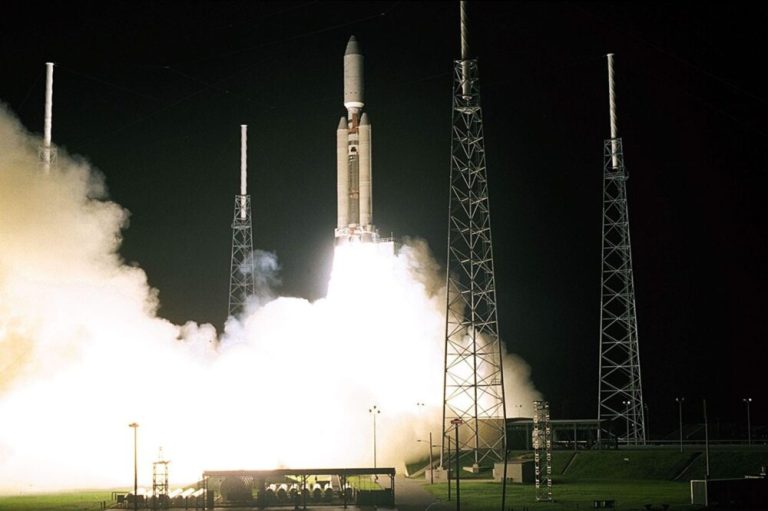
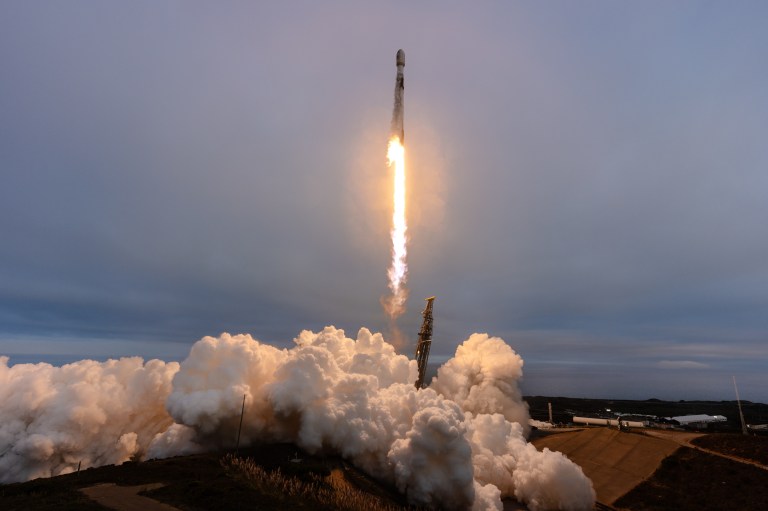
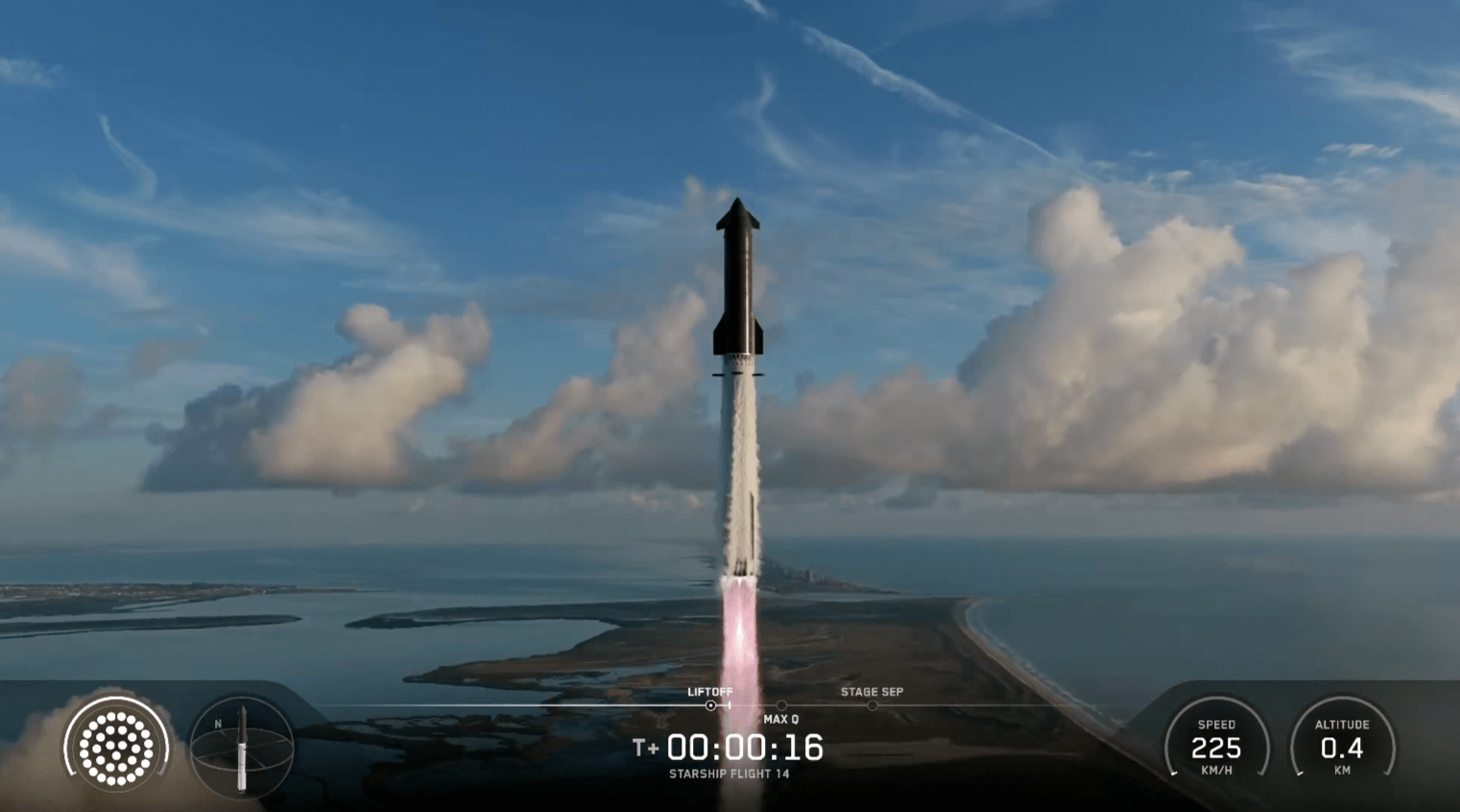
After 13 previous suborbital test flights, Starship finally reached orbit on test flight 14. SpaceX’s launch window opened at 8:15 a.m. EDT on Monday, Sept. 28, and the rocket cleared the tower at Starbase, Texas, at 8:48 a.m. EDT. Just over three hours later, the flight ended in a fireball in the northern Pacific Ocean.
The flight plan called for Starship to settle into an orbit roughly 170 miles (275 kilometers) high and circle the planet about six times. Along the way, it would release 26 Starlink V3 satellites, the first operational payload Starship had ever carried. Assuming everything was nominal, it would make a controlled splashdown in the Pacific Ocean west of Chile, nearly 10 hours after launch.
There was a touch of drama, however: Shortly after Starship lit its engines and separated from the booster, one of the ship’s three Raptor Vacuum engines shut down early. “Ship did lose one of the engines, one of its R Vacs, it looked like, on the way uphill, so we need to check in and see what exactly that means for the rest of the mission,” the SpaceX livestream host said about T+10 minutes after launch.
At first, orbit looked off the table. The burn could happen only if flight controllers were “extremely confident” the ship could still bring itself home. “Because of that [engine failure], we are not going to do the additional burn that will send us into orbit,” Dan Huot, SpaceX communications manager, first said at T+11:30. For the next 10 minutes, Starship coasted while the team pored over the data. Mission controllers found that the engines could still complete the deorbit burn to get Starship home. At T+21:53, Huot delivered the new verdict: “We are go for orbit.”
The Super Heavy booster had its own engine trouble. About a minute into the flight, it appeared to lose one of its 33 Raptors. “Looks like we may have lost one engine along the way, but that’s OK — we’ve got 33 of them, so we can lose a couple along the way,” a SpaceX representative said during the livestream. After separation, only 31 of the booster’s engines relit for the opening of its boostback burn. A SpaceX representative said that Booster 21 performed a “towerlike landing burn” that placed the rocket in a vertical orientation — the same kind it will eventually use before being caught by the launch tower’s mechanical arms. The booster then made “what looked like a fairly soft splashdown” in the Gulf of Mexico, according to the livestream. SpaceX said it would share more details on the booster later.
Back in orbit, the mission’s main event went cleanly. By 10:00 a.m. EDT, all 26 Starlink satellites were out. As each slid free of the ship’s PEZ-style dispenser, the control room broke into applause audible on the livestream. SpaceX later made contact with all 26. Every V3 adds 1 terabit per second of network capacity. “Just this one flight was like 20 Falcon 9 flights in terms of bandwidth,” Huot said. SpaceX has said future Starships will carry about 60 satellites at a time.
At 10:17 a.m. EDT, the company posted on X that flight teams would deorbit Starship “to our pre-cleared area of the Pacific Ocean after 3 hours in orbit.”
“We were going to get the data that we wanted, so we made the call to do this earlier reentry to Hawaii,” Huot explained. SpaceX had lined up two splashdown zones: One was off the coast of Chile, for the full 10-hour mission. The other was in the northern Pacific, “which is where we are currently headed,” he said. After about two orbits, the ship fired a single Raptor for its deorbit burn roughly 2 hours and 12 minutes after liftoff.
On the way down, Starship performed its signature belly flop, falling horizontally with its heat shield facing the atmosphere and steering with its flaps. Just above the water, it flipped upright and fired its engines to slow down. Splashdown came around 11:57 a.m. EDT, 3 hours, 8 minutes, and 32 seconds after liftoff and nearly seven hours ahead of schedule.
“Starship has landed,” Huot announced. Six seconds after touchdown, however, Ship 41 exploded. “Not quite a soft — extra soft splashdown like we had on the last one,” he said shortly after. On Flight 13, Ship 40 executed the softest splashdown to date and remained intact in the water. “Most importantly,” Huot concluded, “Starship made it to orbit.”
Reaching orbit was a positive step for SpaceX and also for NASA’s Artemis program, which is counting on a modified Starship to land the Artemis 4 crew on the Moon as early as 2028. The hardest milestone is still ahead, though: transferring cryogenic propellant between two Starships in space. Before Starship can head for the Moon, it will have to refill its tanks while parked in Earth orbit. That feat will take several coordinated tanker launches and a transfer process no one has yet demonstrated.
Other rocket launches this week
On Thursday, Oct. 1, NASA and SpaceX are targeting 11:10 a.m. EDT for the launch of Crew-13 from Space Launch Complex 40 at Cape Canaveral Space Force Station in Florida. A Falcon 9 will send Crew Dragon Grace toward the International Space Station (ISS). Aboard are NASA astronauts Jessica Watkins and Luke Delaney, serving as commander and pilot. Canadian Space Agency astronaut Joshua Kutryk and Roscosmos cosmonaut Sergey Teteryatnikov will fly as mission specialists.
The crew should dock around 8 p.m. EDT the same day. They’ll join Expedition 75 and relieve Crew-12, which has been aboard since mid-February. The Falcon 9 booster is expected to return to Landing Zone 40 at Cape Canaveral.
Later on Thursday, Oct. 1, SpaceX will launch Transporter 18 from Vandenberg Space Force Base in California at 2:18 p.m. EDT. Transporter is SpaceX’s rideshare program, which bundles small satellites from many customers onto a single Falcon 9 to share the cost of a ride to orbit. This flight carries 130 payloads for a variety of customers, including a prototype AI computing satellite from Google as part of their Project Suncatcher and a technology demonstration from startup Star Catcher, which will attempt to transmit power wirelessly between two free-flying spacecraft. In total, SpaceX has launched over 1,800 payloads to orbit with its Transporter program. The booster is slated to land at Vandenberg’s Landing Zone 4.
Closing out Thursday, Oct. 1, a Falcon Heavy is scheduled to launch NROL-97 from Kennedy Space Center in Florida at 11:53 p.m. EDT. The customer is the National Reconnaissance Office (NRO) and the payload’s details are classified. The two boosters are expected to return to Landing Zones 1 and 2 at Cape Canaveral, while the center core will be expended.
Rocket launches last week
China opened the week on Wednesday, Sept. 23. A Long March 8A launched from Wenchang Space Launch Site at 9:32 a.m. EDT carrying SatNet LEO Group 26, a batch of satellites for Guowang, China’s broadband megaconstellation.
A day later, on Thursday, Sept. 24, a Long March 6A lifted off from Taiyuan Satellite Launch Center at 4:46 a.m. EDT with Yaogan 40 Group 04. Yaogan is the designation China uses for government satellites.
On Friday, Sept. 25, Rocket Lab launched its “Owlright, Owlright, Owlright” mission at 8:39 p.m. EDT from Launch Complex 1 on New Zealand’s Māhia Peninsula. The rocket was an Electron topped with the company’s Curie kick stage, a small upper stage used for precise orbit placement.
The week wrapped up on Saturday, Sept. 26, when SpaceX launched the USSF-385 mission for the U.S. Space Force from Vandenberg at 10:00 a.m. EDT. The Falcon 9 booster landed on the droneship Of Course I Still Love You in the Pacific Ocean.
Upcoming rocket launches
On Tuesday, Oct. 6, the Korea Aerospace Research Institute will launch its KSLV-2 rocket, also known as Nuri, from Naro Space Center at 11:23 p.m. EDT. The rocket carries NeonSat-2 through NeonSat-6, a set of small Earth-observation satellites, along with other payloads.
On Saturday, Oct. 10, SpaceX plans to launch Starlink Group 15-25 from Vandenberg at 12:00 p.m. EDT, with the booster landing on Of Course I Still Love You.
Brooks Mendenhall is a staff writer at Astronomy, based in Chattanooga, Tennessee, fueled by an unending curiosity about the universe. A former classroom teacher, he has a knack for breaking down complex concepts for a wide audience.