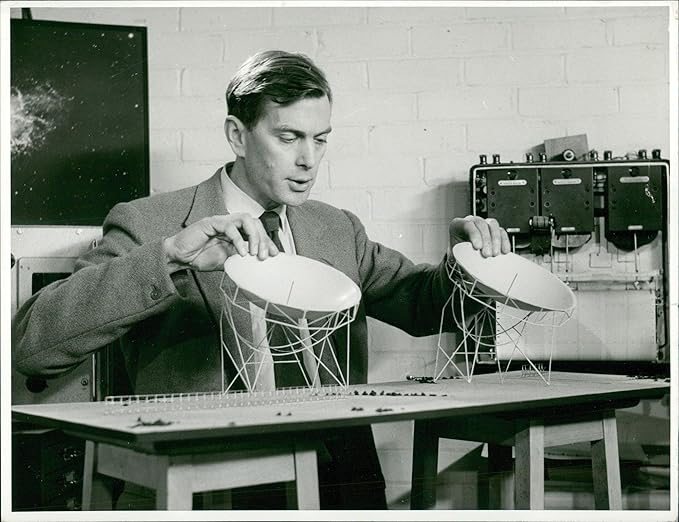
Born Sept. 27, 1918, and educated at Bradfield College and Oxford University in the U.K., Martin Ryle would go on to be the first astronomer royal (1972-1982) with a background in radio astronomy. During World War II, Ryle worked in radio systems and countermeasures for the RAF. He was strongly antiwar, though, and had no desire to continue working in military science, so after WWII’s end, he began research on the Sun’s radio emissions at University of Cambridge.
Ryle was instrumental in the development of radio astronomy, building equipment, compiling catalogs, and discovering quasars. When he was appointed as the chair of radio astronomy, he became Britain’s first professor in that field. Among his many accomplishments was his work with Antony Hewish and Jocelyn Bell, which led to the discovery and study of the first pulsar and earned him the Nobel Prize in Physics in 1974. Ryle was also an activist vocally opposed to nuclear weapons and energy, crusading against them until his death in 1984.
Elisa Neckar is senior production editor of Astronomy magazine, and the editor of the Today in the History of Astronomy feature on Astronomy.com.