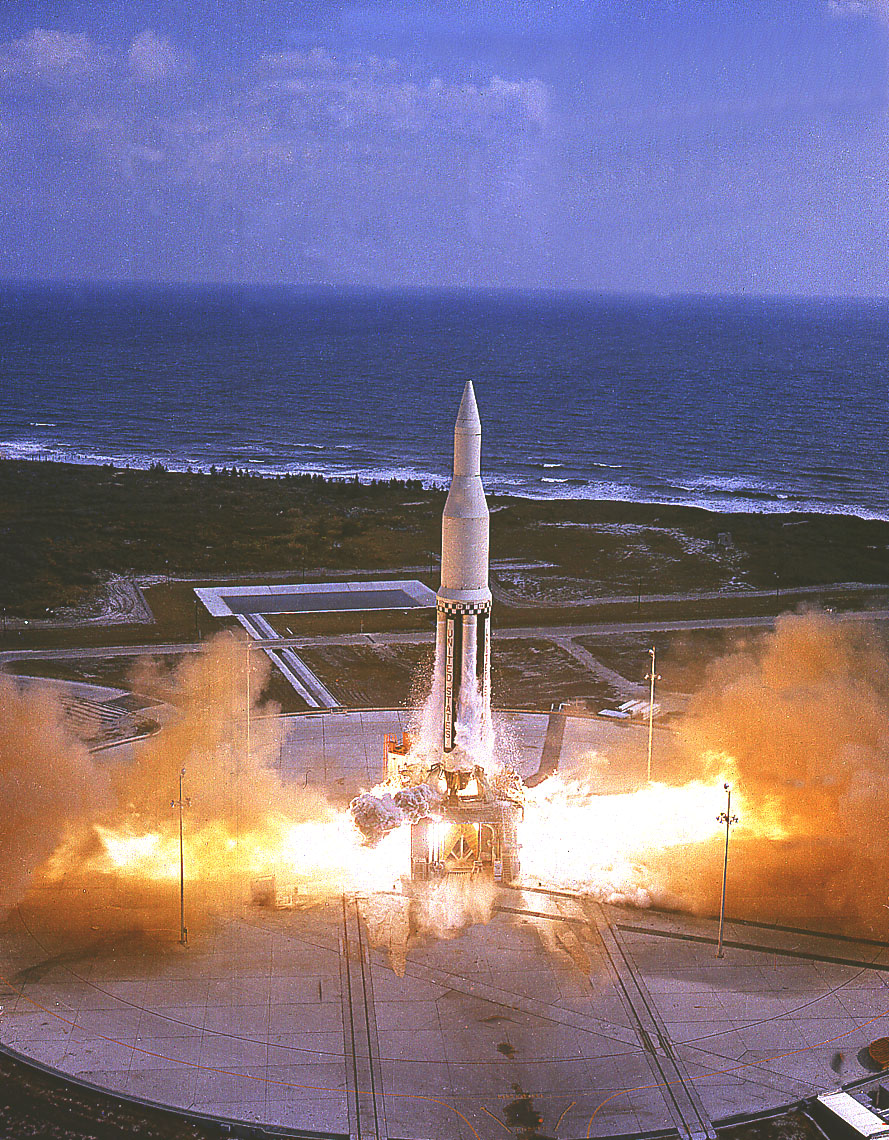
Five months after President John F. Kennedy promised that America would put a man on the Moon, NASA successfully showed that they had a rocket to get them there. Under development with Wernher von Braun’s team since 1957, the Saturn I rocket consisted of a booster stage with a liquid oxygen tank at its core, surrounded by four tanks of kerosene and four additional tanks of liquid oxygen. It featured eight H-1 engines. Elements of the Saturn I were derived from the Redstone missile, the Jupiter rocket, and the Thor rocket and hardware was even reused, lowering costs.
After an array of testing, the Saturn program was transferred to the newly opened George C. Marshall Space Flight Center (MSFC) in Huntsville, Alabama, and assembly began. In April 1961, the Saturn I boosters and engines were tested at the MSFC. Meanwhile, construction of Launch Complex 34 at the Cape Canaveral Air Force Station in Florida had been underway since June of 1960, and the facility was dedicated in June 1961. Components arrived at Cape Canaveral for stacking throughout the summer, eventually reaching 162 feet (50 meters) high and 460 tons. After further testing in September, the Saturn I was successfully launched on Oct. 27, 1961. The booster stage boasted 1.3 million pounds of thrust that lifted the rocket to an altitude of 85 miles (137 kilometers).
Saturn rockets would be launched a total of 32 times – including the Saturn V rockets that powered all the crewed Apollo flights – and per NASA, are “the only family of rockets to have had a 100 percent success rate.”
Elisa Neckar is senior production editor of Astronomy magazine, and the editor of the Today in the History of Astronomy feature on Astronomy.com.