Friday, August 28
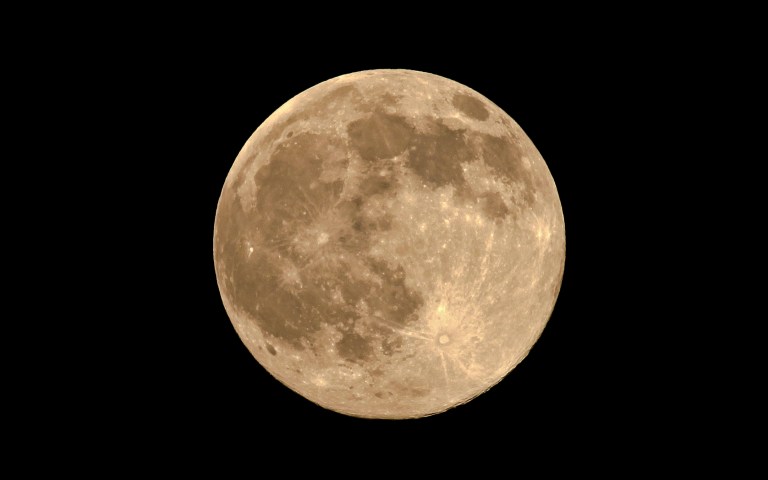
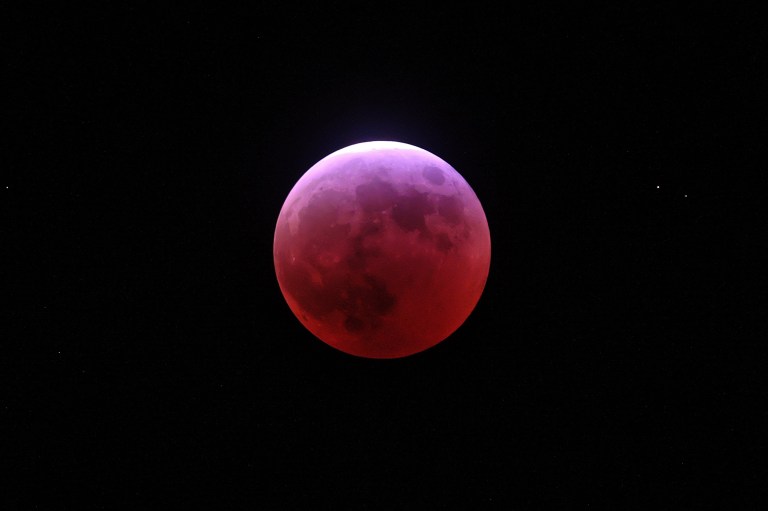
Friday opens with a deep partial lunar eclipse — the Full Moon occurs at 12:19 A.M. EDT, just six minutes after the event reaches maximum eclipse. August’s Sturgeon Moon will appear largely orange or red, with just a sliver of bright white visible along the northeastern limb, the only portion of our satellite not covered by Earth’s darker inner shadow, called the umbra.
The eclipse progresses for roughly the next hour and 40 minutes, with the Moon slowly moving out of the umbra once more. The partial phase of the eclipse ends at 1:51 A.M. EDT and the final phase of the eclipse, when the Moon exits even the lighter outer region of Earth’s shadow, the penumbra, ends at 3:02 A.M. EDT.
In the evening sky, asteroid 4 Vesta — the second-most massive body in the main belt, after 1 Ceres — reaches a stationary point in the constellation Cetus. Shining at magnitude 7.1, it’s within reach of binoculars or a small telescope, near the border of northern Cetus and southern Pisces. Tonight, it is located just 2.3° southwest of magnitude 3.8 Alrescha (Alpha [α] Piscium). Despite its designation as the Fish’s alpha star, Alrescha is actually the third brightest star in this constellation, after magnitude 3.6 Eta (η) and magnitude 3.7 Gamma (γ) Psc.
The best time to look for Vesta is around midnight or later — by midnight, the region has reached some 20° above the eastern horizon. After its pause in celestial motion, Vesta will begin moving westward, or retrograde, with respect to the background stars, slowly pulling away from Alrescha and moving deeper into Cetus.
Sunrise: 6:24 A.M.
Sunset: 7:38 P.M.
Moonrise: 7:52 P.M.
Moonset: 6:48 A.M.
Moon Phase: Waning gibbous (99%)
*Times for sunrise, sunset, moonrise, and moonset are given in local time from 40° N 90° W. The Moon’s illumination is given at 10 P.M. local time from the same location.
Saturday, August 29
You may have heard of Epsilon (ε) Lyrae, the famous Double Double star in the constellation Lyra, but it’s not the only fascinating pair this constellation holds. Tonight, let’s check out another multi-star system in the Lyre: Zeta (ζ) Lyr, which astronomers think holds up to seven stars.
Zeta is easy to find in the evening sky, just a short 2° jump southeast from blazing Vega (Alpha [α] Lyr). Collectively, it shines about 4th magnitude, but a telescope will easily break it into two components: The brighter star is magnitude 4.4, while its fainter companion is two magnitudes fainter. They’re separated by roughly 44” on the sky. According to the late stellar expert Jim Kaler, the brighter star is just over twice the Sun’s mass and 31 times as bright. The fainter star is still more massive than our Sun, with a mass 1.7 times solar, and shines about nine times as brightly. Both lie at a distance of 152 light-years.
What about the other stars in the system? The brighter star is a known spectroscopic binary, which means astronomers can tell it’s actually two stars by the way its light shifts as they orbit each other, but they cannot be split in a telescope. The fainter star is likely also a spectroscopic binary, but the signal here is not as clear. The remaining three stars, which are loosely bound to the initial pair if at all, shine between magnitude 10 and 12.5, lie a little ways away, at distances that range from 26” to 1’ away.
Sunrise: 6:25 A.M.
Sunset: 7:36 P.M.
Moonrise: 8:14 P.M.
Moonset: 7:54 A.M.
Moon Phase: Waning gibbous (96%)
Sunday, August 30
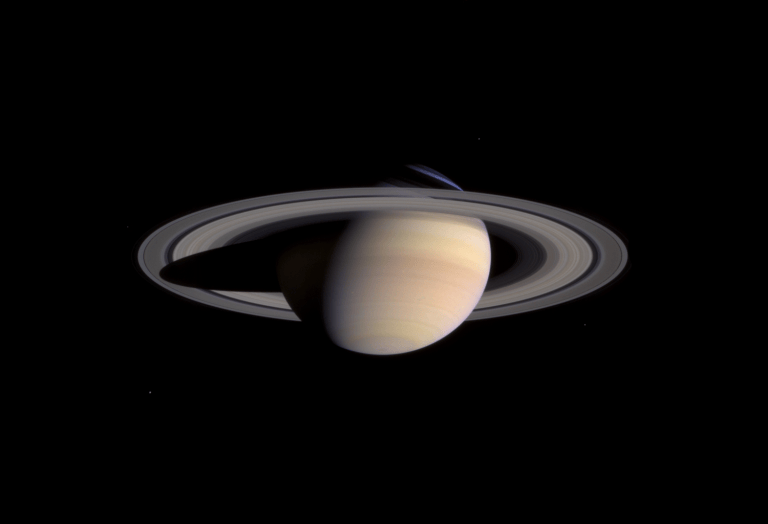
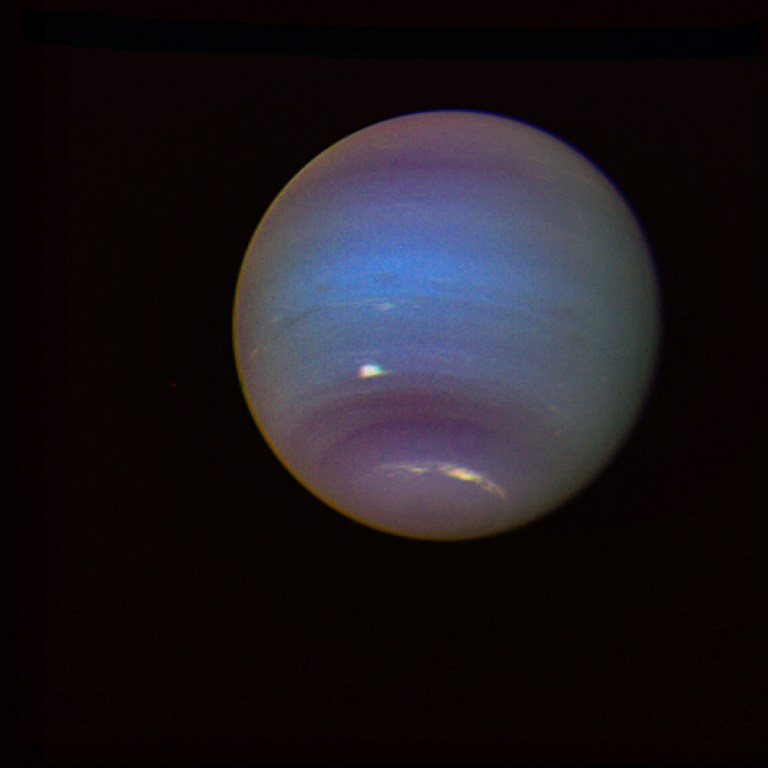
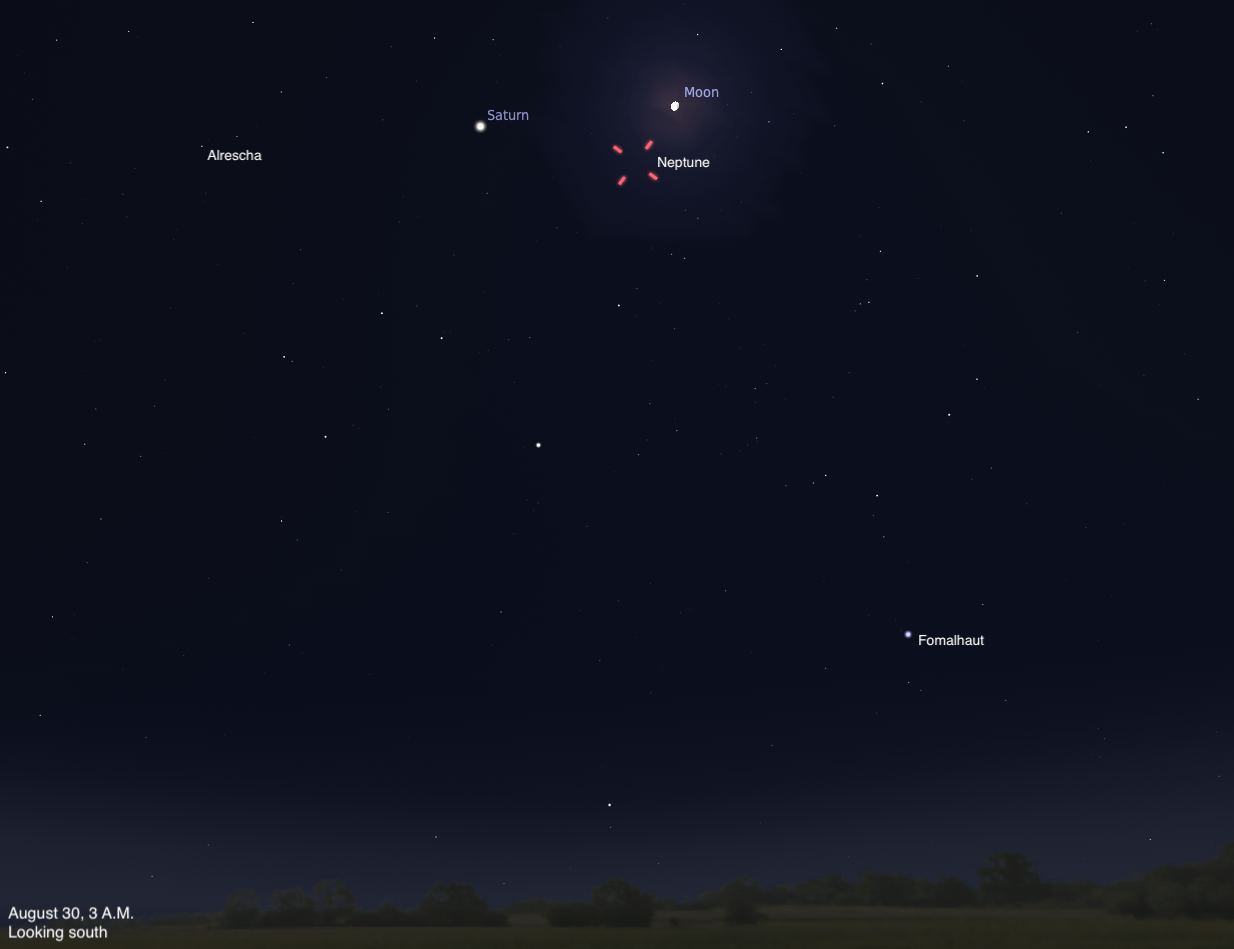
The waxing Moon passes 5° north of Neptune at 9 A.M. EDT. Although both are well above the horizon overnight and into the early morning, the bright moonlight will make the faint, distant ice giant difficult to see, even with the necessary optical aid (you can’t spot it with the naked eye). You will, however, easily be able to see magnitude 0.4 Saturn, which lies about 10° east (to the left) of Neptune. Both planets, as well as the Moon, are in Pisces, with the region standing highest in the south around 3 A.M. local daylight time.
Early on the 30th, the Moon stands above Neptune and to the right of Saturn. Our satellite is just to the left of the famous Circlet asterism in Pisces, although its faint stars will also be hard to see in the bright moonlight. Saturn is the brightest point of light in this region of the sky, standing roughly in line above the horizon with the Moon to its right and Alrescha, Pisces’ alpha star, about twice as far to its left. Far to the lower right, close to the horizon, is Saturn’s only competitor for brightness: magnitude 1.2 Fomalhaut in Piscis Austrinus.
The Moon will continue east through the sky, passing 7° north of Saturn early tomorrow morning, when it will appear above and slightly to the left of the ringed planet.
Sunrise: 6:26 A.M.
Sunset: 7:35 P.M.
Moonrise: 8:36 P.M.
Moonset: 9:00 A.M.
Moon Phase: Waning gibbous (91%)
Monday, August 31
The Moon passes 7° north of Saturn at 4 A.M. EDT, hanging above the bright planet in the early-morning sky. Early risers can catch the pair all the way up until the sky is too bright with the oncoming dawn to view Saturn anymore.
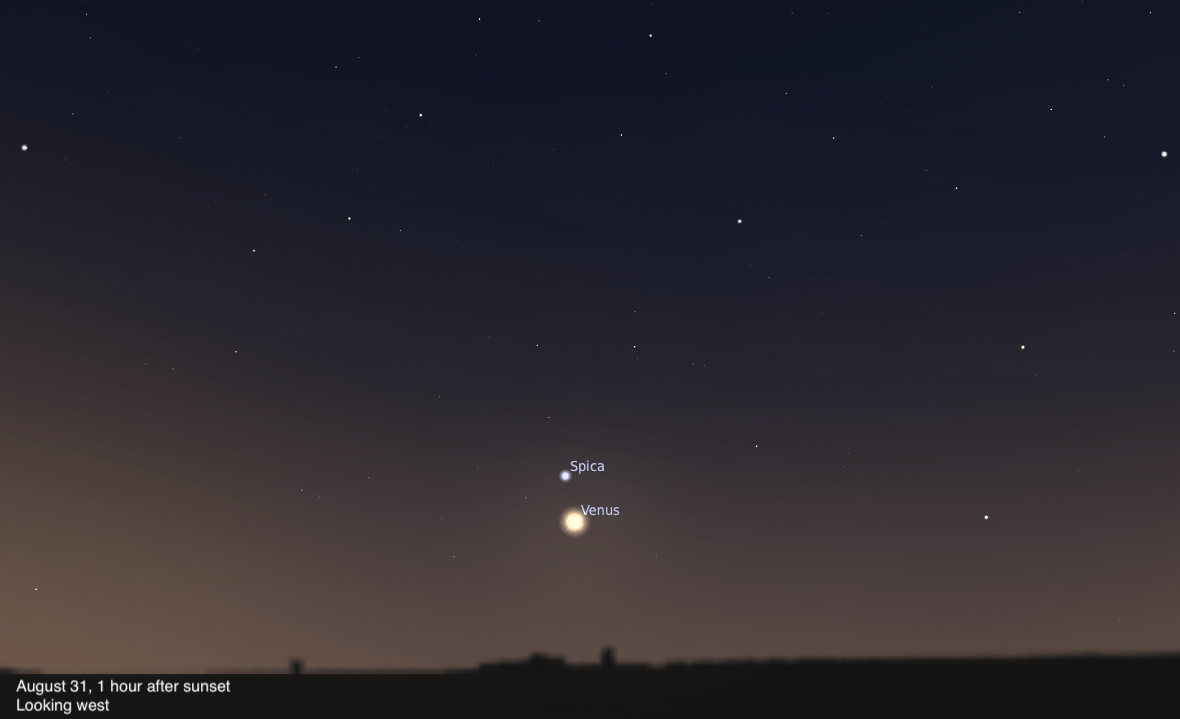
In the evening sky, blazing Venus is less than 2° southwest of Spica, the brightest star in Virgo the Maiden. Over the course of the next two days, Venus will appear to slide to the upper left (east) in the sky relative to stationary Spica, remaining within roughly 2° of the star as it does so.
The pair is easy to spot in the west as soon as the Sun goes down and the sky begins to grow dark. At magnitude –4.6, Venus will pop out first, roughly 12° above the horizon 20 minutes after sunset. Magnitude 1.0 Spica will take a bit more time to appear — use the chart above to note its position, and see how soon you can see it.
You can also enjoy the pair through binoculars or a telescope. In the latter, Venus will show a 39%-lit disk that stretches some 30” in the sky, an impressive size. It’s currently some 0.55 astronomical unit from Earth, where 1 astronomical unit, or AU, is the average Earth-Sun distance of 93 million miles (150 million kilometers).
Sunrise: 6:27 A.M.
Sunset: 7:33 P.M.
Moonrise: 9:02 P.M.
Moonset: 10:09 A.M.
Moon Phase: Waning gibbous (83%)
Tuesday, September 1
There’s a short dark window early in the evening after sunset and before moonrise to do a little deep-sky observing. Let’s try for M30, the brightest deep-sky object in Capricornus; it’s also the Sea Goat’s sole Messier object.
M30 is a globular cluster that shines at magnitude 7.2. It’s just 12’ across, quite compact. That small size, coupled with its highly concentrated stars, makes it relatively easy to spot in binoculars or any small telescope. You’ll find it just over 3° east-southeast of magnitude 3.7 Zeta (ζ) Capricorni, close to a 5th-magnitude background star. Around 9 P.M. local daylight time, it stands 15° above the southeastern horizon.
As always, the higher your magnification, the more detail — and stars — you’ll see, particularly in the crowded center of this cluster. That center is less than 10” across, roughly a light-year in physical length. Overall, the cluster exerts gravitational influence over stars up to some 140 light-years away. M30 has an estimated age of roughly 13 billion years, and lies at a distance of nearly 28,000 light-years from Earth.
Sunrise: 6:28 A.M.
Sunset: 7:32 P.M.
Moonrise: 9:32 P.M.
Moonset: 11:21 A.M.
Moon Phase: Waning gibbous (74%)
Wednesday, September 2
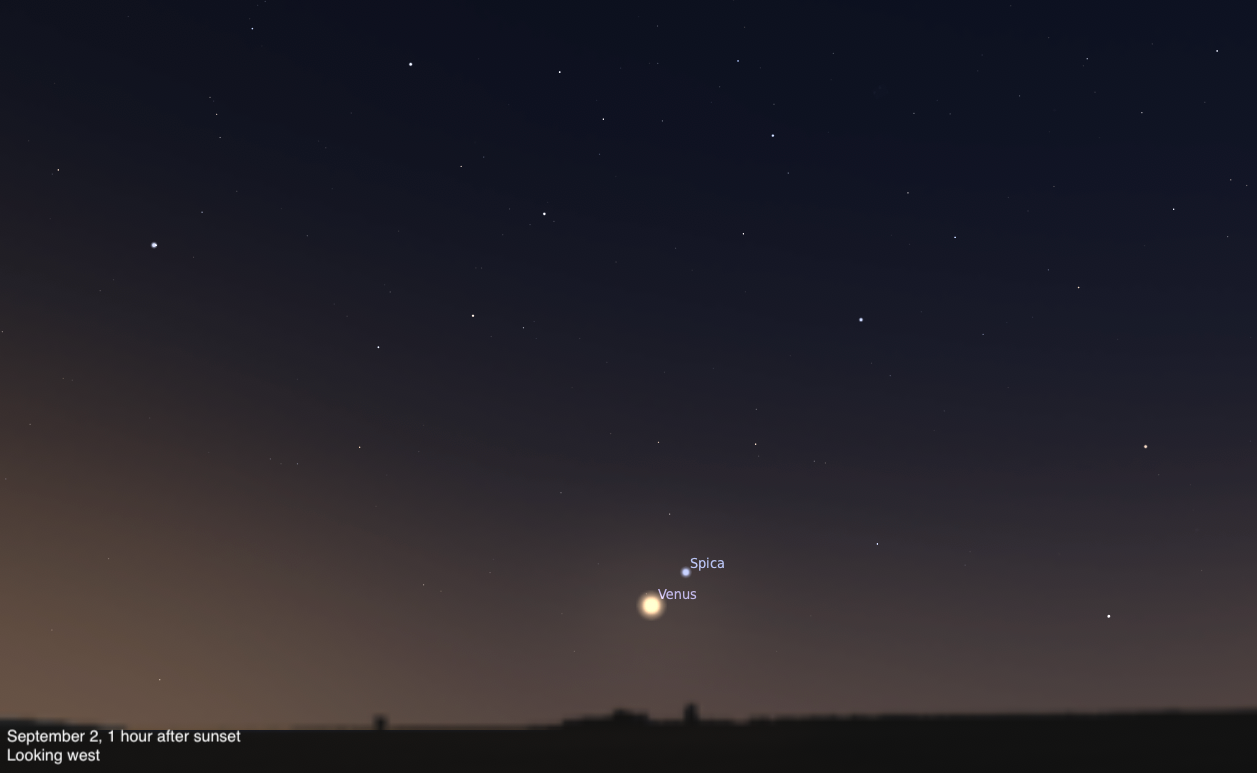
Venus passes 1.7° due south of Spica at 11 P.M. EDT. Although the pair has set for most by then (around 9 P.M. local daylight time), regardless of your location they are visible in the west shortly after sunset. Especially if you caught them a few days ago, compare their positions from then to now.
About an hour after sunset, the pair is roughly 5° above the horizon. Shining brightly, they should dominate the darkening sky. Brighter Venus now lies to the lower left of Spica; to their lower right is 3rd-magnitude Porrima, a lovely double star in central Virgo. To their far upper right is Arcturus, the luminary of Boötes the Herdsman.
Venus’ apparent size has now grown slightly to 31”, while its phase has shrunk a bit to 37%. With the planet so close to the star in the sky, you should be able to capture both easily in binoculars or a telescope’s field of view. They will also make a lovely centerpiece for a nightscape photo — and the bright points of light should be easy to capture even with a cellphone.
Sunrise: 6:29 A.M.
Sunset: 7:30 P.M.
Moonrise: 10:08 P.M.
Moonset: 12:35 P.M.
Moon Phase: Waning gibbous (64%)
Thursday, September 3
The Moon passes 5° north of Uranus at 7 P.M. EDT. However, you’ll want to check out the pair in the early-morning sky, now located in Taurus the Bull.
Rising about an hour before midnight, Uranus is well above the eastern horizon by about 3 A.M. local daylight time. Early on September 3, the waning Moon is approaching the Pleiades star cluster (M45) in northwestern Taurus. Starting around 5 A.M. CDT, our satellite will skim the northern regions of the Pleiades, taking about 2 hours to cross. From some locations, it will occult 6th-magnitude 18 Tauri — the observability and timing will depend heavily on your location, and is only visible in darkness for the western U.S. From southern California, the star disappears behind the bright leading lunar limb just before 3:45 A.M. PDT and reappears just over an hour later. The reappearance from behind the darker trailing limb will be easier to catch.
Regardless of whether you can catch the occultation, Uranus is visible across the U.S. this morning. About 6.8° southeast of the Pleiades, the magnitude 5.7 planet is about 4° northwest of 4th-magnitude Epsilon (ε) Tau. If you draw a line from the Pleiades down to this star, you’ll find the ice giant about two-thirds of the way along it (farther from the Pleiades and closer to Epsilon Tau). Especially with the Moon nearby, you’ll likely need binoculars or a telescope to spot the small, gray disk of Uranus, which spans just 4” on the sky.
Sunrise: 6:30 A.M.
Sunset: 7:28 P.M.
Moonrise: 10:54 P.M.
Moonset: 1:49 P.M.
Moon Phase: Waning gibbous (52%)
Friday, September 4
Last Quarter Moon occurs at 3:51 A.M. EDT, leaving our evening sky completely dark and perfect for searching out fainter, deep-sky targets.
High in the southeastern sky two hours after sunset is the constellation Vulpecula, which sits just to the right of cross-shaped Cygnus the Swan. One of Vulpecula’s most famous inhabitants is M27, also known as the Dumbbell Nebula. This planetary nebula, created by a dying Sun-like star, is thinner in the middle and thicker on either end, giving it the appearance of a bowtie or — you guessed it — a dumbbell.
The nearest bright star is actually Gamma (γ) Sagittae, which shines at magnitude 3.5. From here, the Dumbbell is just a short hop 3.2° due north. Glowing at magnitude 7.4, M27 is one of the best planetaries in the sky, especially for beginning observers. It stretches about 8’ long and nearly 6’ at its widest. Through binoculars or any small telescope, you’ll see a grayish or greenish blob; give your eyes time to adjust, or try looking out of the corner of your eye to pick up on its pinched-in-the-middle shape. Bumping up the magnification once you’ve got a scope centered on it may help as well, while a narrowband or OIII filter will further improve the view.
The central star responsible for the nebula, now a white dwarf, shines at 13th magnitude. Larger scopes (10 inches or more) should allow you to spot it.
Sunrise: 6:30 A.M.
Sunset: 7:27 P.M.
Moonrise: 11:51 P.M.
Moonset: 2:59 P.M.
Moon Phase: Waning crescent (41%)
Alison Klesman is senior editor of Astronomy magazine. She holds a Ph.D. in astronomy and has studied a variety of topics, from minor planets to supermassive black holes.