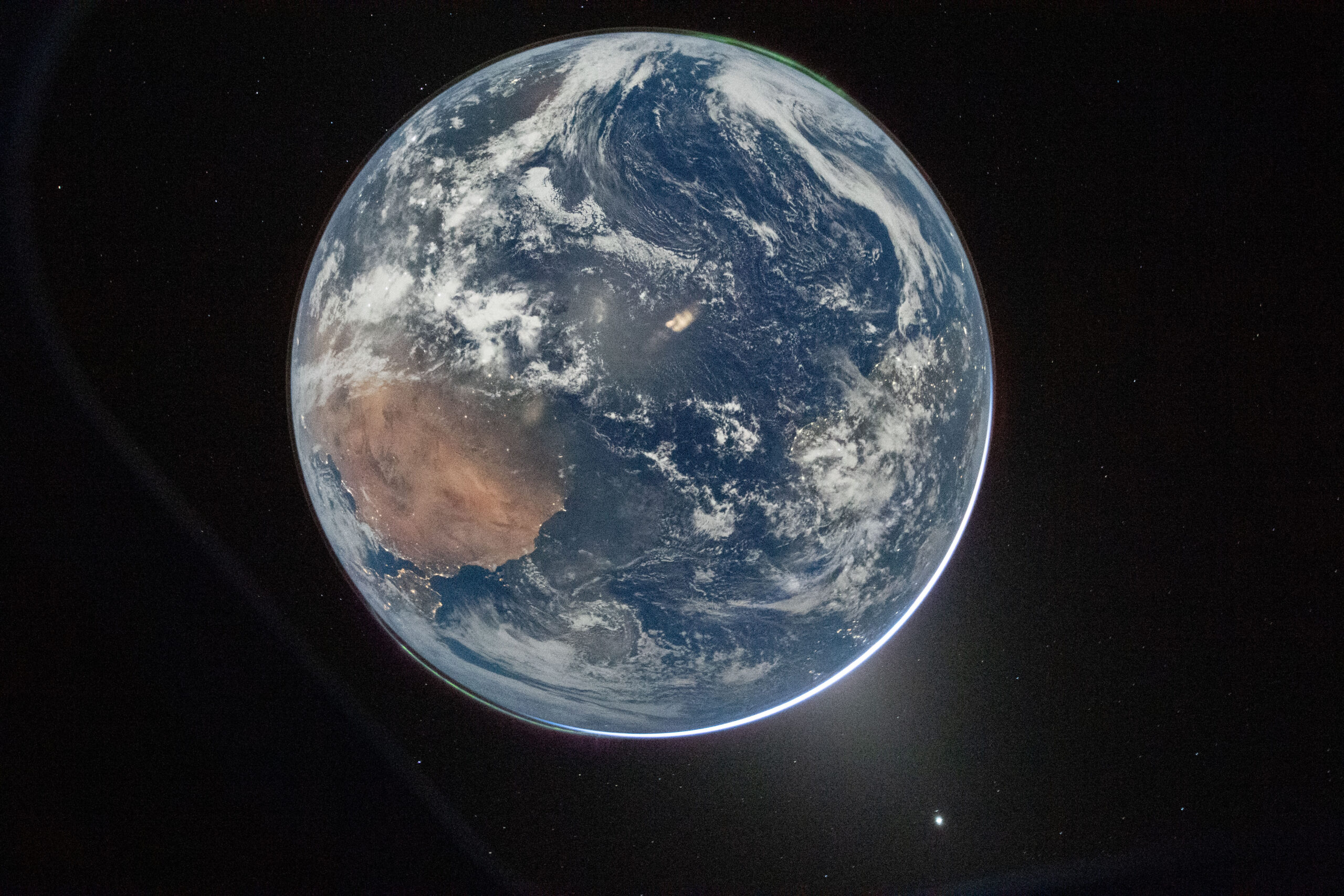
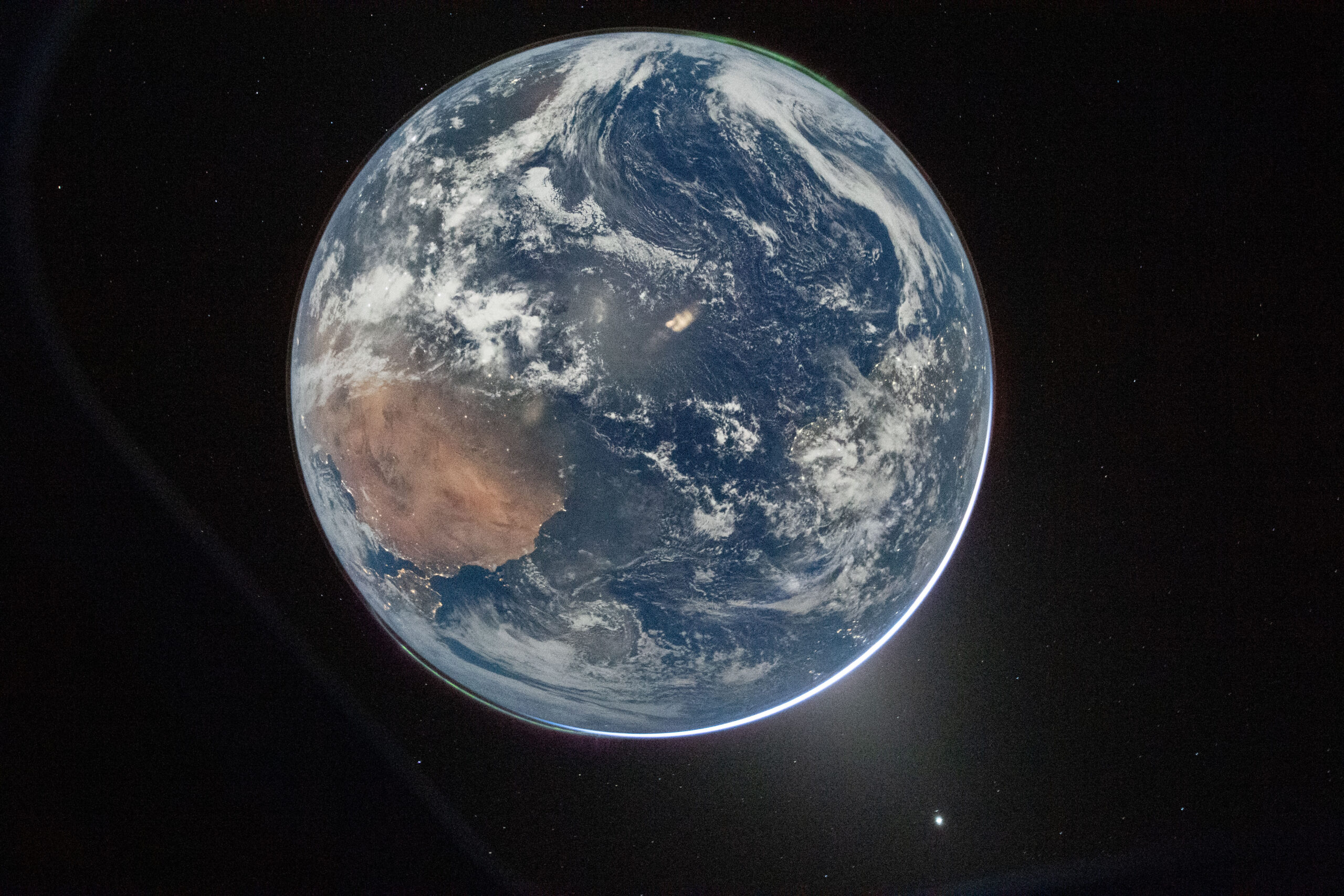
Our home planet hangs against the darkness of space in this image taken by Artemis 2 Commander Reid Wiseman on April 2, 2026. Wiseman snapped the photo shortly after the Artemis 2 crew completed their translunar injection burn — a roughly six-minute engine firing that set the Orion spacecraft, nicknamed Integrity, on course for the Moon.
The south pole is oriented toward the top of the frame — a reminder that there is no right side up in space — with northern Africa and a sliver of Europe on the left. The North Atlantic and sweeping clouds dominate the disk. A faint aurora glows at lower left and upper right, while zodiacal light — sunlight scattered by interplanetary dust — brightens the lower right.
It is the first image of Earth taken by humans at this distance since Apollo 17 in 1972. The view recalls that mission’s famous “Blue Marble,” one of the most iconic photographs ever made. Ahead lies a historic lunar flyby that will carry the crew within roughly 4,600 miles of the Moon’s farside — farther from our planet than anyone in history. Unlike “Blue Marble,” however, this image was taken of Earth’s nightside lit by moonglow, allowing the fainter details of the aurora and zodiacal light to be visible.
Wiseman recounted the moment this scene came into view in an interview with the media. “You could see the entire globe from pole to pole,” he said. “You could see Africa, Europe, and if you looked really close, you could see the northern lights. It was the most spectacular moment and it paused all four of us in our tracks.”
“There’s nothing that prepares you for the breathtaking aspect of seeing your home planet both lit up bright as day and also the moonglow on it at night,” said Mission Specialist Christina Koch. “Knowing that we’re gonna get similar views of the Moon — I’m just really excited for that.”