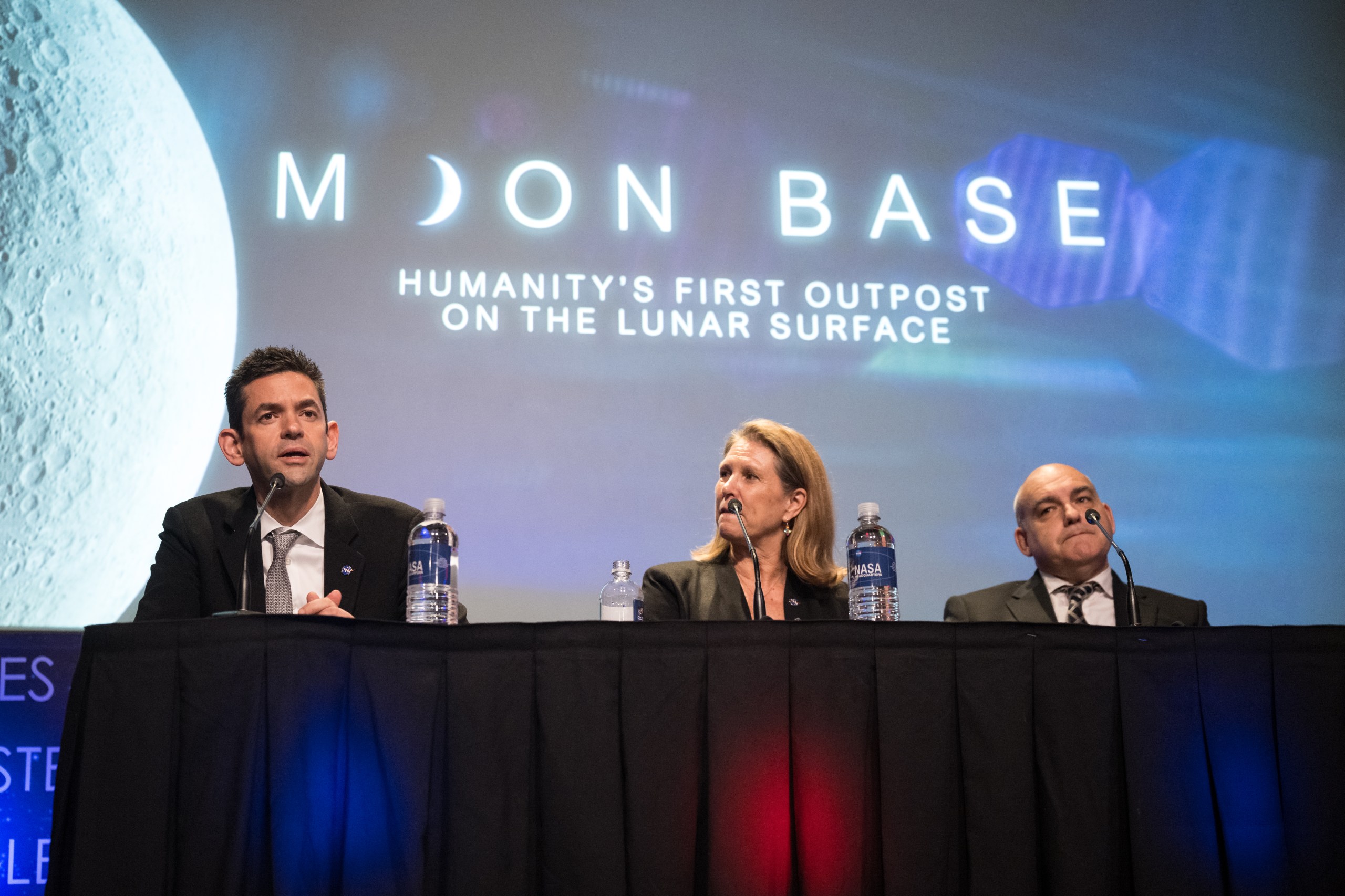
NASA announced new contracts for the rovers and landers that will lay the groundwork for the agency’s proposed $30-billion Moon Base — some of which they plan to launch as soon as this fall — during a May 26 press conference.
The announcement offered the most detailed look yet into the Moon Base plan NASA revealed in March as part of President Trump’s National Space Policy, and came on the heels of Artemis 2’s success and renewed public interest in space exploration. The long-term plan involves three phases, beginning with robotic scouts this year, crewed stays and semi-permanent habitats by 2029, and ultimately a permanent base by 2032. It’s a big lift and a tight timeline.
The May 26 press conference also clarified some of the details for how Phase One will unfold: mission specifics, contract values, and the expansion of the Commercial Lunar Payload Services (CLPS) initiative to handle the logistics demands. Even still, it’s an optimistic schedule, and a long road — with much of the tech still unproven.
“The Moon Base will be America’s and humanity’s first outpost on another celestial world. Every mission, crewed and uncrewed, will be a learning opportunity as we return to the lunar surface, build the infrastructure to stay, and master the skills required to live and operate in one of the most demanding and dangerous environments imaginable,” NASA Administrator Jared Isaacman said at the press conference.
Choosing the right location
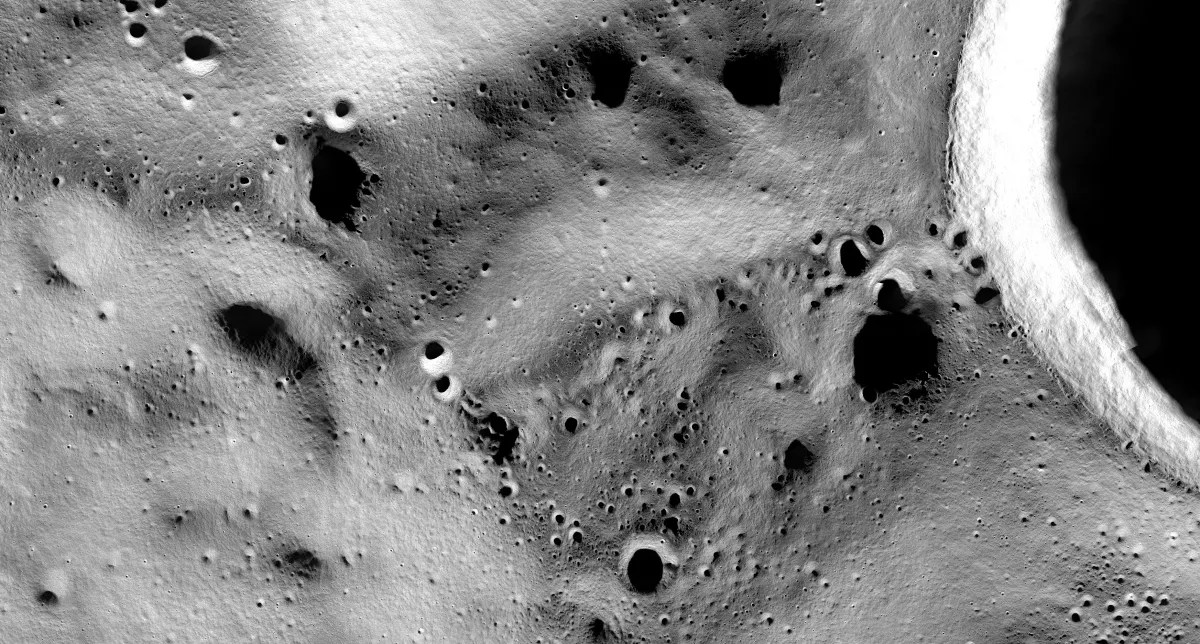
Due to its unique geography, the lunar south pole has long been an area of interest for science missions and exploration, making it an easy choice for the first human settlement on the Moon. The Moon’s axis is almost completely upright relative to the Sun, meaning the Sun stays low on the horizon. As a result, ridges and peaks at the poles catch sunlight perpetually while the deep craters beside them remain in permanent shadow. On sunlit ridgelines like the Shackleton Connecting Ridge — the primary site for the future base — solar panels can generate power almost continuously. The shadowed craters below harbor water ice that has never evaporated, preserving a scientific record of the early solar system and providing a resource that can be converted into drinking water, breathable air, and rocket fuel. The south pole is the one place on the Moon where astronauts could power a base, do crucial science, and extract at least some of the resources required for life.
But it’s also punishing. Temperatures swing hundreds of degrees, regolith shreds equipment, and radiation is a constant threat — which is why NASA wants robotic scouts on the ground before astronauts ever arrive.
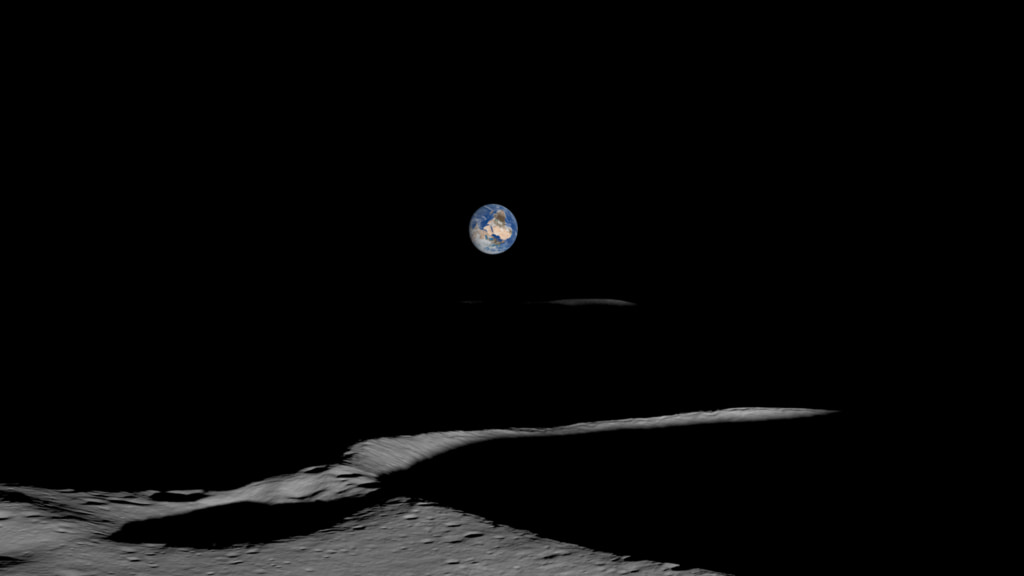
Shackleton Crater near the lunar south pole is where NASA plans to establish its Moon Base. The crater’s rim receives near-constant sunlight while its permanently shadowed floor holds large deposits of water ice. Credit: Ernie Wright (USRA): Lead Visualizer David Ladd (Advocates in Manpower Management, Inc.): Lead Producer David Ladd (Advocates in Manpower Management, Inc.): Narrator Noah Petro (NASA/GSFC): Scientist Laurence Schuler (ADNET Systems, Inc.): Technical Support Ian Jones
Phase One: Laying the groundwork
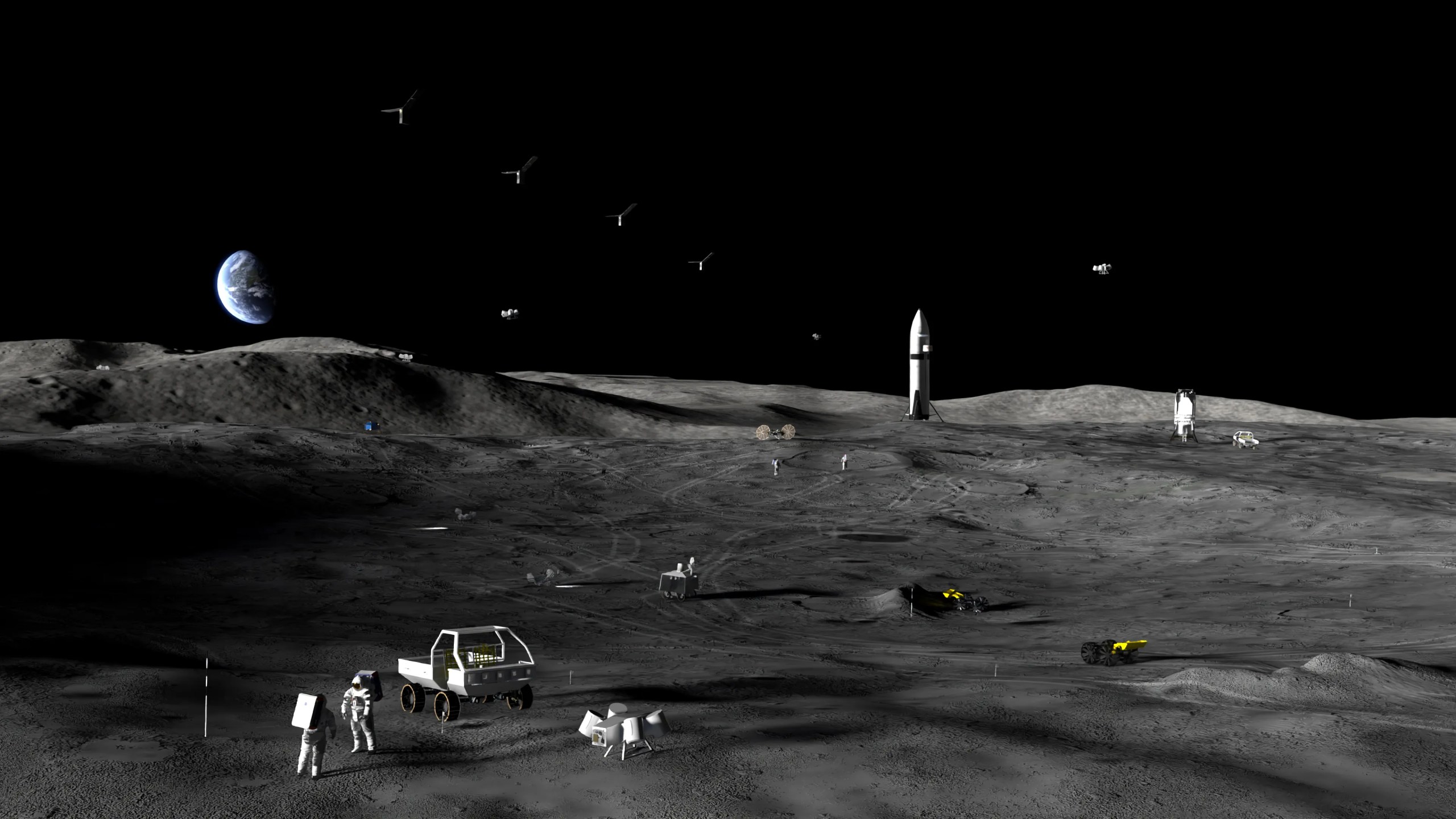
When we picture a Moon base, we no doubt imagine infrastructure: permanent habitats, laboratories, and vehicles. In reality, it will be at least six years before astronauts are living full time on the lunar surface. NASA’s three phases build confidence and capability incrementally before committing crews to long-duration stays in the hostile environment of the lunar surface.
Phase One of the Moon Base program is mostly reconnaissance. It won’t feature any permanent infrastructure or buildings — only robots and short-term crew testing new tech and gathering data to ensure future mission safety. At least 25 missions and 21 landings are planned during this period, beginning with three before the end of this year.
The first mission, fittingly called Moon Base 1, is targeting launch no earlier than this fall. It will be carried by Blue Origin’s Blue Moon Mark 1 Endurance lander, launched atop the company’s own New Glenn rocket — the same rocket that exploded on the launch pad just days after the May 26 press conference, raising questions about the feasibility of NASA’s timeline. Blue Origin CEO Dave Limp assessed the damage and posted on X that Blue Origin “will fly again before the end of this year.”
When Endurance does get off the ground, it will set course for Shackleton Connecting Ridge, a precipice perched above the rims of Shackleton and de Gerlache craters near the lunar south pole. In some sense, the landing is the mission itself. Endurance will demonstrate the systems that future crewed landers will depend on. It will carry two science payloads: an array of high-resolution cameras that will capture how the lander’s engine exhaust disturbs the lunar surface during descent and a laser retroreflector array — a permanent surface target, to be deployed on all landers, that future orbiting spacecraft can ping with lasers to precisely measure their position and distance relative to the surface. Endurance is currently in preflight testing at Kennedy Space Center.
Moon Base 2 and 3 are scheduled to follow before year’s end, each with a different vehicle, company, and scientific focus. Moon Base 2 will send Astrobotic’s Griffin lander to the lunar south pole aboard a SpaceX Falcon Heavy. It will be Griffin’s first flight — and Astrobotic’s second attempt at reaching the Moon. Their first, the Peregrine lander, suffered a propellant failure shortly after launch in 2024 and never made it to the surface. The lander’s payload will include Astrolab’s FLIP (Flex Lunar Innovation Platform) rover, a technology demonstration for the company’s upcoming FLEX rover. According to Astrolab, FLEX will be the biggest and most capable Moon rover to date. FLIP will test the wheels, avionics, batteries, and other components to be further developed for use on FLEX. FLIP will also help mature the technology central to the crewed Lunar Terrain Vehicles (LTVs) that will one day carry crew across the lunar surface.
Moon Base 3 will use Intuitive Machines’ Nova-C Trinity lander to carry the Lunar Vertex science package, a suite of instruments designed to study lunar swirls (reflective features on the Moon’s surface whose origins are unknown) and the Moon’s surface evolution.
Rounding out Phase One, separate from the numbered missions, NASA is also planning to launch two LTVs by 2028. These are next-generation moon buggies capable of carrying crew across the south pole terrain but also of operating autonomously before any astronaut arrives. NASA awarded contracts to two companies: Astrolab received $219 million to develop its Crewed Lunar Vehicle, or CLV-1, derived from its FLEX rover architecture, and Lunar Outpost received $220 million for its Pegasus rover, a lighter evolution of the company’s Eagle rover. NASA’s goal is to have both on the surface by 2028 — scouting terrain and prestaging resources in an effort to reduce risk before astronauts step off the lander.
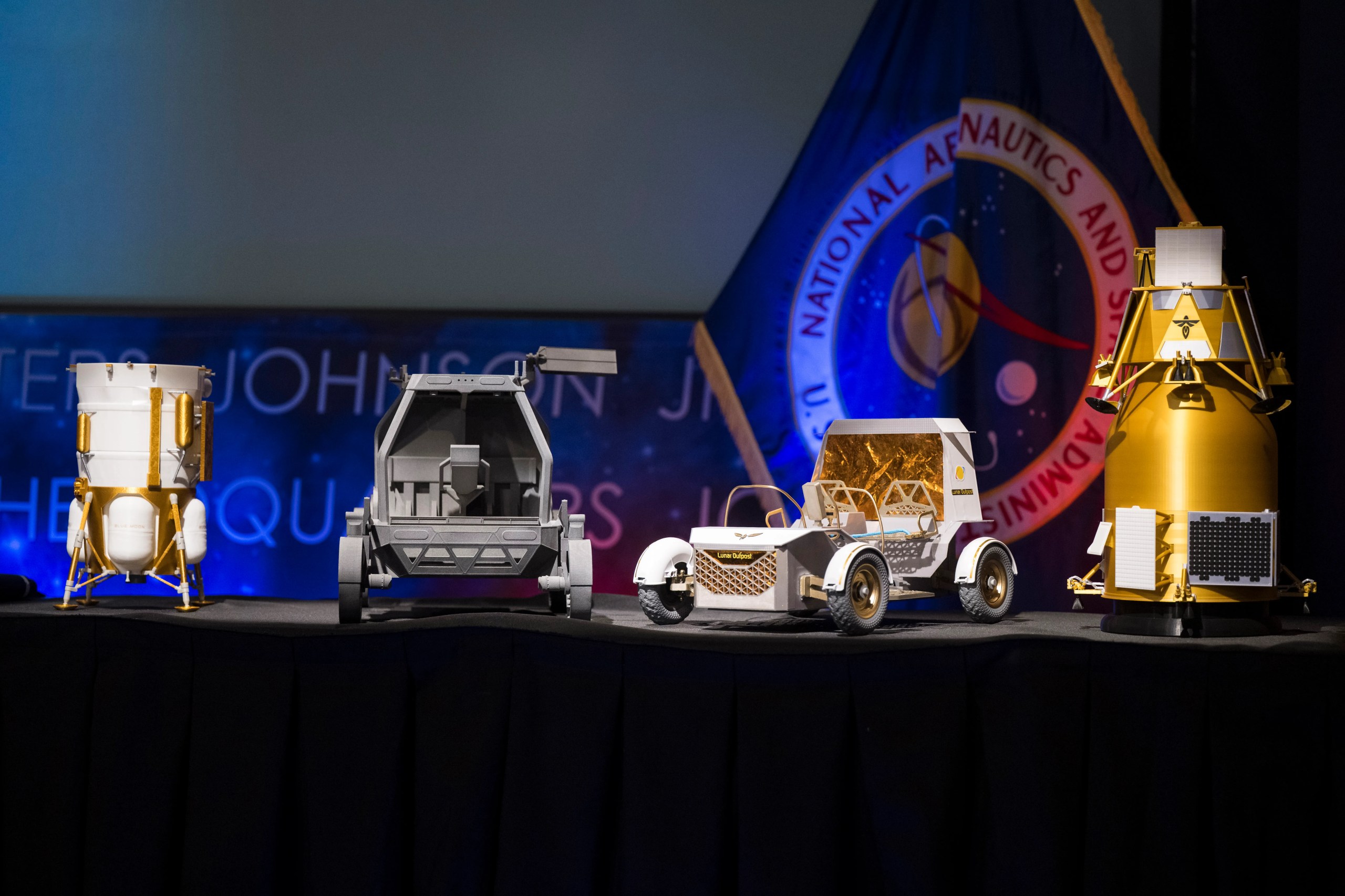
Models of four key Moon Base assets on display at the May 26 press conference: from left, the Blue Origin Mark 1 lunar lander, Astrolab’s Crewed Lunar Vehicle, Lunar Outpost’s Pegasus rover, and Firefly’s Elytra Dark orbiter. Credit: NASA/Aubrey Gemignani
Phase Two: Early infrastructure development
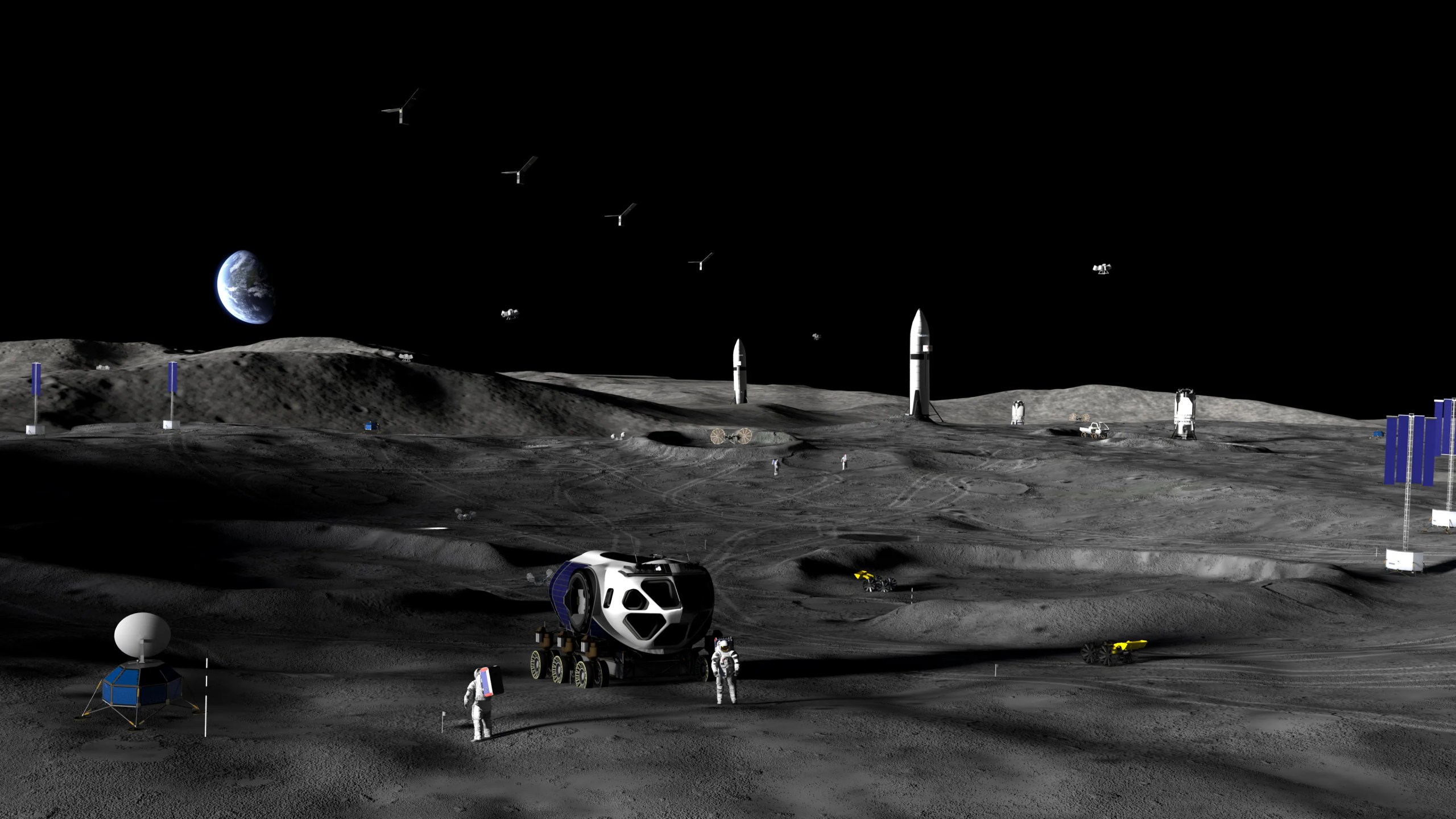
Phase Two, slated to begin around 2029, is when NASA starts laying the foundation. The recon work of Phase One is done. Now comes the first generation of hardware that the permanent base will depend on.
In order to power the base, NASA will rely on a combination of solar and nuclear power. During Phase Two, demonstration solar arrays with battery storage will go up on the sunlit ridgelines. In the long run these will be developed to generate more than 10 kilowatts during illuminated periods and store enough energy to survive the lunar night. Small-scale radioisotope thermoelectric generators — compact nuclear power sources that produce a few hundred watts continuously — will begin demonstrating how nuclear power can keep systems alive inside permanently shadowed regions. These will be replaced in Phase Three by large-scale permanent nuclear facilities. Communications towers, working like cell towers, each covering roughly a 6-mile (10 kilometers) radius, will start stitching together a “surface-to-orbit” comms network across the south pole.
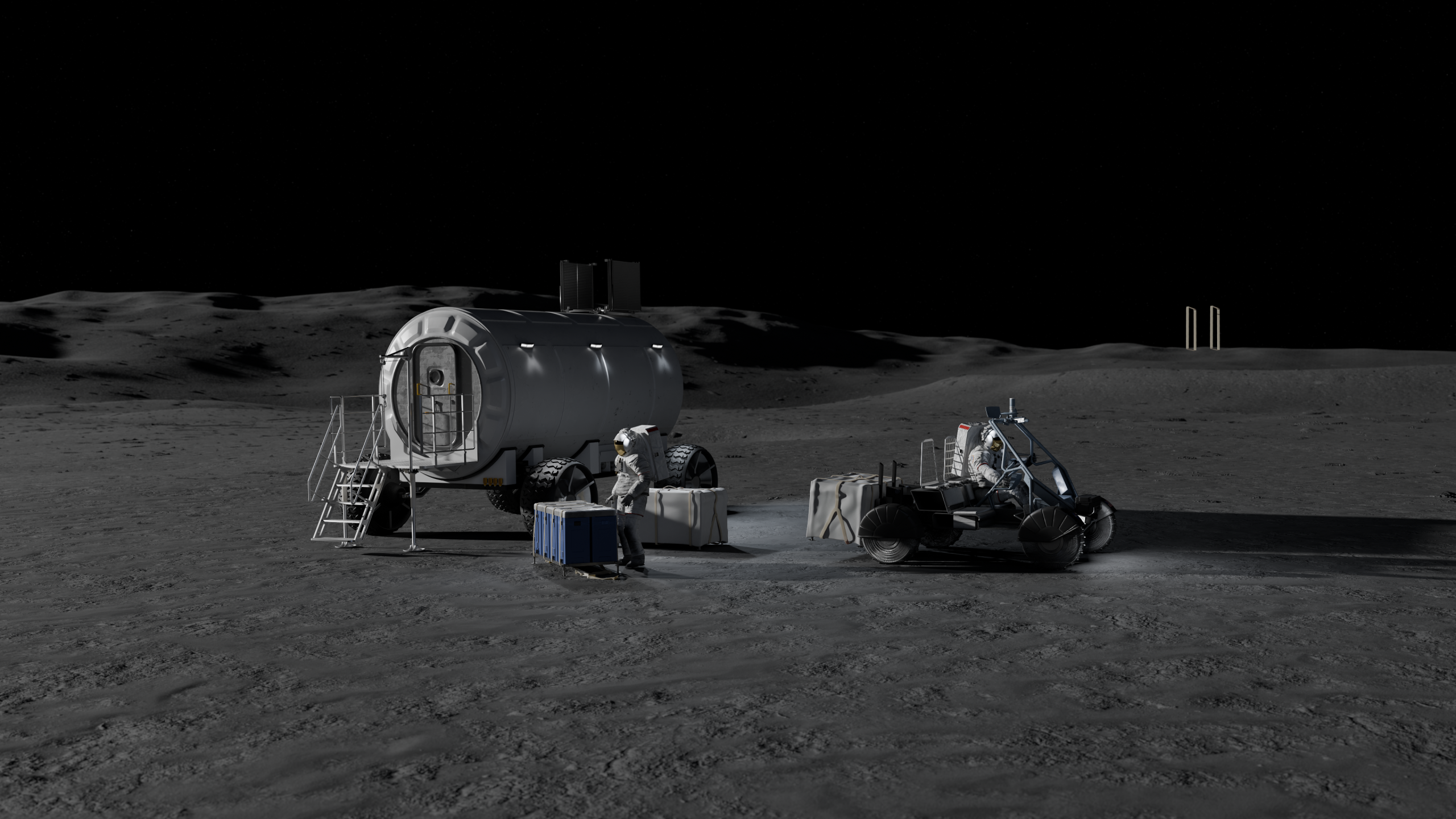
The centerpiece of Phase Two is JAXA’s pressurized rover — the base’s first habitat. A mobile laboratory and living quarters, it can keep two astronauts alive for up to 30 days without the need for a spacesuit. The rover will be able to navigate inclines up to 15 degrees, and survive up to 150 hours without light. Offering mobility and safety, it turns the south pole into a place crews can stay and explore rather than just visit.
If all goes to plan, as much as 60 tons of cargo across as many as 24 landings will deliver the Phase Two infrastructure, with regular crew rotations beginning around 2030.
Phase Three: Moving in
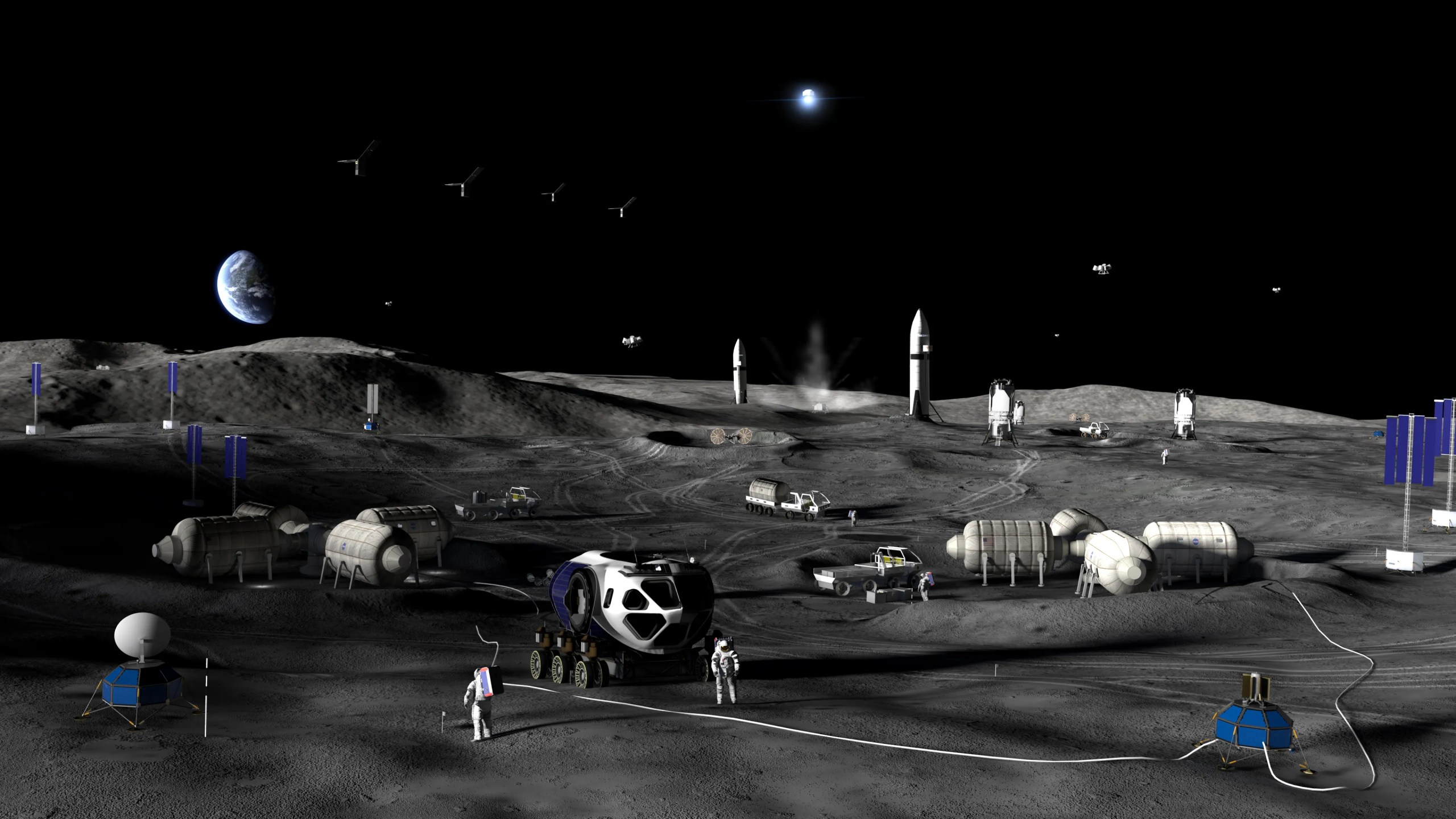
Phase Three, beginning around 2032, is when the base fully transitions from demonstration into a place people actually live. The first permanent habitat modules arrive — larger structures with airlocks that can link together and expand, featuring living and working spaces. Large-scale fission reactors come online, supplying steady power through the lunar night independent of the sun.
Water ice extracted from shadowed craters is converted into drinking water, oxygen, and rocket propellant onsite. Lunar regolith begins to be processed into construction material. Delivery capacity grows to as much as 17,637 pounds (8,000 kilograms) every four weeks, and cargo starts flowing back to Earth: uncrewed vehicles capable of returning up to 1,102 pounds (500 kg) of samples and hardware. By the mid-2030s, if everything holds, the base will have become humanity’s first permanent outpost on another world.
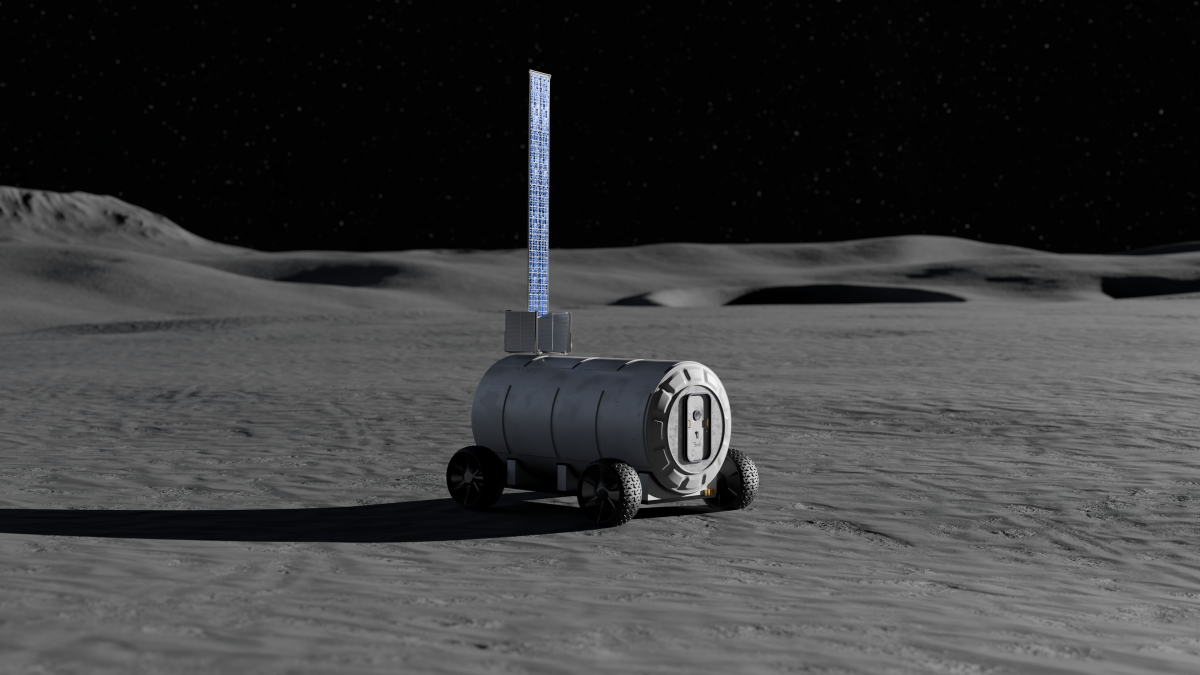
One of the interconnected habitat modules NASA plans to deploy during Phase Three, designed to support long-duration crew stays at the Moon Base by the mid-2030s. Credit: NASA
The long road ahead
NASA’s plan is ambitious — dozens of missions, untested technology and a permanent human outpost on the Moon within a decade. Whether NASA will be able to follow through on that vision is a difficult question.
Delivering all the hardware for the Moon Base program falls to NASA’s Commercial Lunar Payload Services program, or CLPS — the agency’s framework for contracting private companies to carry cargo to the Moon. NASA is confident the commercial sector is ready for the task. The numbers, though, invite some scrutiny. Since CLPS kicked off in 2018, NASA has awarded 14 missions to five vendors. In the time since, one vendor went bankrupt, and only four missions have launched. On average, the missions experienced 14-month delays, according to a 2024 NASA Office of Inspector General report. And of the four that did launch, only one — Firefly Aerospace’s Blue Ghost — fully achieved all its mission objectives.
CLPS 2.0, announced at the May 26 press conference, calls for 77 missions over the next decade — almost 20 times more than what CLPS 1.0 achieved. According to industry estimates, these missions will run roughly $91 million each, down from an average of $129 million under CLPS 1.0. In other words, the commercial industry would need to execute magnitudes more in the next 10 years, at lower cost per mission, than what it barely began in seven.
Isaacman made clear that hitting those targets will require NASA to be an active partner — not just a customer waiting on delivery. “We will not sit on our hands and wait for industry to deliver,” he said. “We’ve been … having the tough conversations with those failing to meet expectations, and offering NASA’s assistance to solve problems, and doing the other hard things that should be expected of the world’s most accomplished space agency.” With the contract awards on the table, Carlos Garcia-Galan, program executive for the Moon Base, was matter of fact about what they represent. “Now gets the hard part,” he said, “which is delivering on time and having successful missions back to back.”
Moon Base 1 depends on Blue Origin’s New Glenn program overcoming its recent explosive setback. Moon Base 2 relies on Astrobotic’s Griffin lander, which has never flown. And underpinning all of it is a contracting framework that asks far more of the commercial lunar industry than its predecessor ever did. Whether the rocky road so far represents the inevitable growing pains of a new industry or a warning sign about what lies ahead remains to be seen.
Brooks Mendenhall is a staff writer for Astronomy and is based in Chattanooga, Tennessee.