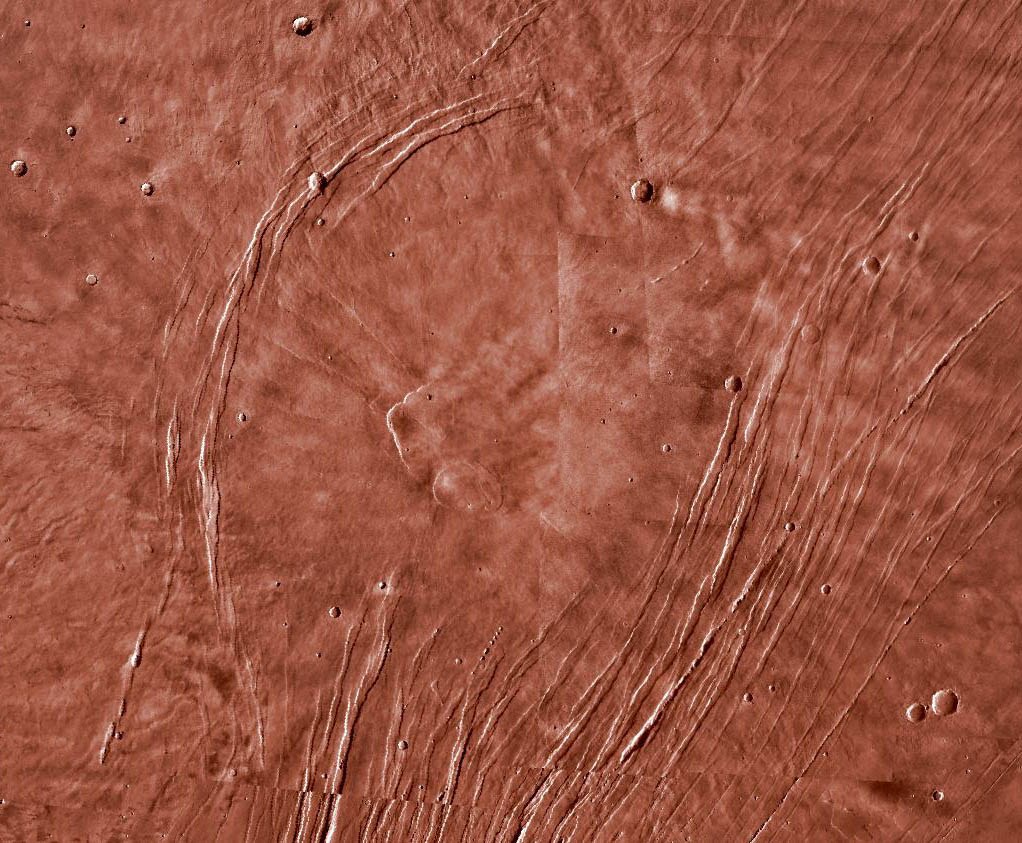
Something is leaking from the ground near one of Mars’ largest volcanoes, and scientists think it’s a sign that active magma is buried below.
In a study published Nov. 4 in Science Advances, researchers report detections of hydrogen chloride (HCl) gas within 6 miles (10 kilometers) of the planet’s surface near the volcano Alba Mons. Notably, the detections came during aphelion, when Mars is farthest from the Sun and HCl is typically absent from its atmosphere. The location and out-of-season timing combined with the site’s unique geology likely point to volcanic outgassing — gas escaping from magma as it rises toward the surface — the authors argue.
“It seems that we are showing that there may still be more heat inside Mars than we thought, enough heat to have still fluid magma at depth,” co-author Daniel Mège, a professor at the Space Research Centre of the Polish Academy of Sciences, tells Astronomy.
The detection adds to mounting evidence, including recent detections of marsquakes, that the martian interior is not the dead world scientists once assumed. While scientists know volcanism influenced the planet’s evolution, it has remained unclear whether it continues today.
A volcanic past
There’s no question that igneous activity shaped Mars into the planet we see today. Between 3.7 billion and 3 billion years ago, eruptions flooded the planet’s surface with vast lava plains. Later volcanic activity built some of the solar system’s largest volcanoes, including the roughly 16-mile-high (25 km) Olympus Mons — the tallest — and the 4.2-mile-high (6.8 km) Alba Mons, the largest by surface area. Though it rises just 4.2 miles (6.8 km), Alba Mons sprawls roughly 870 by 620 miles (1,400 by 1,000 km).
Those colossal peaks formed not through shifting plate tectonics like on Earth, but through stagnant-lid tectonics. Mars’ outer shell is a single rigid plate, meaning magma repeatedly erupted at the same sites, piling lava to towering heights over millions of years.
Many of these giants, including Olympus and Alba Mons, sit atop Tharsis, a volcanic plateau roughly 3,000 miles (5,000 km) across. Some lava flows at Tharsis are relatively young, dating back only tens of millions of years, yet there has been no definitive evidence for ongoing volcanic activity at the plateau or on the planet as a whole. Nevertheless, the case has been slowly building.
Mounting evidence
Before its mission ended in 2022, NASA’s InSight lander recorded more than 1,300 marsquakes. Quakes alone don’t prove volcanic activity. “Marsquakes can happen for multiple reasons, only one of which is faulting or other tectonic activity around volcanoes,” says R. Aileen Yingst, a senior scientist at the Planetary Science Institute who studies Mars geology and was not involved in the study. For example, some of the marsquakes InSight detected were caused by meteoroid impacts. And a cooling and contracting crust can cause seismic activity without magma.
Most of the quakes, though, were traced to a system of young volcanic fissures — long, parallel cracks where the martian crust was once pulled apart by rising magma — called Cerberus Fossae. Deposits of volcanic ash at Cerberus Fossae date to as recently as 53,000 years ago. Some scientists argue the large number of marsquakes in this setting could hint that magma is still moving below. In 2022, researchers proposed that a 2,500-mile-wide (4,000 km) active mantle plume lies beneath the Elysium Planitia region that surrounds Cerberus Fossae. On Earth, such columns of hot solid rock rise from deep in the planet’s interior, melting rock and creating magma, which could explain both the marsquakes and the ash deposits.
Orbiters searching for evidence of active volcanism on the martian surface have yet to turn up anything conclusive, the authors say. Sulfur dioxide (SO₂), the gas most often used to track volcanoes on Earth, has never been detected on Mars at concentrations that would point to magma. But that absence doesn’t mean Mars’ magma has gone quiet. Measurements at volcanoes on Earth show that SO₂ dominates during eruptions but drops sharply between them, when HCl becomes the more abundant gas. “[A]s long as we do not observe an active lava flow, or lava fountain, or explosion on Mars, we do not expect SO₂ emissions to be very high,” Mège says. Mars is also about 2.5 times richer in chlorine than Earth, and some martian volcanic meteorites are “up to four times richer” in chlorine than sulfur. “All this suggests that HCl is the best gas to look for on Mars if we want to identify active magma at depth that is not being erupted,” Mège explains.
An out-of-season signal
The detections in the study come from the Atmospheric Chemistry Suite (ACS), a set of three infrared spectrometers aboard the Trace Gas Orbiter, a joint mission of the European Space Agency and Russia’s space agency, Roscosmos. The orbiter began science operations in 2018. ACS’s spectrometers analyze the sunlight filtering through the martian atmosphere, picking out the wavelengths each gas absorbs to reveal what’s in the air and at what altitude. In 2020, ACS made the first detection of HCl on Mars. It appeared planetwide during the warm, dusty season near perihelion, reaching concentrations of 4 to 5 parts per billion. Researchers attributed the presence of that HCl to chemical reactions involving dust, ice, and water vapor in the atmosphere during the warm season, not to volcanic activity.
What’s different about the new finding is that they detected HCl not at perihelion, but near aphelion, when the gas is otherwise absent from Mars’ atmosphere. The HCl was also localized above an interesting geological location: the region around the sprawling, low-profile volcano Alba Mons, located on the northern edge of Tharsis. After two tentative detections in one Mars year, a dedicated search two Mars years later turned up six more, mostly northeast of the volcano. The gas hugged the lowest 6 miles (10 km) of the atmosphere at concentrations up to 1.5 parts per billion.
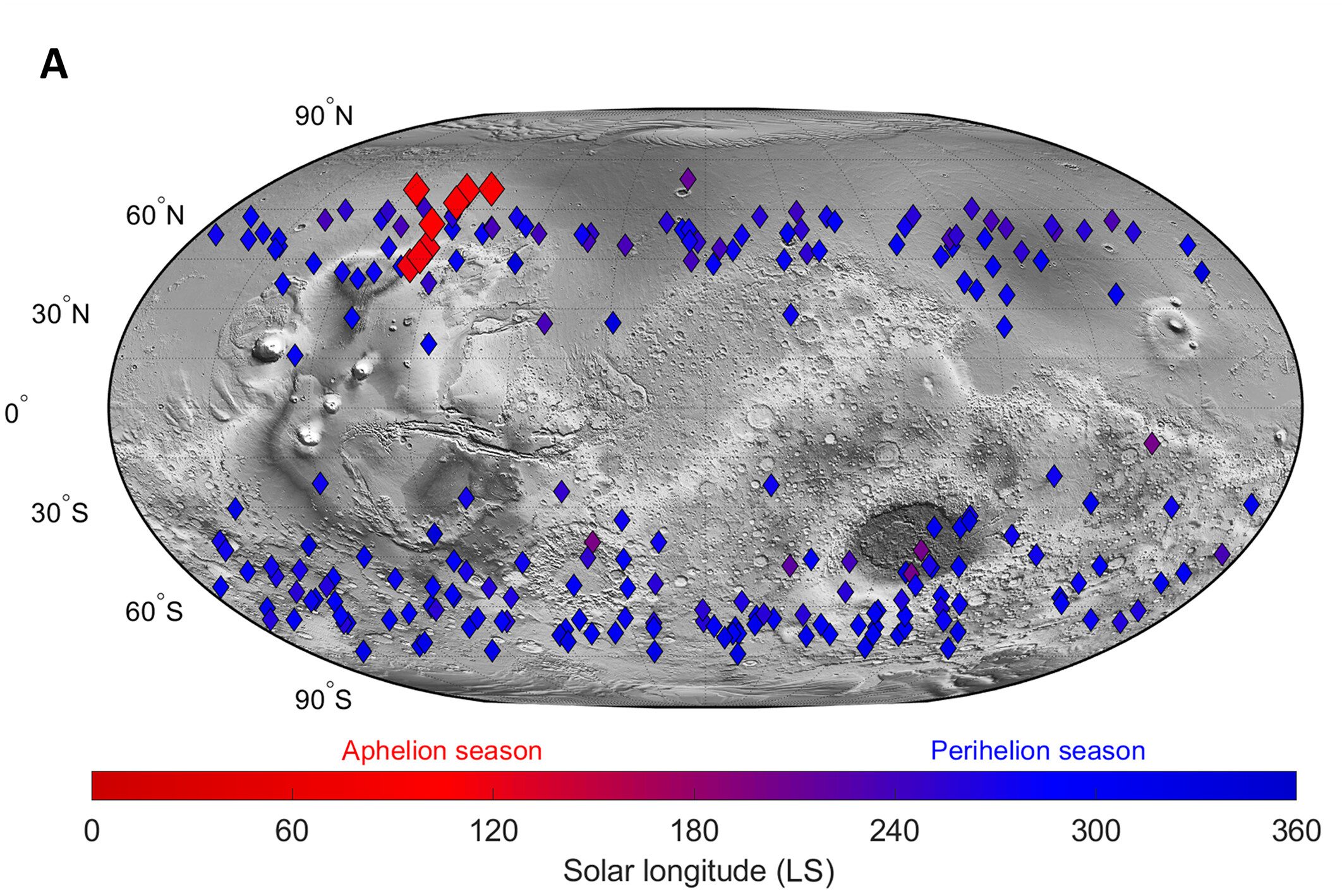
Hydrogen chloride detections by the ExoMars Trace Gas Orbiter during Mars’ warm perihelion season (blue) are scattered widely across the planet, while those from the cold aphelion season (red) cluster in a single region near the Alba Mons volcano. That isolated signal led researchers to suspect the gas is seeping from magma below. Credit: Trokhimovskiy et al., Science Advances (CC BY 4.0)
Tracing the source
The team ruled out atmospheric processes for the HCl and considered three possible ground sources: volcanic activity, mud volcanism, and the breakdown of chlorine-bearing salts called perchlorates. Mud volcanoes — likely inactive for billions of years — are widespread across Mars’ northern lowlands, so they alone couldn’t explain why the gas showed up in only one isolated place. And even if mud volcanism were active and releasing the HCl, it would likely still point to magma beneath the surface. Perchlorates are likewise found across the northern lowlands, which rules them out on the same grounds. “[I]f this mechanism were involved, HCl would be detected throughout the northern hemisphere, it would not be local,” Mège says. That leaves localized volcanic activity, which fits with models of the planet’s formation suggesting HCl should be among the most abundant gases in its volcanic emissions.
To gather more data, the team turned to high-resolution images from the High Resolution Imaging Science Experiment (HiRISE) camera aboard NASA’s Mars Reconnaissance Orbiter, and the Colour and Stereo Surface Imaging System (CaSSIS) aboard the Trace Gas Orbiter. They were looking for features near Alba Mons that could explain the seepage. They found a grouping of several narrow fissures that had not previously been identified. Many were just tens of centimeters wide, and some extended for up to 6.21 miles (10 km) long. Some were ringed by dark halos, suggesting material may have recently been ejected from within. The fissures were so thin that seasonal dust and ice activity should have already covered them up unless something was actively keeping them open. The authors did not confirm that the HCl came from the fissures, but they suggest the cracks may run from the icy ground near the surface all the way down to magma. Gas rising through them could escape directly or become trapped in the frozen ground, seeping into the atmosphere over time as the ice turns to vapor.
The case isn’t closed. The team didn’t catch gas escaping from any specific fissure. And although the cracks hadn’t been described before, they appear in older orbital images, with no visible changes between then and now. The authors stop short of a firm conclusion, saying only that ongoing volcanic activity is the best explanation for what they found. “What we can say today is: when we consider all the alternatives, it is the best explanation,” Mège notes. The next step is to keep watching. Future searches could reveal more hidden pockets of gas, and with them, more signs that Mars’ interior is still stirring. Ultimately, “to confirm the source,” Mège says, “we would need someone or some robot to check, with a very multidisciplinary payload.”
If there is still magma beneath Alba Mons, the implications reach beyond geology. Mars is smaller than Earth, so it should have shed its internal heat faster. “If it’s the case that Mars is still volcanically active, then the thermal models of Mars would probably need to be revisited,” Yingst explains. And where magma meets groundwater, hydrothermal systems – the kind of environment where life on Earth may have first emerged – usually follow. If conditions stayed stable long enough, Mège says, life could have arisen there. And “if these stable conditions continue until now, then these living organisms may still be there, somewhere below the surface.”
Brooks Mendenhall is a staff writer at Astronomy, based in Chattanooga, Tennessee, fueled by an unending curiosity about the universe. A former classroom teacher, he has a knack for breaking down complex concepts for a wide audience.