Credit: Lick Observatory
For many years, planetary scientists have believed that water-rich meteorites arriving late in Earth’s history (OK, the time might be late to the researchers, but it’s still 4 billion years ago) could have delivered most of Earth’s water. But in a paper (https://www.pnas.org/doi/10.1073/pnas.2531796123) published in the Proceedings to the National Academy of Sciences, researchers led by Tony Gargano at the Lunar and Planetary Institute and The University of New Mexico analyzed a large number of Apollo lunar regolith samples using high-precision triple oxygen isotopes.
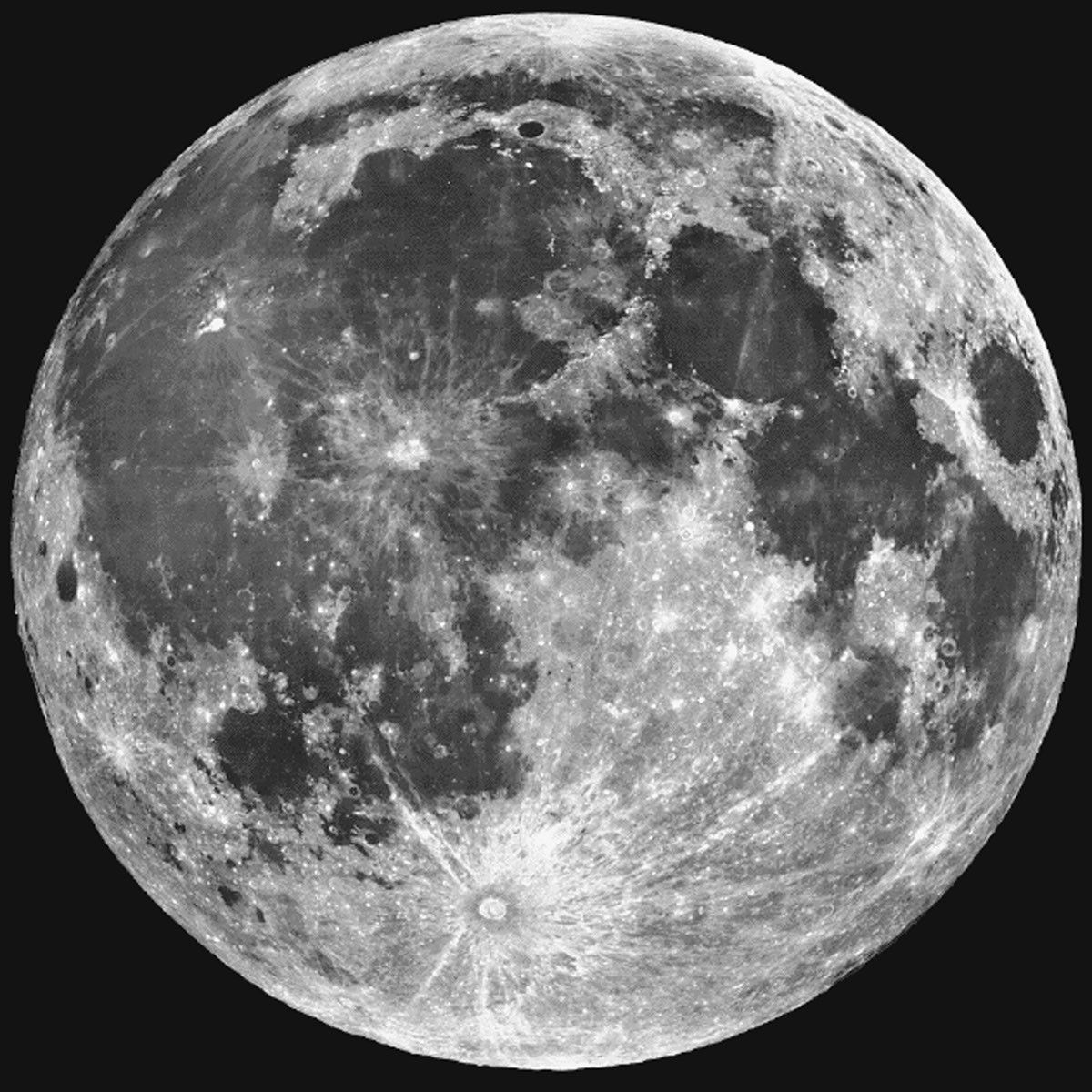
They can’t do the same with Earth because tectonics and constant crustal recycling have erased the meteorite bombardment record. But the Moon is stable with no atmosphere, and therefore no weather. So, it has maintained an archive: lunar regolith, the loose layer of debris produced and reworked by impacts over billions of years.
Analyzing the Moon’s soil
Ever since the Apollo missions brought back lunar samples, scientists have analyzed that material by studying elements abundant in meteorites but scarce in the Moon’s crust. But lunar regolith is difficult to decipher. First, meteorite impacts can melt, vaporize, and rework material repeatedly. Second, geological processes after those impacts can separate metal from silicate, which complicates trying to figure out the type and amount of material that came from meteorites.
“The lunar regolith, which is a collection of loose ‘soil’ and broken rock at the surface, acts like a long-term mixing layer,” said Gargano. “It captures impact debris, stirs it in, and preserves those additions for immense spans of time. That is why it is such a powerful archive. It lets us study a time-averaged record of what was hitting the Earth-Moon system.”
The new study takes a different approach. It uses oxygen — the main element by mass in rocks — to determine what and how much meteorite material has been added and any effects from the vaporization of material by the impacts. By measuring the amount of oxygen isotopes in the regolith, the team found that about only 1 percent by mass of the regolith consists of impactor-derived material from carbon-rich meteorites that were partially vaporized upon impact.
“Triple oxygen isotopes give us a more direct and quantitative way to approach the problem. Oxygen is the dominant element in most rocks, and the triple-isotope framework helps us distinguish true mixing between different reservoirs from the isotopic effects of impact-driven vaporization,” said Gargano. “In practice, that lets us isolate an impactor fingerprint from a regolith that has a complicated history, with fewer assumptions and a clearer chain from measurement to interpretation.”
Figuring out how much water
The team translated that 1 percent into water-delivery limits for the Moon and Earth, which it expressed in Earth-ocean equivalents for scale. For the Moon, the implied delivery since about 4 billion years ago is tiny on an Earth-ocean scale. But because that water is concentrated in small, cold-trapped reservoirs, it can be important for future long-term lunar missions.
The researchers then applied the same calculation to Earth, which, because of its size, would have gotten using substantially more impactor material than the Moon. But even if our planet received roughly 20 times the meteoriteimpacts the Moon got, all that water delivers only a few percent of an Earth ocean at most. That makes it difficult to believe water-rich meteorites were the dominant source of Earth’s water.
“The lunar regolith is one of the rare places we can still interpret a time-integrated record of what was hitting Earth’s neighborhood for billions of years,” said Gargano. “The oxygen-isotope fingerprint lets us pull an impactor signal out of a mixture that’s been melted, vaporized, and reworked countless times. The main takeaway from our study is that Earth’s water budget is hard, if not impossible, to explain if we only consider a single, late delivery pathway from water-rich impactors from the outer solar system. Even though some meteorite types carry a lot of water, their broader chemical and isotopic fingerprints are quite exotic relative to Earth. Habitability models have to satisfy such empirical constraints, and our study adds a constraint that future theories will need to reproduce.”
The results don’t say meteorites delivered no water. But they do say the Moon’s long-term record makes it hard for late meteorite delivery to be the dominant source of Earth’s oceans.
Gargano framed the work as part of a scientific lineage that began with Apollo. “I’m part of the next generation of Apollo scientists — people who didn’t fly the missions, but who were trained on the samples and the questions Apollo made possible,” Gargano said. “The value of the Moon is that it gives us ground truth: real material we can measure in the lab and use to anchor what we infer from meteorites and telescopes.”