Since the first observations of the CMB, astronomers have been creating space-based telescopes to study the radiation and see how it varies. The COsmic Background Explorer was the first spacecraft to study the CMB in detail. Then in 2001, the Wilkinson Microwave Anisotropy Probe (or, WMAP) launched to record the microwave sky and create the best map we have of the radiation background. This telescope measured the CMB as 2.73 kelvins (or –270.40° C), and the color variations in the image show temperature differences of just a few hundred-thousandths of a degree. These tiny temperature deviations also provide evidence that the universe is expanding and must have begun in a much smaller state, because those regions of similar temperature would have had to be in contact.
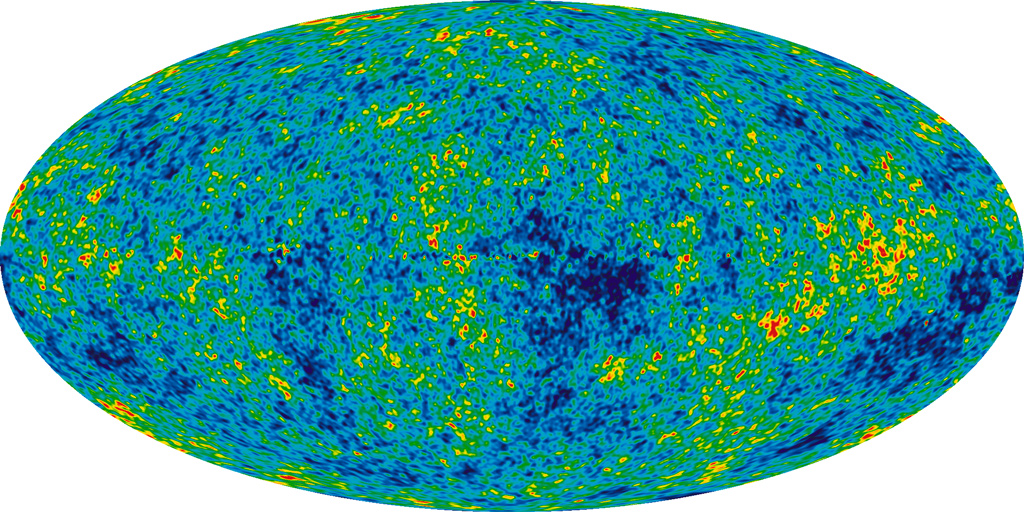
The sizes of the spots can tell astronomers about the universe’s age, shape, and composition: the amount of normal matter (which makes up the stars and galaxies), dark matter (the majority of the universe’s mass), and dark energy (the mysterious “something” that’s accelerating expansion) in the cosmos.
The WMAP team released its final data set in 2012, incorporating nine years of observations. According to those numbers, the universe is 13.77 billion years old and geometrically flat, which means that if you follow parallel lines forever across the universe, they will never meet or diverge. Analysis also shows that 4.6 percent of the universe is normal matter, 24 percent is the mysterious dark matter, and 71.4 percent is dark energy. Astronomers have a lot to learn about our universe, as just 4.6 percent is well understood.
Expand your knowledge at Astronomy.com
Check out the complete Astronomy 101 series
Learn about our stellar neighborhood with the Tour the Solar System series
Read about the latest astronomy news