Looking for a sky event this week? Check out our full Sky This Week column.
March 3: The Moon turns to blood
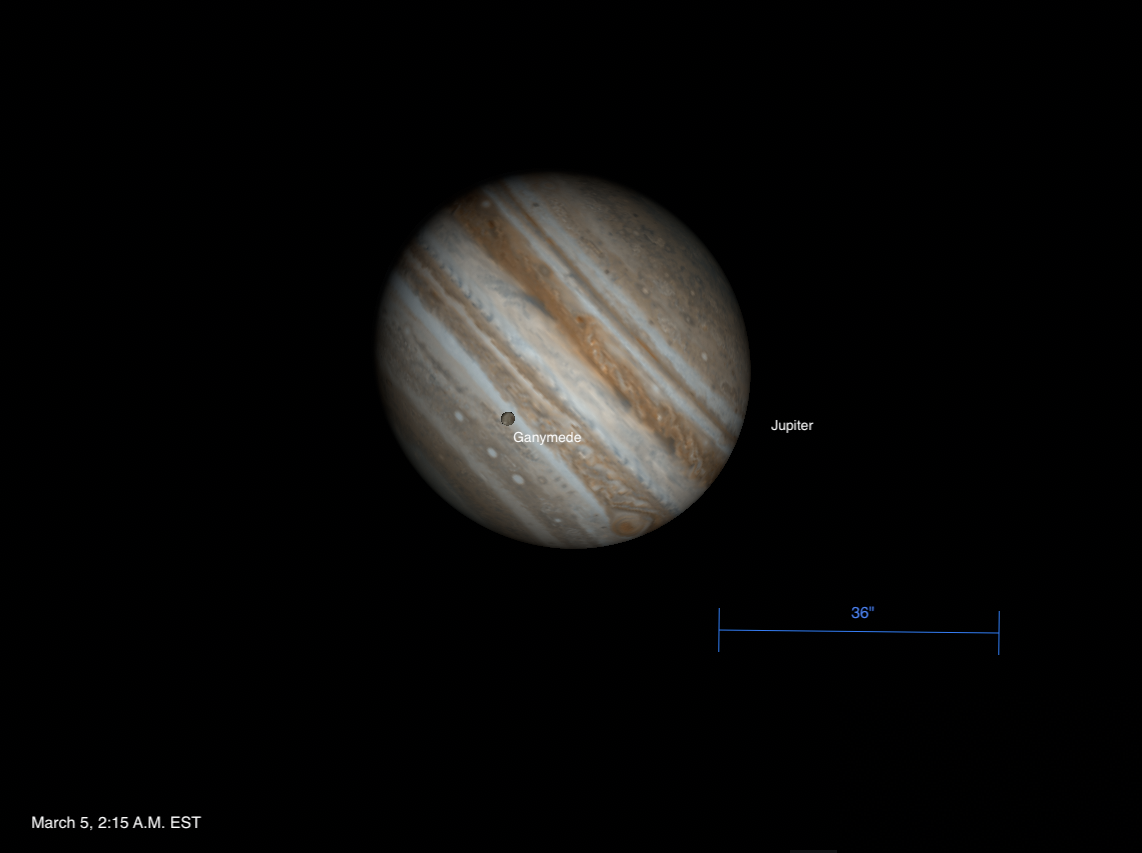
Jupiter’s largest moon, Ganymede, transits the gas giant’s large disk overnight, beginning late on the evening of the 4th for much of the U.S.
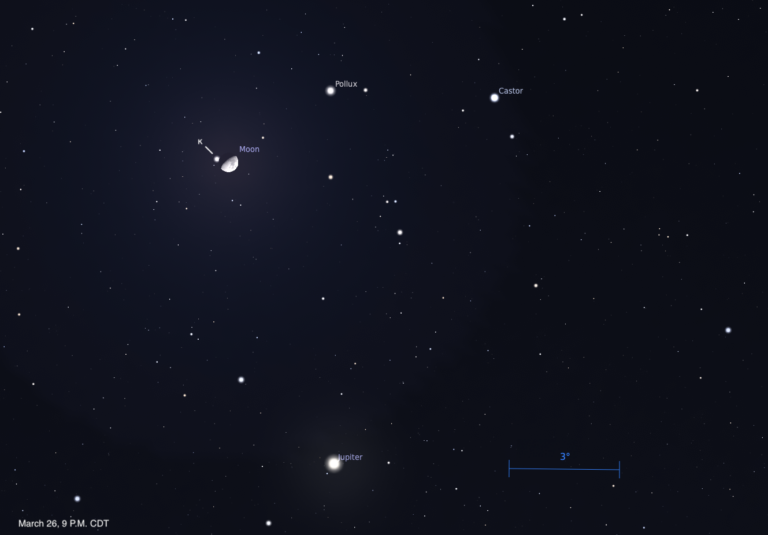
Jupiter remains a fixture in Gemini the Twins, now visible in the west late tonight. You can find the planet hanging below the bright stars Castor and Pollux as the region sets. Zoom in on Jupiter and you’ll spot Callisto alone far to the planet’s west; on its eastern side, Ganymede is closing in on the southeastern limb, while Io and then Europa lie farther east.
Ganymede finally the limb and begins its transit at 12:33 A.M. EST (now the 5th in the Eastern time zone only). Because it’s so large, it will take the moon several minutes to fully cross onto the disk. After that, the moon slowly treks from east to west, reaching midway across the disk around 2:15 A.M. EST (early on the 5th for much of the U.S., and with Jupiter less than 20° high along the East Coast). The transit ends around 2:48 A.M. CST — note the time change, as well as that this is around the time Jupiter is setting in the Midwest.
Observers along the West Coast can catch the start of the moon’s shadow transit, which begins around 2 A.M. PST, as Jupiter is very low in the Mountain time zone (although observers there at higher altitudes might be able to watch the shadow appear as well). Jupiter sets with the shadow crossing the disk for West Coast observers.
Sunrise: 6:28 A.M.
Sunset: 5:55 P.M.
Moonrise: 7:31 P.M.
Moonset: 6:55 A.M.
Moon Phase: Waning gibbous (97%)
*Times for sunrise, sunset, moonrise, and moonset are given in local time from 40° N 90° W. The Moon’s illumination is given at 10 P.M. local time from the same location.