Looking for a sky event this week? Check out our full Sky This Week column.
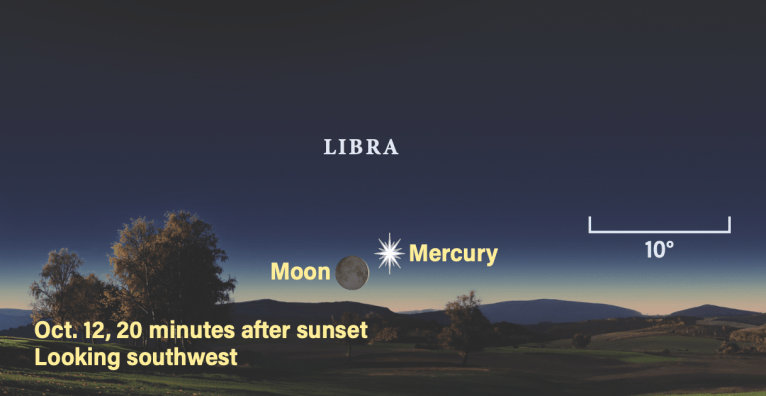
October 12: Mercury at greatest elongation
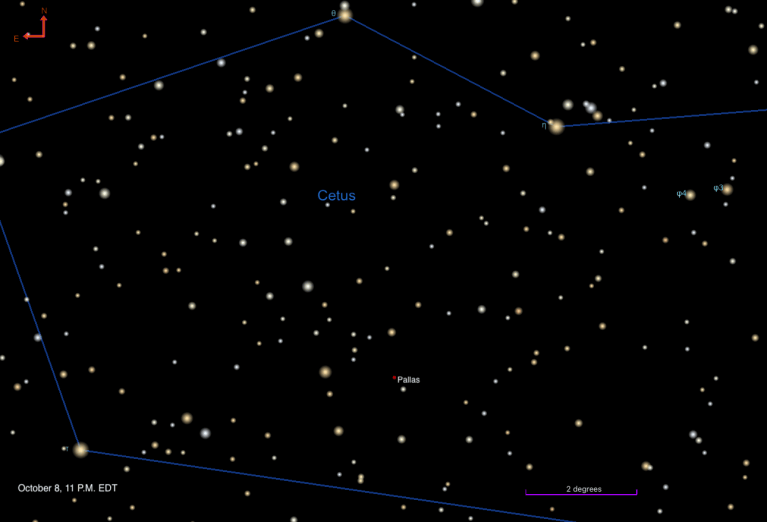
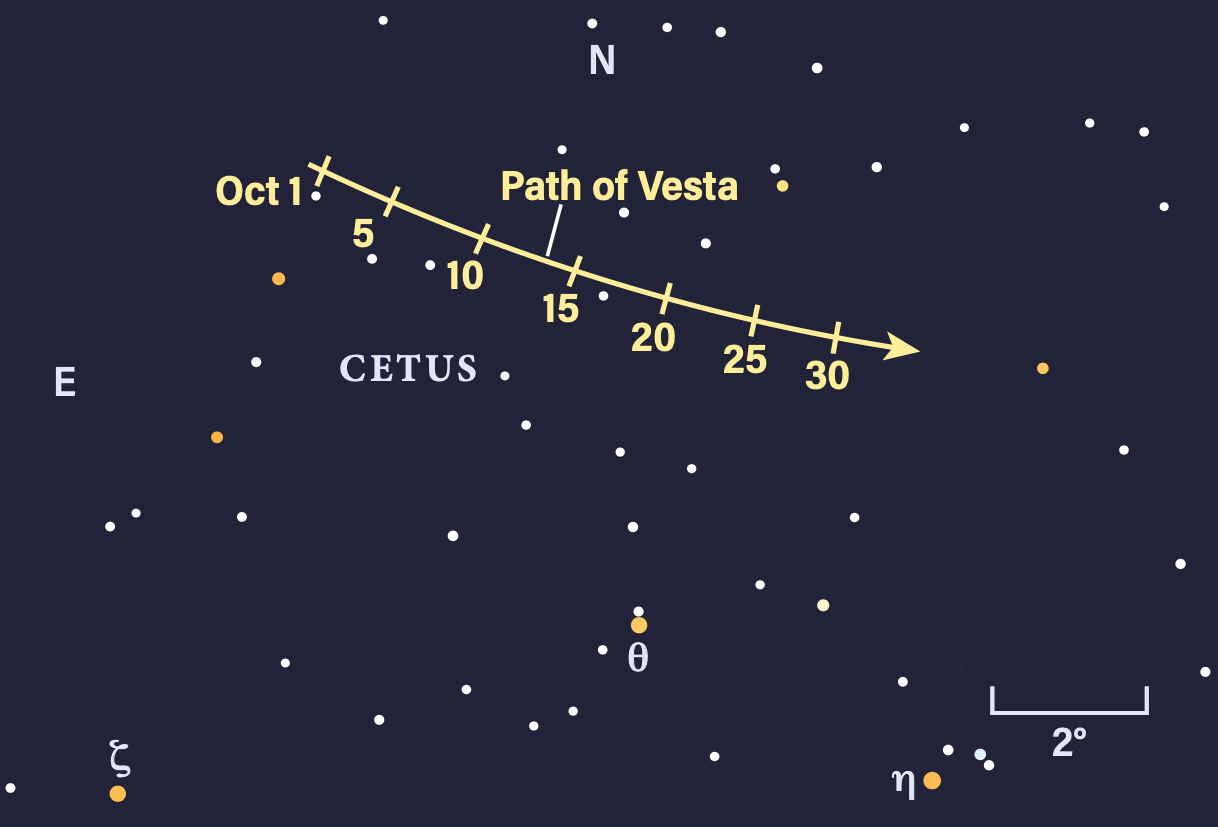
Asteroid 4 Vesta reaches opposition at 2 A.M. EDT. Shining at magnitude 6.5, it’s an easy catch, even under somewhat light-polluted skies.
While at opposition, objects are visible all night long. The best time to observe Vesta is after 10 P.M. local daylight time, when it has risen to 30° above the southeastern horizon. It’s located in northern Cetus the Whale, just 4.9° north of magnitude 3.6 Theta (θ) Ceti. There aren’t many similarly bright stars nearby — check out the chart above to help you peg Vesta’s position with respect to Theta as well as similarly bright (magnitude 3.5) Eta (η) Ceti.
The large main-belt world isn’t moving quickly, but if you take a photo or make a sketch, come back tomorrow to the same spot in the sky and do it again to see which point of light has moved. Even if you don’t see Vesta move, however, you might spot something else — sunlight briefly glinting off a geostationary satellite as it passes through your field of view. This can brighten such objects to 2nd magnitude for a few minutes, and because geostationary satellites don’t appear to move relative to the background stars, this time it is the field stars that will appear to drift past, while the brighter satellite sits still. You might just catch one by chance!
Sunrise: 7:09 A.M.
Sunset: 6:23 P.M.
Moonrise: 10:25 A.M.
Moonset: 7:42 P.M.
Moon Phase: Waxing crescent (12%)
*Times for sunrise, sunset, moonrise, and moonset are given in local time from 40° N 90° W. The Moon’s illumination is given at 10 P.M. local time from the same location.
Observers in the U.S. Midwest and farther west have a great opportunity the morning of October 14 to watch one Galilean moon pass in front of another. Io crosses in front of Callisto, occulting it from our point of view between about 5:39 A.M. and 5:44 A.M. CDT. This occurs in bright twilight along the East Coast, making the observation challenging. If you do want to try from this time zone, make sure to put away your optics at least several minutes before sunrise from your location.
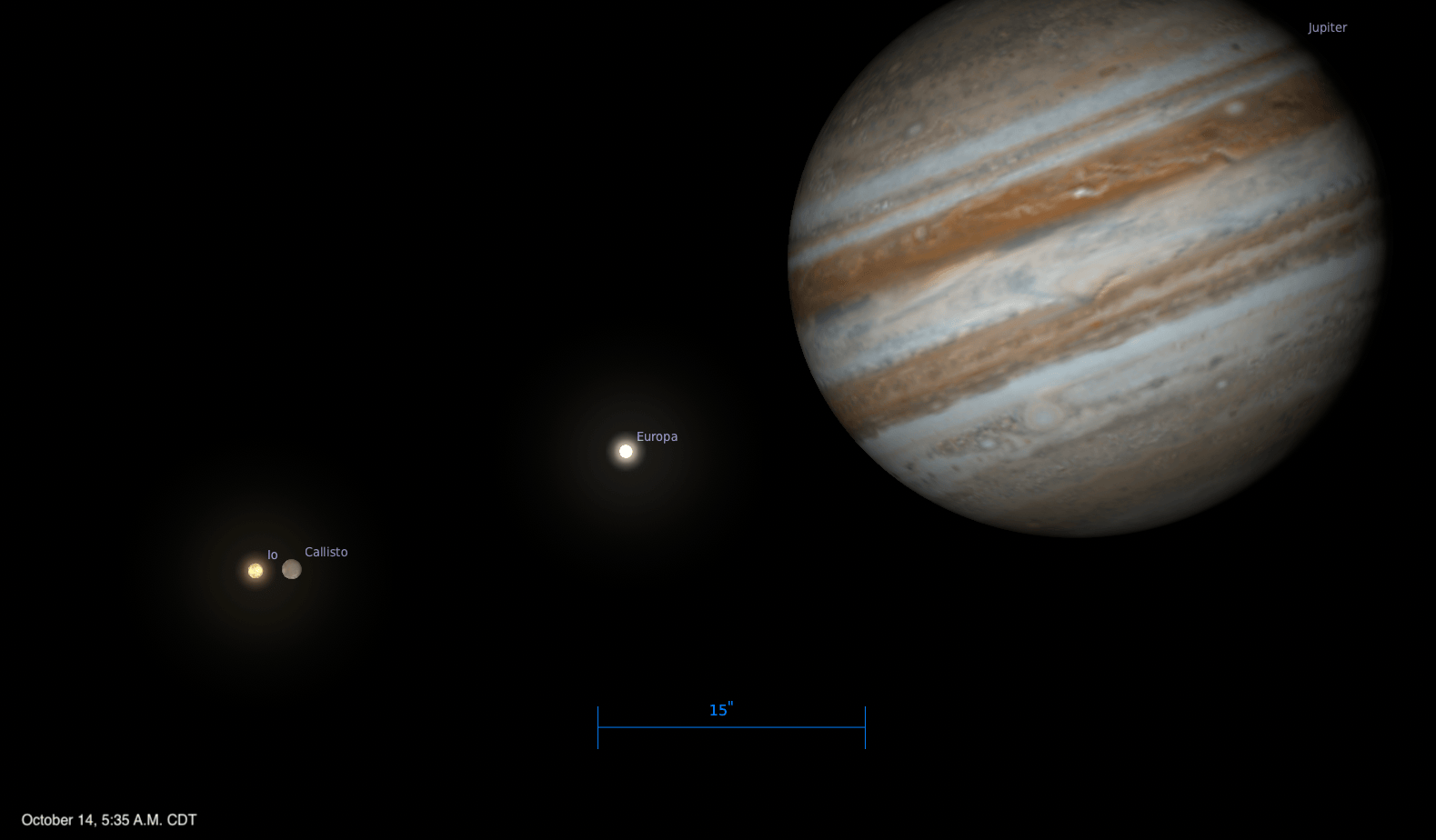
Around the time of the event, Jupiter is some 36° high in the east in the Midwest, to the upper right of the bright star Regulus in Leo. The gas giant is unmissable, shining brightly at magnitude –1.9. Zoom in with a telescope around 5:30 A.M. CDT and you’ll see Ganymede alone to Jupiter’s west, with Europa close to the planet on the eastern side, followed by Callisto just west of Io (farthest from the planet). Keep your eye on those last two moons, as they will close in and appear to merge for visual observers. If you’re an experienced astrophotographer, try capturing the event on camera and see what detail you can get!
Alison Klesman is senior editor of Astronomy magazine. She holds a Ph.D. in astronomy and has studied a variety of topics, from minor planets to supermassive black holes.