Looking for a sky event this week? Check out our full Sky This Week column.
October 11: Mars meets the Beehive
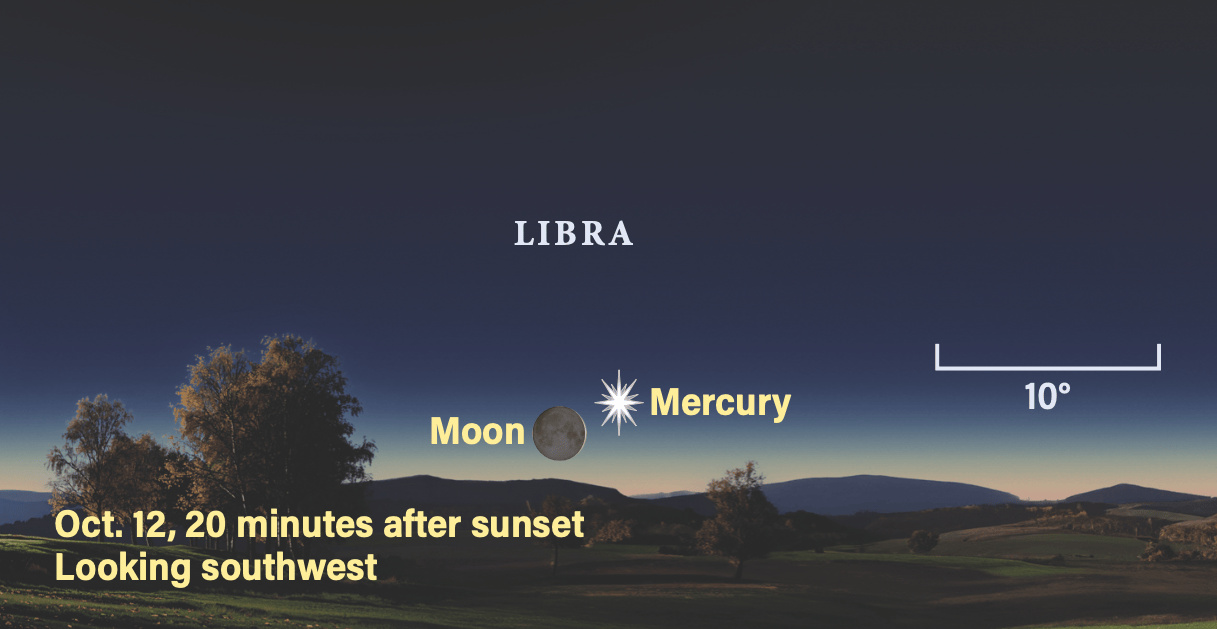
Mercury reaches its greatest eastern elongation from the Sun at 6 A.M. EDT today, standing 25° from our star. The Moon then passes 2° south of Mercury at 4 P.M. EDT. Both are now in Libra.
By evening, our satellite sits to the lower left of bright Mercury, and both are visible for a short time in the west after sunset. Mercury shines at magnitude 0.0 and should pop out quickly in the twilight — which is fortunate, as it’s just 4.5° high 20 minutes after sunset. Look for it some 3.5° to the upper right (north) of the delicate waxing crescent Moon, now some 6% lit. You might have good luck spotting the planet in binoculars or a finder scope before you can see it with your eyes — just make sure not to pull out any optical aid until at least several minutes after the Sun has disappeared below the horizon.
Through a telescope, Mercury spans 7” and appears 60% lit. The planet sets shortly after 7 P.M. local daylight time.
Sunrise: 7:08 A.M.
Sunset: 6:25 P.M.
Moonrise: 9:20 A.M.
Moonset: 7:08 P.M.
Moon Phase: Waxing crescent (6%)
*Times for sunrise, sunset, moonrise, and moonset are given in local time from 40° N 90° W. The Moon’s illumination is given at 10 P.M. local time from the same location.
Alison Klesman is senior editor of Astronomy magazine. She holds a Ph.D. in astronomy and has studied a variety of topics, from minor planets to supermassive black holes.