Looking for a sky event this week? Check out our full Sky This Week column.
August 12: A total solar eclipse, plus the Perseids peak
The early-morning hours of August 13 will be the best time to view this year’s Perseid meteor shower, peaking under the New Moon that brought August 12’s total solar eclipse.The shower’s high rate, lack of moonlight, and calendar date (when weather is warm in the Northern Hemisphere) mean it will be one of the best this year.
During the hours prior to dawn, observers are on the hemisphere of Earth that is turning into the meteor stream, creating the greatest show. Under dark skies, you may see some 60–80 meteors per hour in the few hours prior to dawn. Even observers under city lights will see bright meteors, though only about 30 or so per hour at best, as the lights wash out fainter streaks.
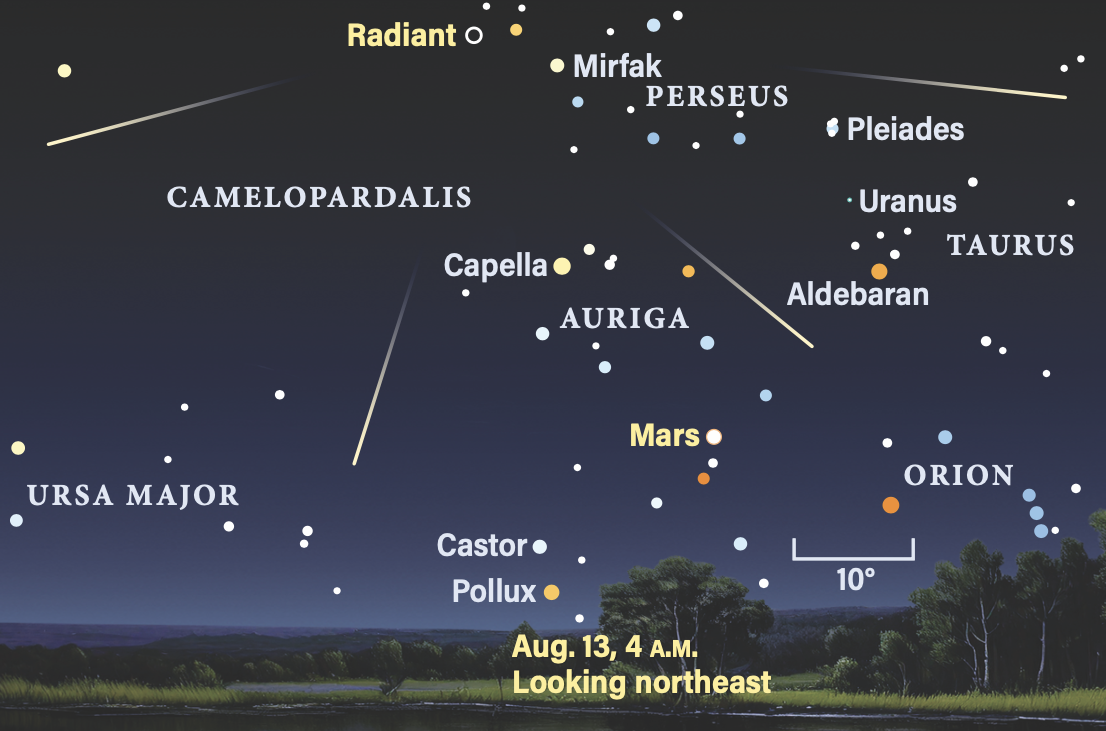
The Perseids’ radiant lies in northern Perseus, about 8° northwest (to the upper left) of 2nd-magnitude Mirfak. This is the point away from which shower meteors appear to stream, so to see the longest trails, you’ll want to look some 40° to 60° away from the radiant, to either side in the sky. You don’t need a telescope or any equipment to view a meteor shower, and your best bet is to constantly scan the sky with your eyes to catch shooting stars as they occur.
If you do happen to have your telescope out (it’s fine to take breaks from meteor watching to enjoy some deep-sky viewing under moonless skies!), make sure to swing it over to Saturn, which is 50° high in the south around 4 A.M. local daylight time. There, you’ll spot the ringed planet’s brightest moon, mid-8th-magnitude Titan, about 40” southwest of the disk as it passes by on its 16-day orbit. Tomorrow morning, Titan will stand southeast of Saturn.
Sunrise: 6:10 A.M.
Sunset: 7:59 P.M.
Moonrise: 7:08 A.M.
Moonset: 8:35 P.M.
Moon Phase: Waxing crescent (3%)
*Times for sunrise, sunset, moonrise, and moonset are given in local time from 40° N 90° W. The Moon’s illumination is given at 10 P.M. local time from the same location.
Mars stands within 1° of the open cluster M35 in the early-morning sky of August 14. Both are located at the feet of Gemini the Twins, after Mars crossed into the constellation from Taurus on the 12th.
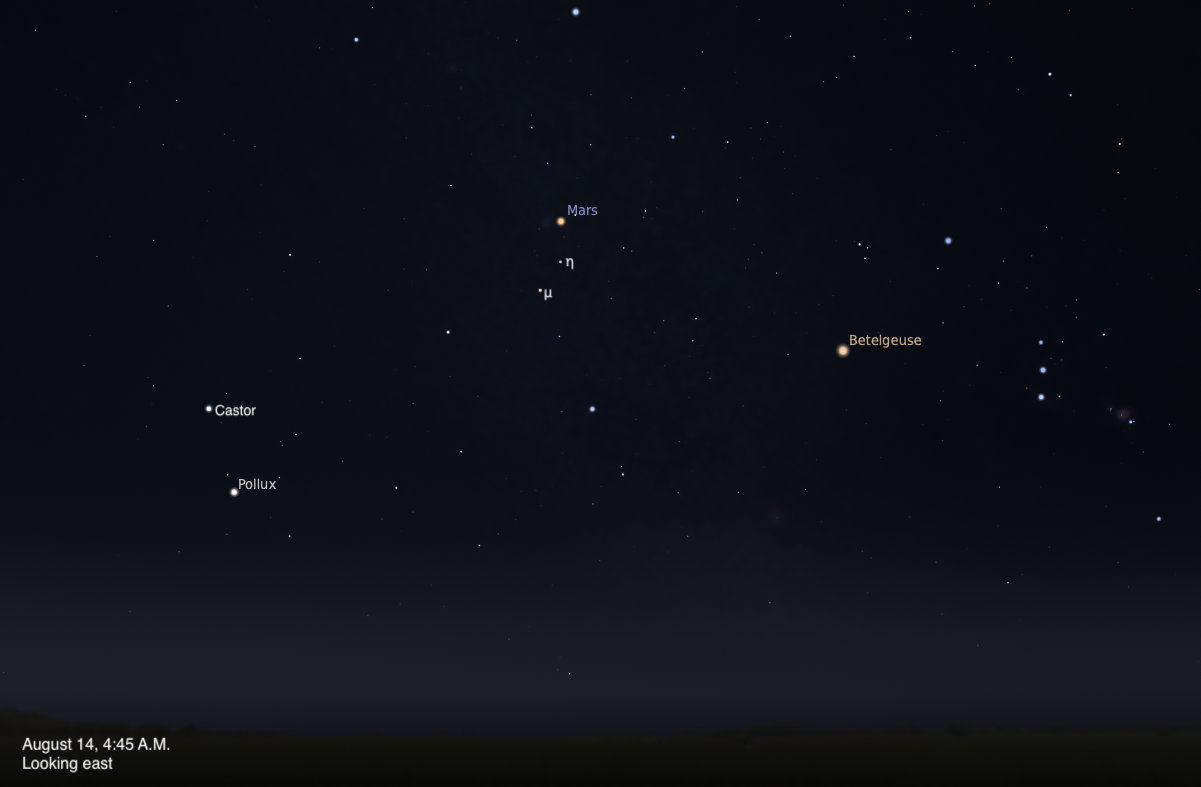
Around 4:45 A.M. local daylight time, you’ll find the Red Planet nearly 30° high in the east, to the far upper right of Castor and Pollux, the heads of Gemini, and to the lower left of Zeta (ζ) Tauri, the tip of the southern horn of Taurus the Bull. Magnitude 1.3 Mars is now just over 2° northwest of 3rd-magnitude Eta (η) Geminorum; it will pass close to this star later in the week.
M35, glowing at magnitude 5.3, is a great target for binoculars or a small telescope. It will appear within the same field of view as Mars using either optical aid, just 1° to Mars’ northeast. Spanning nearly half a degree, roughly the same size as the Full Moon, this open cluster contains more than a hundred young stars. Dozens will pop out even under low magnification, with more becoming apparent as you step up in telescope size. But to capture all its stars, staying at low magnification to give yourself the largest field of view is best.
Alison Klesman is senior editor of Astronomy magazine. She holds a Ph.D. in astronomy and has studied a variety of topics, from minor planets to supermassive black holes.