Looking for a sky event this week? Check out our full Sky This Week column.
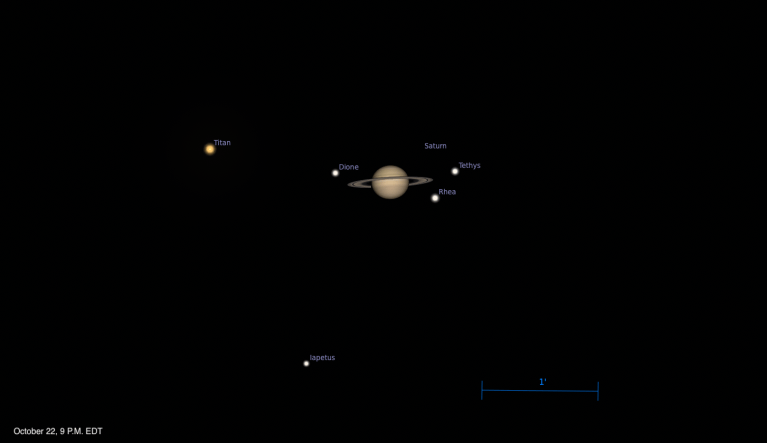
September 12: Dione skims Saturn’s pole
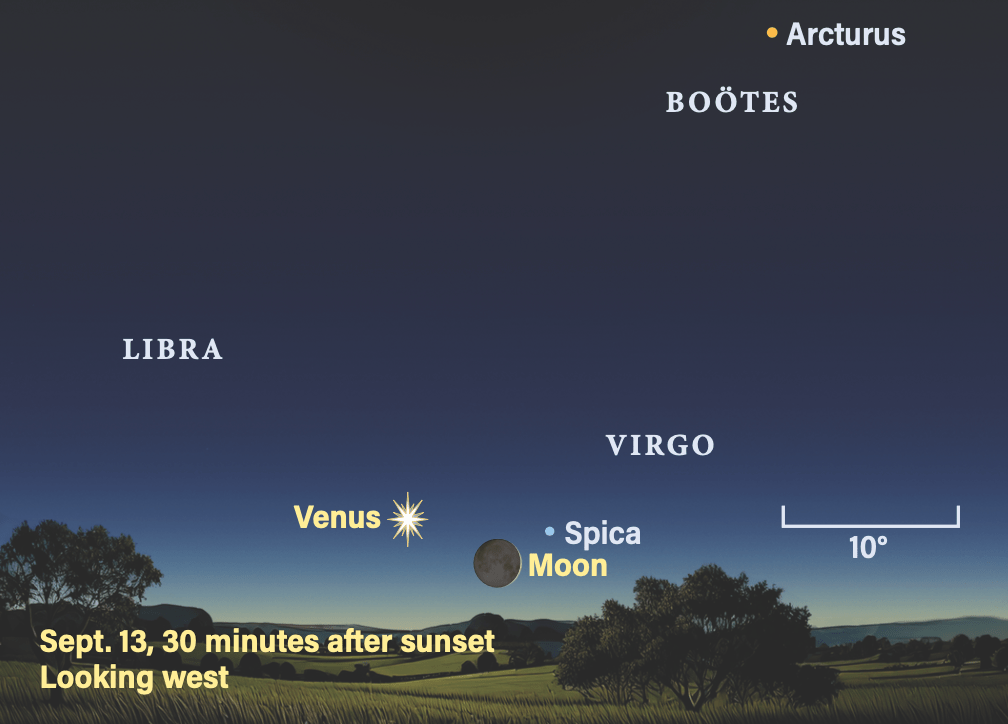
Blazing at magnitude –4.8, Venus is nearing its greatest illuminated extent and stands out as an unmissable evening star after sunset. This evening it is joined by a lovely thin crescent Moon as the pair hangs together in Virgo the Maiden, near its bright alpha star, Spica.
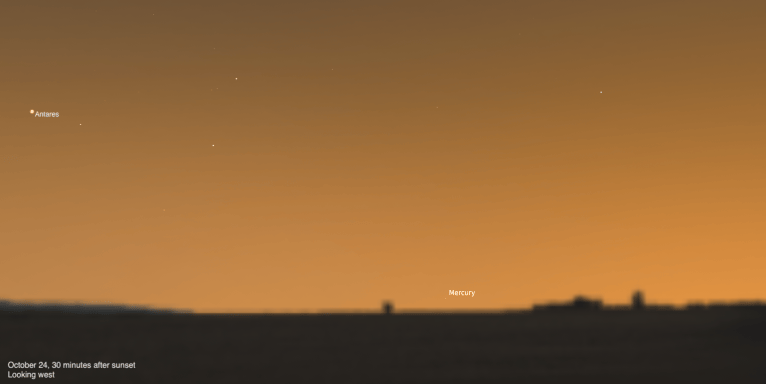
Venus should be visible shortly after sunset — a good thing, as it’s not particularly high, only 8° above the western horizon 20 minutes after the Sun disappears. The Moon lies just to its lower right, now nearly three days past New. If you have a particularly clear, flat horizon or an elevated observing site, you may also spot magnitude –0.6 Mercury, but it’s only 2° high 20 minutes after the Sun sets. It disappears within another 10 minutes.
Just to the Moon’s upper right is magnitude 1.0 Spica. Some 250 light-years away, this relatively nearby star is nearly 2,000 times as bright as our own Sun. Together with Venus, the three objects form a nice triangle in the west as they set, offering a great astrophoto target — especially for a wide-view nightscape shot.
Sunrise: 6:39 A.M.
Sunset: 7:12 P.M.
Moonrise: 9:24 A.M.
Moonset: 8:10 P.M.
Moon Phase: Waxing crescent (10%)
*Times for sunrise, sunset, moonrise, and moonset are given in local time from 40° N 90° W. The Moon’s illumination is given at 10 P.M. local time from the same location.
Alison Klesman is senior editor of Astronomy magazine. She holds a Ph.D. in astronomy and has studied a variety of topics, from minor planets to supermassive black holes.