Looking for a sky event this week? Check out our full Sky This Week column.
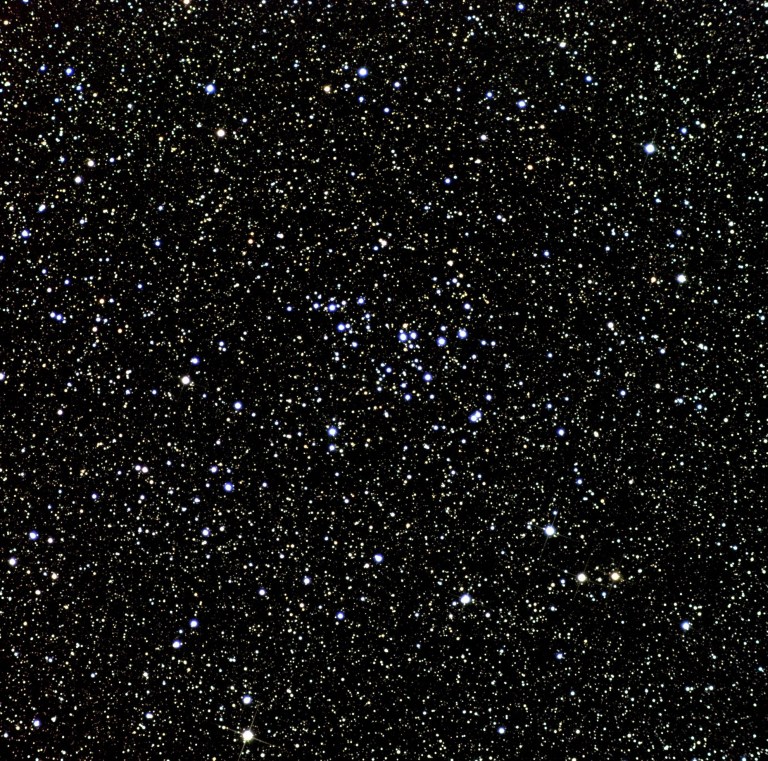
September 18: The Lizard’s brightest cluster
Mars passed 6° due south of Pollux in Gemini at midnight on the 18th, and they now rise together in the early-morning sky. An hour before sunrise, the heads of Gemini have reached an altitude of roughly 50° high in the east. Gemini’s alpha star, Castor, is the higher of the two, shining at magnitude 1.6. Just below it is the constellation’s slightly brighter beta star, Pollux, which glows at magnitude 1.2. Mars sits just to Pollux’s lower right and is nearly the same magnitude: 1.1.
Take a moment to study each object closely. Mars should appear distinctly orange or red. Pollux may look slightly yellowish to the eye, while Castor may appear more bluish-white. Can you see the difference? Mars is red because sunlight reflects off its rust-colored surface, while the two stars differ in color because of their different temperatures: Pollux is cooler than Castor, but it is also closer to Earth, lying just 34 light-years away, compared with Castor’s distance of 51 light-years.
Below the trio, about 25° high an hour before sunrise, is Jupiter, stealing the show at magnitude –1.8. If you point your telescope toward the gas giant, most observers will see only three of its moons: Callisto, Io, and Ganymede, as Europa is crossing the planet’s dark shadow and then behind its massive disk much of the morning.
Sunrise: 6:45 A.M.
Sunset: 7:02 P.M.
Moonrise: 3:23 P.M.
Moonset: —
Moon Phase: Waxing gibbous (62%)
*Times for sunrise, sunset, moonrise, and moonset are given in local time from 40° N 90° W. The Moon’s illumination is given at 10 P.M. local time from the same location.
Alison Klesman is senior editor of Astronomy magazine. She holds a Ph.D. in astronomy and has studied a variety of topics, from minor planets to supermassive black holes.