Looking for a sky event this week? Check out our full Sky This Week column.
April 24: Posidonius illuminated
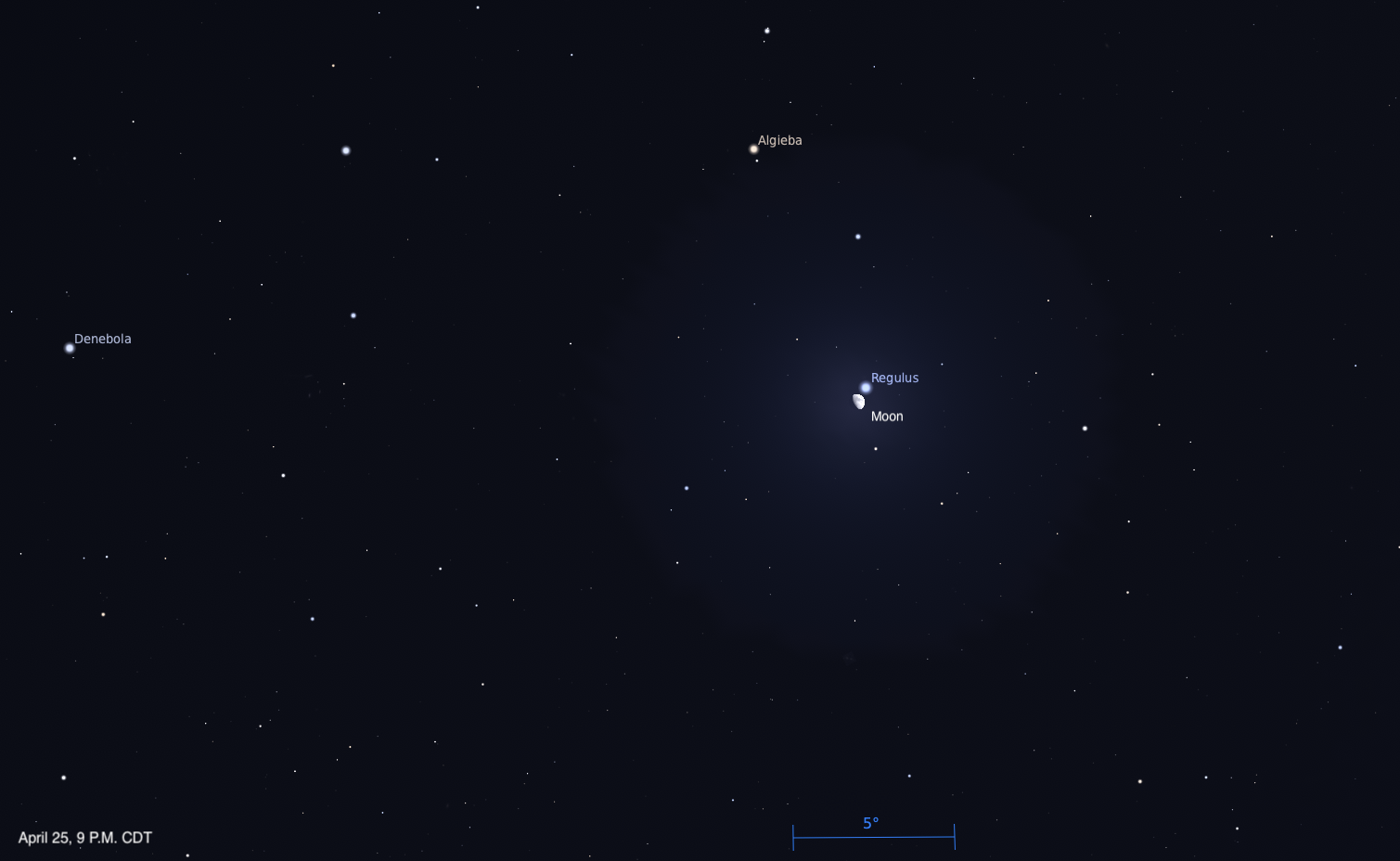
The Moon passes 0.2° north of Regulus at 9 P.M. EDT. Before this, our satellite occults (passes in front of) the bright star in Leo the Lion for some locations in South, Central, and North America — including portions of the eastern U.S.
Observers along the U.S. East Coast, particularly in southern states, see this occur in darkness, while others in the eastern portion of the Central time zone can catch a twilight occultation before night fully falls. From Orlando, Florida, the occultation begins at 8:28 P.M. EDT and ends at 9:51 P.M. EDT. From Kansas City, Missouri, the occultation starts at 6:58 P.M. CDT and ends at 8:12 P.M. CDT. For the times of disappearance and reappearance from many major cities, visit the International Occultation Timing Association’s webpage for the event here. The star’s disappearance at the dark leading limb of the Moon will be easier to catch than its reappearance at the bright trailing edge.
Regardless of whether you see Regulus slip behind the Moon, you can still observe the pair together, a lovely sight in the evening sky. They hang high in the south about an hour after sunset, the Moon’s waxing gibbous face glowing brightly. Regulus is a bright star and should be visible even with the Moon nearby. Shining at magnitude 1.4, it is actually a multiple-star system. It can be easily split into two, although in truth this system houses four stars in total.
The pair will remain visible overnight and into the early hours of the morning, setting around 3:40 A.M. local daylight time on the 26th.
Sunrise: 6:08 A.M.
Sunset: 7:49 P.M.
Moonrise: 1:56 P.M.
Moonset: 3:16 A.M.
Moon Phase: Waxing gibbous (71%)
*Times for sunrise, sunset, moonrise, and moonset are given in local time from 40° N 90° W. The Moon’s illumination is given at 10 P.M. local time from the same location.