Looking for a sky event this week? Check out our full Sky This Week column.
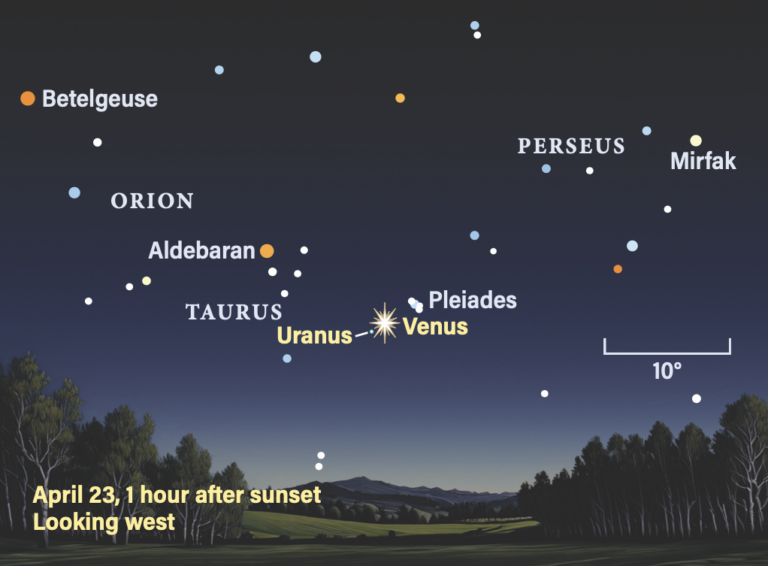
April 23: A conjunction of Venus and Uranus
By evening, the waxing Moon is in eastern Cancer, not far from the Beehive open cluster (M44). This lovely grouping of stars shines at third magnitude and covers roughly a degree on the sky — it’s a great binocular target, even with the Moon nearby.
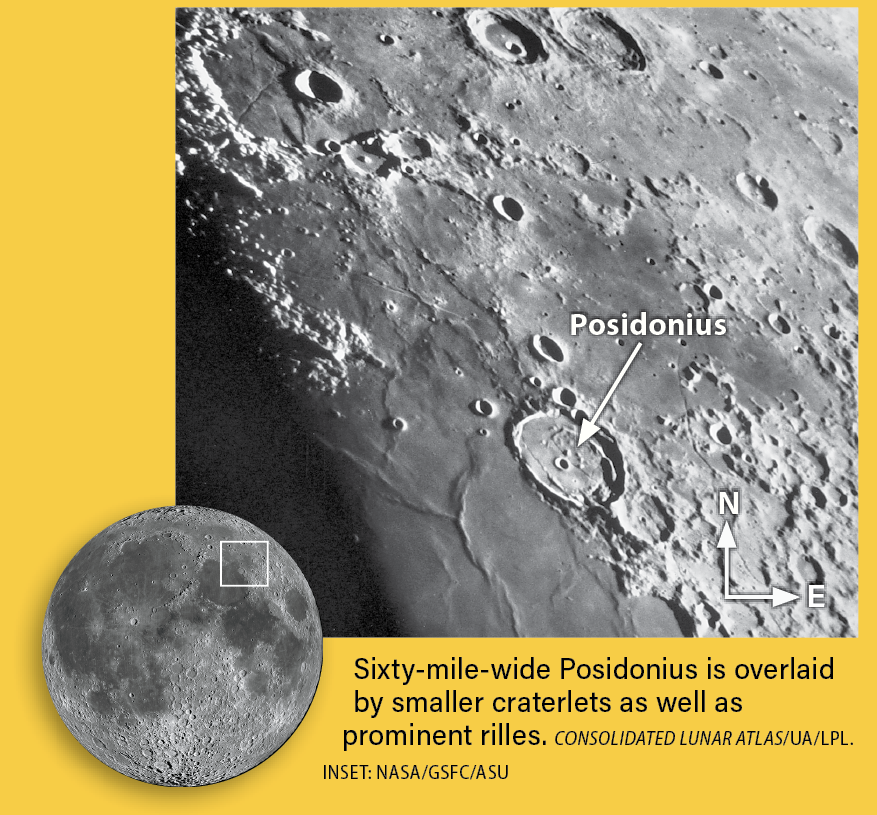
If you’ve got a telescope available this evening, turn it toward the Moon to scan around the sunlit portion of the disk as the terminator dividing night and day continues sweeping westward. The Sea of Serenity looms, dark and circular, just northeast of the terminator in the Moon’s northern hemisphere. Look along the northeastern rim of this mare to find the well-defined crater Posidonius. Use the map above to help you, though note the shadow in the lower lefthand corner of the larger image won’t be there, as the region is now in full daylight, unlike in the photo.
Nonetheless, Posidonius should appear similar to the photo. It’s a 60-mile-wide (97 km) circular crater with a distinctive central pockmark as well as a small curve of central peaks. Study its broad floor for differences in color — these arise from variances in reflectivity, or albedo, of the material covering it. Smoother, lava-covered regions appear darker, while lighter terrain is indicative of impacts and their debris. You may also notice Posidonius B, a 9-mile-wide (14.5 km) crater overlaying the larger Posidonius’ northeastern rim.
Sunrise: 6:09 A.M.
Sunset: 7:48 P.M.
Moonrise: 12:45 P.M.
Moonset: 2:45 A.M.
Moon Phase: Waxing gibbous (61%)
*Times for sunrise, sunset, moonrise, and moonset are given in local time from 40° N 90° W. The Moon’s illumination is given at 10 P.M. local time from the same location.