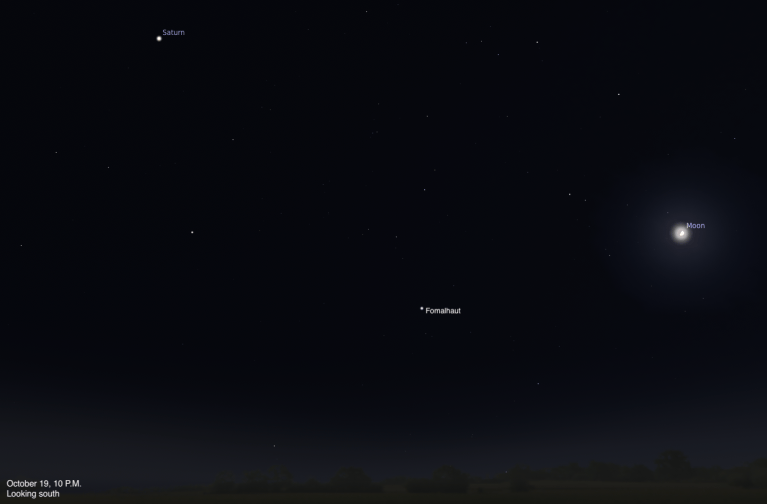
Looking for a sky event this week? Check out our full Sky This Week column.
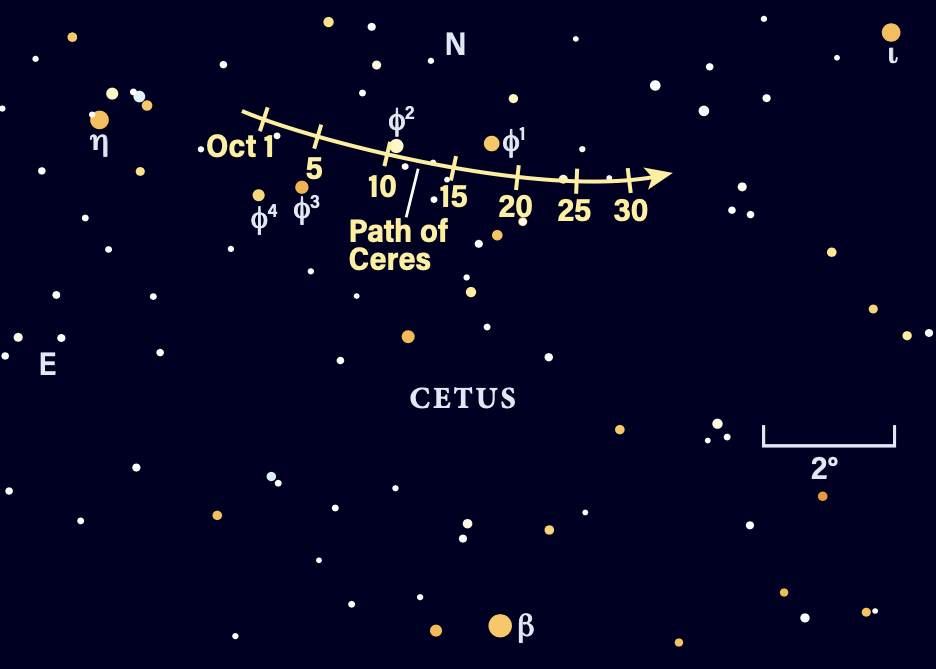
1 Ceres is passing close to the 5th-magnitude star Phi2 (φ2) Ceti this evening. Viewing will be best about two hours after sunset, after the sky has grown dark but shortly before the Moon rises. At that time, Ceres will be about 15° high in the east; it will continue to climb throughout the evening hours, so even after the Moon rises you can give it a try if the horizon is too murky early on.
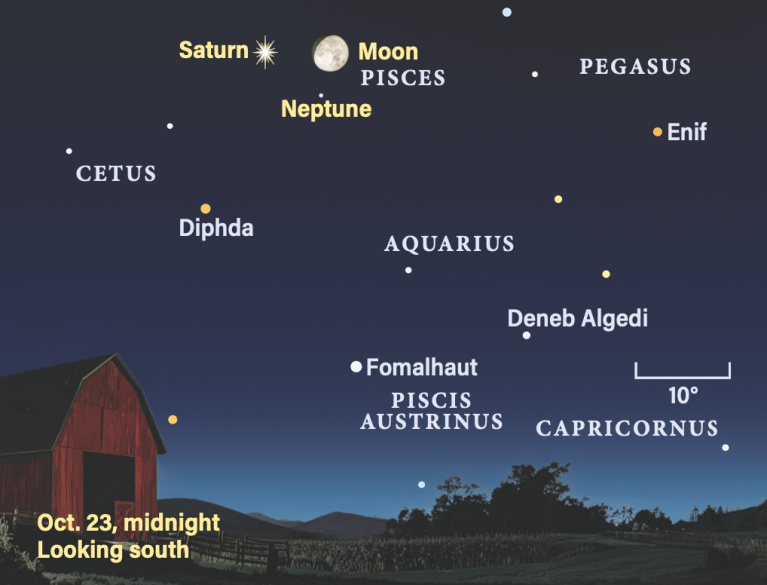
Look for brighter magnitude 2.0 Diphda (Beta [β] Ceti) first. Also called Deneb Kaitos, this star is a giant about three times the mass of our Sun, and it’s reaching the end of its life. From Diphda, scan to the upper left (north) with binoculars or any telescope about 7.3° to locate Phi2. Ceres is just 10’ southeast of Phi2 this evening, making the main-belt world easy to find, glowing at magnitude 7.6.
Tomorrow night, the Moon rises even later and Ceres is still close to this same star, so you can try again with the pair a bit higher in the sky. Note that on the 11th, Ceres will be about 10’ southwest of Phi2.
Sunrise: 7:06 A.M.
Sunset: 6:27 P.M.
Moonrise: 8:39 P.M.
Moonset: 11:37 A.M.
Moon Phase: Waning gibbous (78%)
*Times for sunrise, sunset, moonrise, and moonset are given in local time from 40° N 90° W. The Moon’s illumination is given at 10 P.M. local time from the same location.
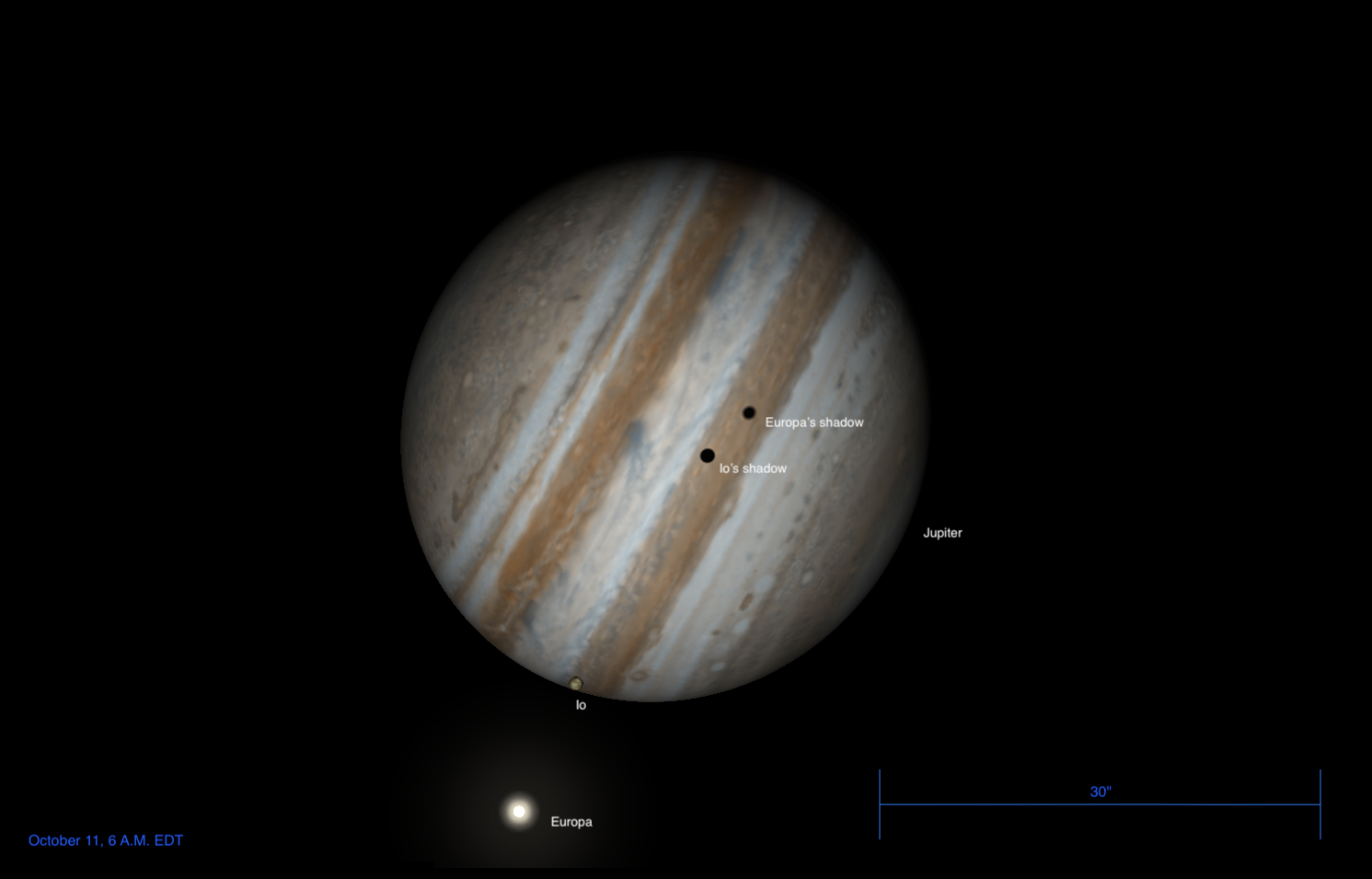
Looking ahead, Io and Europa take a trip across Jupiter together early on October 11.
Bright Jupiter stands high above the eastern horizon during the early-morning predawn hours of October 11. By 4:30 A.M. EDT, Europa’s shadow is already visible on Jupiter’s large disk, while Io and Europa sit off to the planet’s east. Note that although it is Europa’s shadow on the cloud tops, Io appears physically closer to the planet, with Europa to Io’s east. Io’s shadow appears at 4:43 A.M. EDT, and by 4:50 A.M. EDT, both are readily visible.
The two moons continue approaching Jupiter’s eastern limb, with Io reaching it first just over an hour later, at 5:58 A.M. EDT. The shadows are a bit more than halfway across the disk by this point, Europa’s shadow still leading. Europa’s transit begins at 6:43 A.M. EDT, as the shadows are approaching the western limb. The shadow transits end just three minutes apart, starting at 6:53 A.M. EDT.
If you have cloudy skies or simply aren’t able to catch the transit, don’t worry — there will be another on the morning of the 18th, although the view will be better for those in the western half of the U.S.