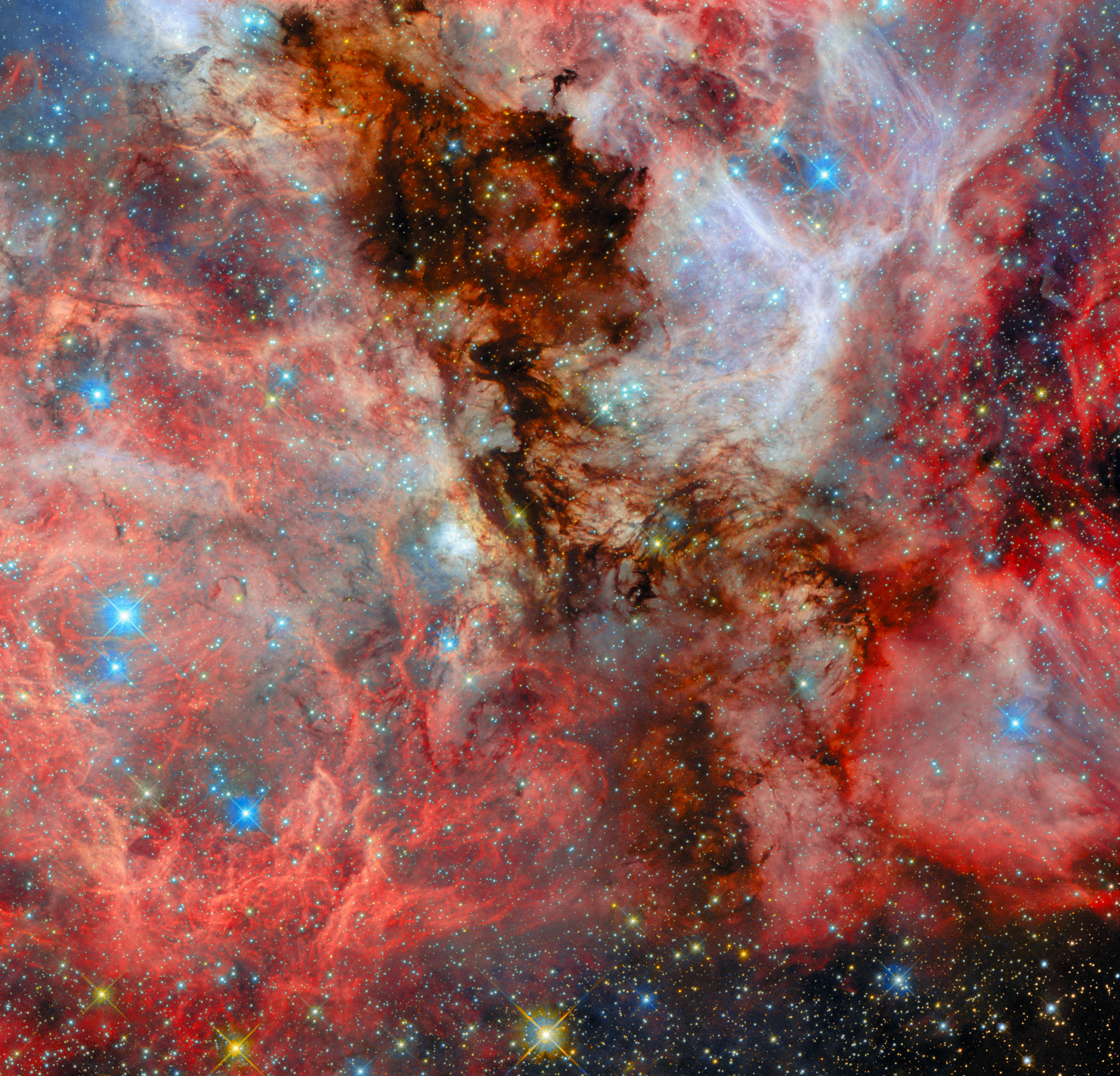
Credit: ESA/Hubble & NASA, R. Indebetouw
When deep-sky observers contemplate the Large Magellanic Cloud (LMC), the Milky Way’s largest satellite galaxy, they immediately think of the Tarantula Nebula (NGC 2070). And no wonder — this emission nebula is the largest star-forming region in the local universe. But the LMC offers much more. Just 0.7° south of the Tarantula lies another impressive stellar nursery astronomers have cataloged as N159. This Hubble image showcases a small part of the 150-light-year-wide nebula, which boasts many newly formed stars. The most massive of these suns glow blue and radiate enough ultraviolet energy to ionize surrounding hydrogen, giving the nebula its characteristic reddish hue.