What would Earth be like if there were no Moon?
Peter Allen Rhodes
North Bellmore, New York
Without the Moon, Earth’s geology, biology, and climate — as well as human philosophy — would be different in many significant ways.
If Earth had no Moon, the postulated origin of the Moon through a collision between the proto-Earth and a Mars-sized object we now call Theia would never have occurred. The Earth/Theia collision shattered both worlds and the larger Earth attracted much of Theia’s iron and heavier elements. The resulting larger iron core within Earth created a stronger magnetic field that protected the planet from the radiation effects of energetic solar particles, allowing the earliest life-forms to evolve. Without the shield of a strong magnetic field, the evolution of life on Earth would have taken a different path.
After its creation, the Moon was about 10 times closer to Earth than it is today. When Earth’s oceans formed over 3 billion years ago, the greater gravitational pull from the Moon’s proximity created titanic ocean tides hundreds of feet high that washed far inland. The violent churning of the oceans helped mix and distribute the waterborne chemistry that sparked the evolution of life on Earth. But with no lunar gravity driving the tides and assisting currents, those oceans would have become largely stagnant.
Even at its current distance, lunar gravity pulling on the tidal bulge creates friction between the water and the ocean basins, slowing Earth’s rotation. Without the Moon, our days would be much shorter. And without the stabilizing effect of the Moon’s gravity, our rotational axis would wobble, altering or periodically eliminating the seasons. Thus, without the Moon stabilizing the seasons, plant life could have evolved, but animal life may not have. Many plant and tree species are far more radiation- and harsh-climate-resistant than animal life, so a moonless Earth might be lush and green, but without the chirp of birds or the howl of a wolf.
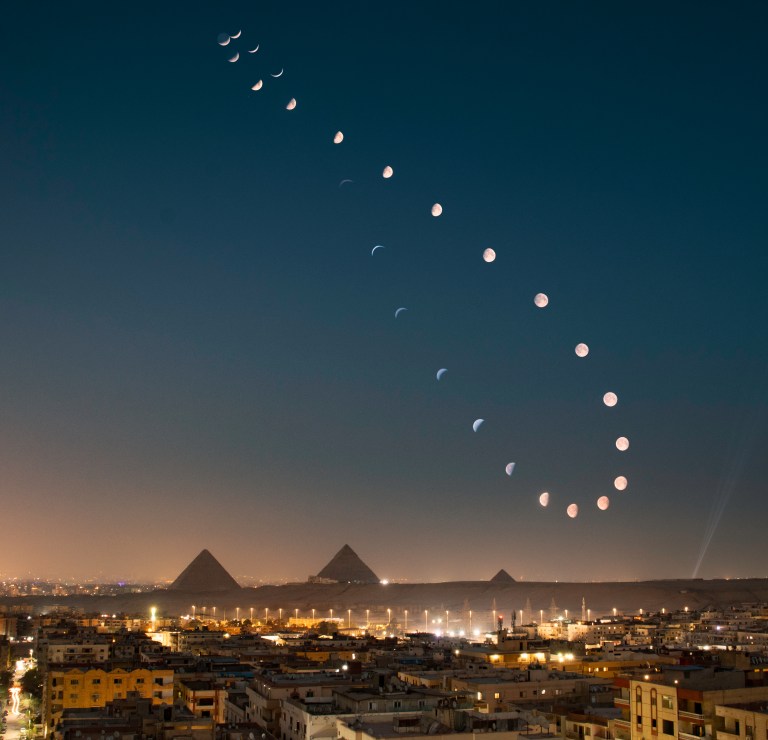
Finally, even if humanity had evolved on a moonless Earth, only the distant, pinpoint planets and starry realm of the Milky Way would be our nightly companions. Archaeological evidence shows that 20,000 years ago, there was already interest in the Moon’s cycles. Without the nearby Moon sparking our curiosity about other worlds, our space exploration program would be vastly different. Humanity might not even be a spacefaring species.
Life on Earth, and humanity itself, owes its existence and part of its legacy to the silver orb that circles our green Earth.
Robert Reeves
Author of Photographic Atlas of the Moon
Related: Earth as a planet