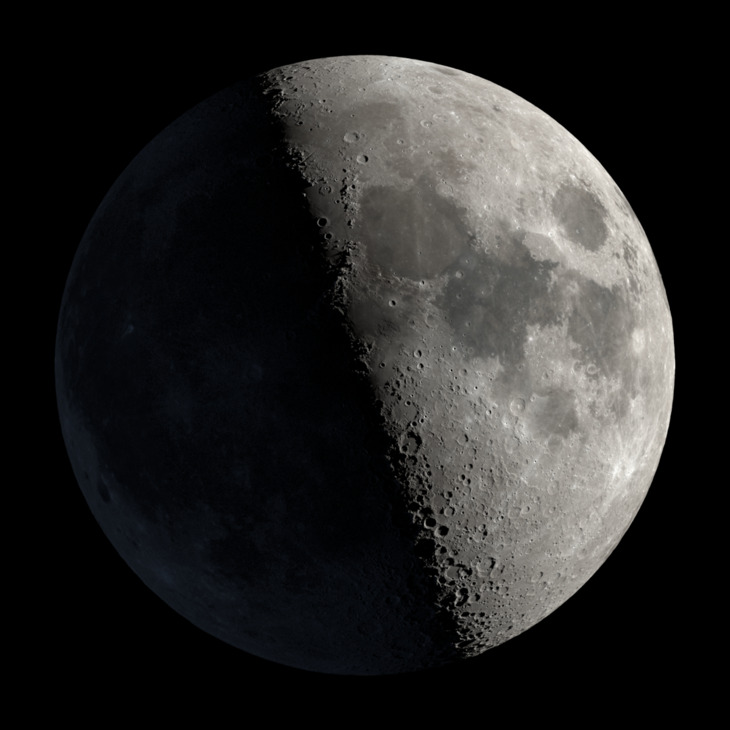
First Quarter Moon occurs at 8:41 A.M. EDT. Rising early in the afternoon, the Moon then reaches apogee — the farthest point from Earth in its orbit — at 4:36 P.M. EDT, when it will be 251,134 miles (4041,61 km) away. Readily visible in the south at sunset, our satellite is now half-lit and shows off its terminator, which separates night from day, running roughly down the middle of the visible lunar face.
Mare Crisium is still apparent in the lunar northeast; now in the southeast you’ll find the large crater Stevinus, surrounded by a mass of bright rays, also easy to spot. These rays are composed of material that was excavated and thrown outward by the force of the impact that created the 47-mile-wide (74 km) crater. Note how some of those rays fall across the dark floors of the neighboring Maria, the Seas of Nectar and Fertility. The way these features are layered shows clearly that the seas are older, with the ejecta from Stevinus strewn overtop them, signaling it came later in time.
Along the terminator, you may also be able to pick out the craters Alphonsus, Ptolemaeus, and Arzachel. Ptolemaeus is northernmost of the trio, located just south of the Moon’s equator. Below it is Alphonsus, and below that is Arzachel. This lunar phase is one of the best times to observe this trio, as their proximity to the terminator creates shadows that help highlight their striking features.
Sunrise: 5:59 A.M.
Sunset: 8:13 P.M.
Moonrise: 2:03 P.M.
Moonset: 11:54 P.M.
Moon Phase: Waxing gibbous (52%)
*Times for sunrise, sunset, moonrise, and moonset are given in local time from 40° N 90° W. The Moon’s illumination is given at 12 P.M. local time from the same location.
For a look ahead at more upcoming sky events, check out our full Sky This Week column.