Opportunity finds a meteorite
A shiny, puckered “rock” sitting on the plains of Meridiani is a nickel-iron meteorite, says Steve Squyres, Mars rover project scientist. This is the first time such an object has been found on another planet.
The rock, which is about the size of a basketball, lies close to where the largest piece of Opportunity’s heat shield came to rest. (Project scientists promptly dubbed it “Heat Shield rock.”) Opportunity is examining the heat-shield impact site to collect information to help flight engineers improve designs.
“This rock is unlike anything we’ve seen on Mars,” says Squyres. He notes that when Opportunity first saw the object in early January, the rover’s thermal emission spectrometer (mini-TES) found the rock has a very low emissivity. This is a measure of how much radiation an object gives off compared to its temperature. The results hinted the rock contains a lot of metal.
This was confirmed soon after, when the rover used its Mössbauer spectrometer to study the object’s composition. The instrument found high percentages of metallic nickel and iron.
“It’s hard to imagine a metal object on Mars that’s anything other than a nickel-iron meteorite,” Squyres told Astronomy.
“I’ve been telling the rover drivers we shouldn’t hang around here,” he adds. “This is a part of Mars where pieces of metal fall from the sky.”
Astronomers find the biggest stars
A team of astronomers led by Philip Massey of Lowell Observatory reports finding three red supergiant stars bigger than any known. The previous record-holder, Mu Cephei, now ranks fourth in size.
The three largest stars are KW Sagittarii (distance: 9,800 light-years), V354 Cephei (9,000 light-years), and KY Cygni (5,200 light-years); all have diameters roughly 1,500 times the Sun’s. The well-known red supergiant star Betelgeuse is comparatively small, at just 650 times bigger than the Sun. If any of the newly identified big stars replaced the Sun, its surface would reach to between the orbits of Jupiter and Saturn.
The team’s observations, made using telescopes in Arizona and Chile, yielded the most accurate temperatures for this kind of star, finally reconciling theory with observations. The coolest stars’ temperatures were about 3,450 kelvins, or 5,720° F. This is about 10 percent warmer than previously thought. By combining distance estimates with the new temperature measurements, the astronomers were able to calculate the stars’ sizes.
“These stars aren’t the most massive known,” says team member Emily Levesque, an undergraduate student at MIT. Nor, she says, are these the most luminous — or even the coolest. “But the combination of modestly high luminosities and relatively low temperatures does make them the biggest stars known,” she says.
The team’s next step will be to look at stars in the Large and Small Magellanic Clouds, where stars have fewer heavy elements (“metals” in astrophysicists’ jargon) than those in the Milky Way. “We expect these stars will prove even bigger,” says Levesque. “Metal-poor stars tend to be larger.”

Surfing a wave in space-time
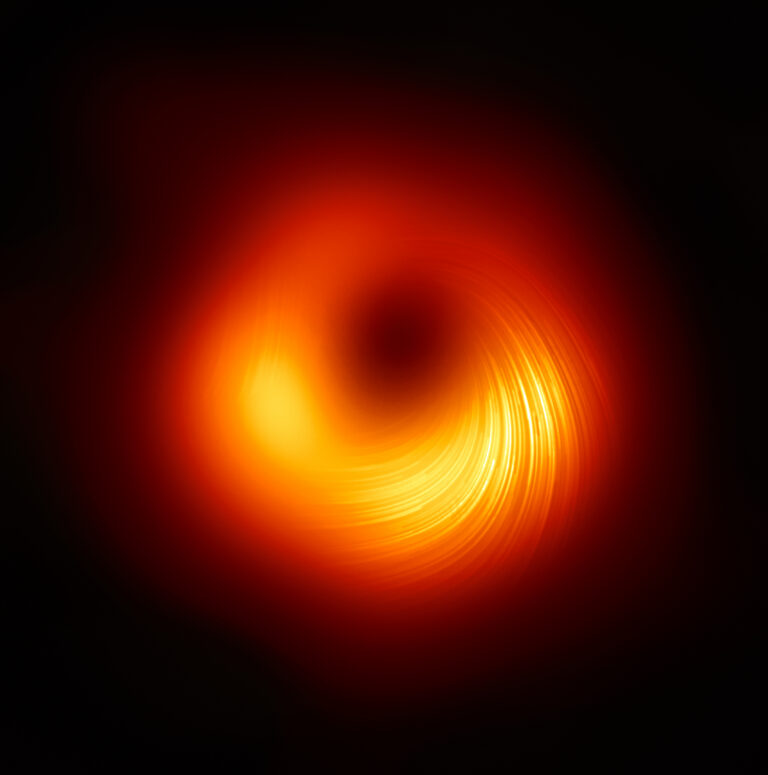
Hot gas falling into a spinning black hole is surfing a wave in space-time, according to two astronomers. The black hole GRS 1915+105, which weighs about 14 suns and lies about 40,000 light-years away, is dragging the framework of space-time forward as it spins, producing a wave predicted by Albert Einstein’s theory of general relativity.
According to Jon Miller of the Harvard-Smithsonian Center for Astrophysics, lead author of the study, “The black hole draws matter off the companion star which settles into an accretion disk around the black hole.” Looking at the innermost part of the disk, the astronomers study X-ray emission as matter becomes extremely heated through gravitational compression. At that point, Miller says, the material is making hundreds of revolutions every second.
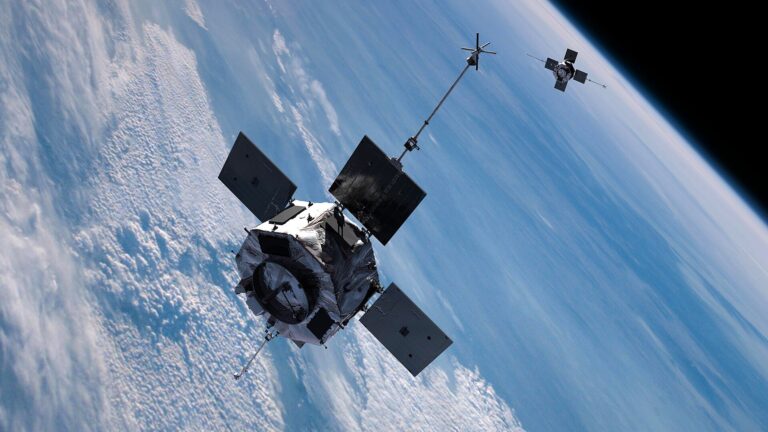
Using the Rossi X-ray Timing Explorer satellite, Miller and coworker Jeroen Homan of MIT identified quasi-periodic pulses in the X-ray emission, which came from extremely hot iron atoms. The periodic changes, about one each second, hinted time was running differently for the material close to the black hole compared to the rest of the accretion disk (and universe).
One solution to the puzzle, Miller and Homan suggest, is that the extreme velocities in the inner accretion disk show the “frame-dragging” effect predicted by general relativity. In essence, the 1-second periodicity is the signature of the spinning wave of space-time close to the black hole. Each time the infalling, hot iron gas hits the space-time wave, it gets a jolt and the X-ray emission changes. Even if this model doesn’t prove out, says the pair, the close coupling of the periodicity and the emission will help astronomers better understand black holes.
Miller and Homan’s report will be published in an upcoming issue of the Astrophysical Journal Letters.
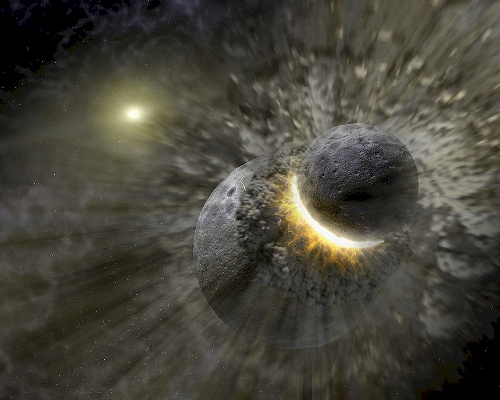
Astronomers have found a dusty disk around the bright star Vega is the relatively recent product of a collision involving Pluto-size bodies orbiting the star.
Kate Su of the University of Arizona headed a team that used the Spitzer Space Telescope to study the particles in Vega’s disk. They found the dust grains are so small that starlight pushes them out of the system after 1,000 years. The total amount of dust adds up to about a third of our Moon’s mass.
“We are witnessing,” Su says, “the aftermath of an event that probably happened within the last million years.”

As many as 10,000 black holes may lie close to the Milky Way’s center, say astronomers who used the Chandra X-ray Observatory to study the galactic center. The black holes have masses in the range of a few suns, and they are distinct from the supermassive black hole at the Milky Way’s center, known as Sagittarius A* (Sgr A*).
Michael Muno of UCLA and his coworkers reported monitoring the region within about 70 light-years of Sgr A*, looking for X-ray sources. They found hundreds but concentrated on the brightest and most variable as the most likely black-hole candidates. This reduced the number to seven, of which four lay within 3 light-years of Sgr A*.
“We thought we had only a 1 in 5 chance of finding a single black hole within 3 light-years of Sgr A*,” says Muno. Finding four X-ray active black holes in that small region implies a much larger total population.
Mark Morris, also of UCLA, predicted a decade ago that black holes would drift toward the galactic center as they interact with low-mass stars. In encounters with binary stars, he notes, a black hole may capture a star and devour it.
Astronomers using a spectrograph on the XMM-Newton spacecraft have found hot blobs of gas swirling around a black hole at more than one-tenth the speed of light. This is the first time astronomers have tracked material orbiting a black hole though one complete revolution. The finding confirms earlier predictions and gives a better picture of the black hole’s size, mass, and other properties.
The astronomers, Jane Turner of NASA’s Goddard Space Flight Center and Lance Miller of Oxford University, will publish their findings in an upcoming issue of the Astrophysical Journal Letters.
Archived observations from May 2001 of the active galaxy Markarian 766 gave Turner and Miller an unusually long (27-hour) continuous record of the galaxy’s central black hole. This was enough to let them observe emission from iron atoms (in long-lived flares of hot gas) making a complete orbit of the black hole.
While XMM-Newton did not image the gas blobs directly, Turner and Miller followed the blobs’ Doppler-shifted radiation as it circled the black hole at a distance equal to about 4 times Earth’s distance from the Sun.
The gas blobs’ speed, coupled with the blobs’ orbital distance, told the astronomers the black hole weighs about 4 million solar masses. “This discovery,” says Turner, “gives us the best evidence to date for a supermassive black hole in the center of a galaxy.”

First exoplanet imaged by Hubble?
Astronomers using the Hubble Space Telescope’s NICMOS infrared camera think they may have made the first direct image of an extrasolar planet. The candidate object lies close to a young brown dwarf star 225 light-years away in the southern constellation Hydra. While the astronomers think the object is a planet, they are not yet certain the object is actually orbiting the brown dwarf.
In April 2004, another team of astronomers at the Very Large Telescope (VLT) in Chile detected a possible planet around the brown dwarf, 2MASSWJ 1207334-393254 (or 2M1207 for short). But they could not confirm it. The candidate planet shines with only 1 percent of the brown dwarf’s brightness, and it has a temperature of some 1,250 kelvins (1,800° Fahrenheit) — cooler than a lightbulb filament.
Glenn Schneider of the University of Arizona led the team using Hubble to study the object. Comparing the object’s VLT location in the sky with that determined by Hubble, Schneider says, “The NICMOS position measurements, relative to the VLT’s, indicate the object is a true, orbiting companion.” He rates the chance of the object not being a planet at only 1 percent.
If this proves to be a planet, says Schneider, “it has about 5 times the mass of Jupiter.” And it orbits at a distance of 54 astronomical units from the star, he says. One “year” would last some 2,500 Earth years.
The brown dwarf star belongs to a group of young stars called the TY Hydrae association that were all born around the same time. No member of the association is believed to be more than 8 to 10 million years old.
Schneider plans follow-up observations with NICMOS on Hubble April 2005.