Looking for a sky event this week? Check out our full Sky This Week column.
March 28: Corvus’ time to shine
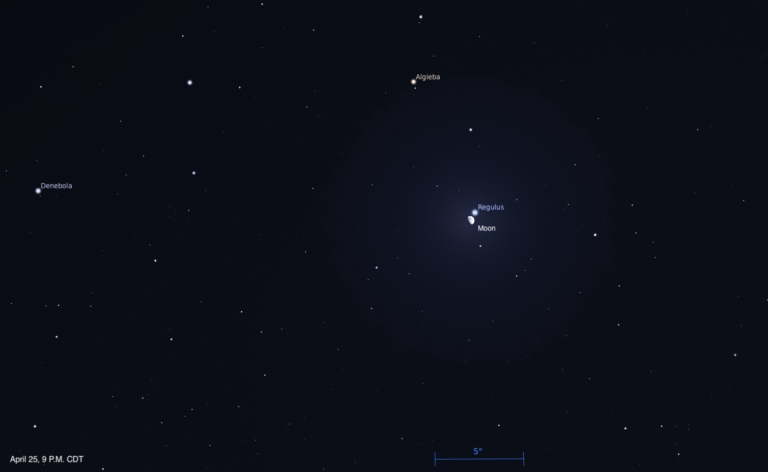
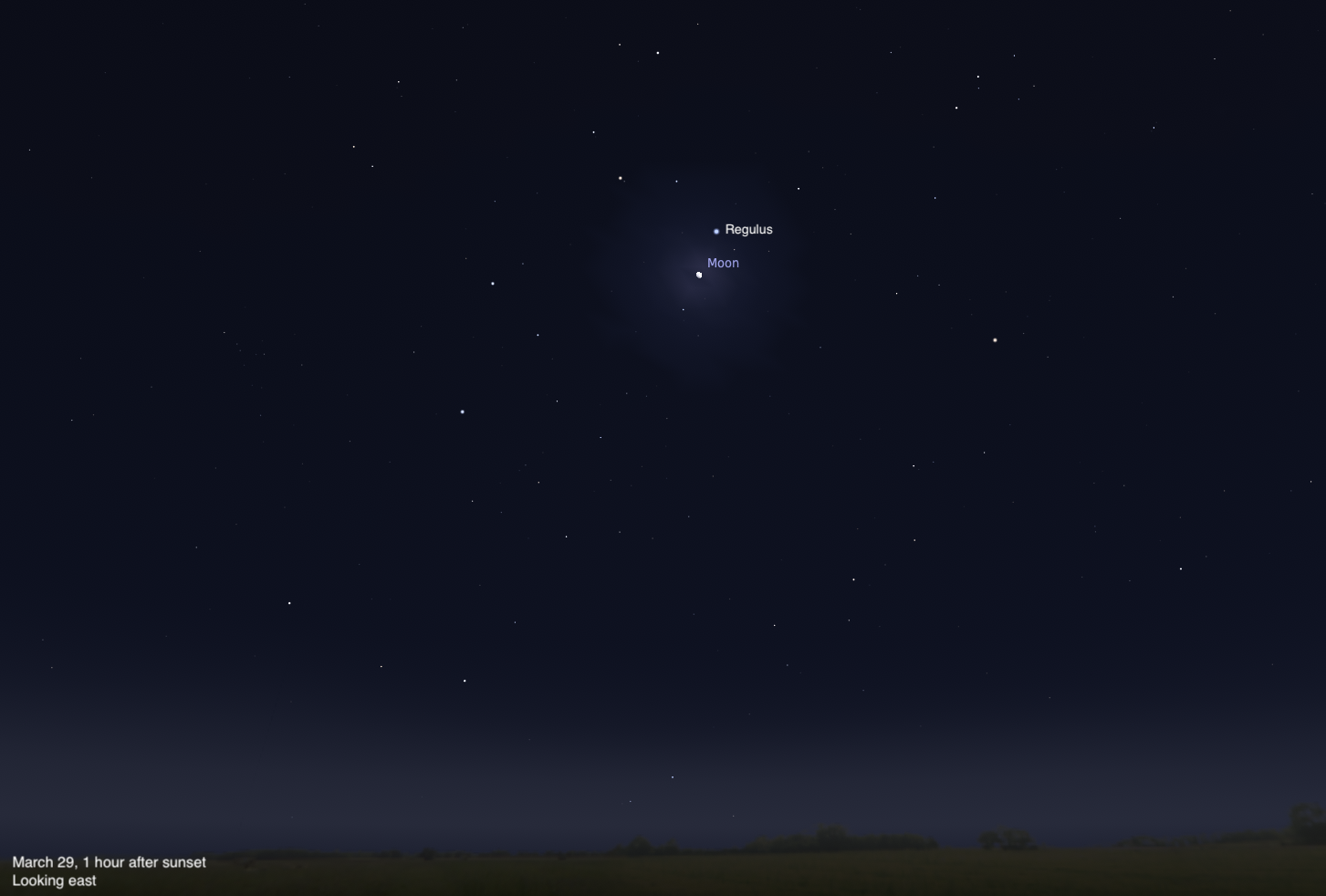
The Moon passes 0.3° north of Leo’s alpha star, Regulus, at 4 P.M. EDT. By the time darkness falls, our satellite stands about 3.5° east of this bright star.
Shining at magnitude 1.4, Regulus sits nearly on the ecliptic — the imaginary line on the sky along which the planets, Sun, and Moon travel. In fact, draw a line between Regulus and the waxing Moon this evening, and you are tracing the ecliptic almost exactly.
Regulus serves as the base of the Sickle of Leo, an asterism shaped like a backward question mark and meant to trace out the shape of its eponymous farm implement in the sky. The top of the Sickle’s handle is marked by magnitude 3.5 Eta (η) Leonis, 4.8° due north of Regulus. The next several stars trace out the blade: magnitude 2.0 Gamma Leo, 4.3° northeast of Eta; magnitude 3.4 Zeta (ζ) Leo, 3.7° north of Gamma; magnitude 3.9 Mu (μ) Leo, 6° northwest of Zeta; and magnitude 3.0 Epsilon Leo, 2.7° southwest of Mu. Epsilon marks the tip of the blade.
Many observers also picture the Sickle’s outline as the Lion’s head, complete with fluffy mane, seen in profile. The figure of Leo is typically drawn with its nose facing west, hindquarters and tail to the east.
Sunrise: 6:49 A.M.
Sunset: 7:22 P.M.
Moonrise: 4:03 P.M.
Moonset: 5:12 A.M.
Moon Phase: Waxing gibbous (91%)
*Times for sunrise, sunset, moonrise, and moonset are given in local time from 40° N 90° W. The Moon’s illumination is given at 10 P.M. local time from the same location.